
Level:
Correct: 0
Incorrect: 0
Marks: 0/0
Exam Practice
Course:
Topics:
Edexcel GCSE Combined Science (Foundation Biology Paper 2) Smart practice A mixed round aimed at your weak spots
Avg
score:
–
Topics
done:
0/28

Transpiration and translocation

Practise 14 exam-style questions on Transpiration and translocation for Edexcel GCSE Combined Science (Foundation Biology Paper 2). Write your answer as you would in the exam and get it marked in seconds against the mark scheme, point by point, with the Study Helper on hand if you get stuck.

  • 14 questions
  • 1–6 marks each
  • Instant marking
  • No sign-up needed
14 questions, marked as you go

Sample questions with model answers

Here are 4 of the questions in this topic, each with a model answer, an explanation of why it earns the marks and the mark scheme an examiner would use.

Question 1

1 mark

What is transpiration?

Choose your answer.

  • A the loss of water vapour from the leaves of a plant
  • B the movement of sucrose through the phloem
  • C the uptake of mineral ions by root hair cells
  • D the absorption of light by chlorophyll

Model answer

A - the loss of water vapour from the leaves of a plant.

Explanation

Transpiration is the loss of water vapour from the leaves. As water evaporates and leaves through the stomata, more water is pulled up the xylem from the roots, carrying mineral ions with it. Do not mix up transpiration (water, xylem) with translocation (sucrose, phloem).

Mark scheme
  1. 1 mark

    A / the loss of water vapour from the leaves of a plant

    The only correct answer is A: transpiration is the evaporation of water from the leaves and the loss of the water vapour through the stomata, which draws more water up the plant. B is not correct because the movement of sucrose through the phloem is translocation; C is not correct because mineral ions are taken up by root hair cells by active transport, not by transpiration; D is not correct because chlorophyll absorbs light for photosynthesis. Accept the letter or the option. If more than one option is given, do not award the mark.
Question 2

2 marks

Blue cobalt chloride paper turns pink when water touches it.

Erin used forceps to clip a small square of blue cobalt chloride paper to the lower surface of a leaf on a plant. Most of the leaf's stomata are on its lower surface. After 10 minutes, the paper had turned pink.

Explain why the paper turned pink.

Model answer

Water evaporates from the cells inside the leaf, and the water vapour diffuses out of the leaf through the stomata on the lower surface. This is transpiration. The water vapour reached the cobalt chloride paper and turned it pink.

Explanation

The pink colour shows that water is leaving the leaf. Water evaporates inside the leaf and the vapour diffuses out through the stomata, which is why the lower surface, with most of the stomata, loses the most water. Forceps are used because cobalt chloride is harmful and should not be touched.

Mark scheme
  1. 1 mark

    water (vapour) is lost from the leaf / water evaporates inside the leaf and (the water vapour) diffuses out / transpiration

    accept the leaf gives out water vapour / transpires; ignore 'the leaf is wet' / 'the leaf sweats'

  2. 1 mark

    (the water vapour leaves) through the (open) stomata

    accept through the pores / holes in the lower surface; do not accept through the guard cells / through the cuticle

Question 3

2 marks

In the stem of a flowering plant, sucrose is transported both upwards and downwards in the phloem.

Explain why sucrose is transported in both directions.

Model answer

Sucrose is made in the leaves, which are in the middle of the plant. Some of it is transported down the stem to the roots and some is transported up to the flower and growing tips, because these parts cannot make their own sucrose. They use it for respiration and growth, or store it as starch.

Explanation

Translocation moves sucrose from where it is made (the leaves) to wherever it is needed, so it can go up or down the stem. This is different from water in the xylem, which only moves upwards from the roots to the leaves.

Mark scheme
  1. 1 mark

    sucrose is made in the leaves (by photosynthesis), and it is transported down to the roots and up to the flower / growing tips

    Max 2. Both directions must be linked to a destination for this mark, e.g. 'down to the roots and up to the flower'. accept to parts above and below the leaves that cannot photosynthesise

  2. 1 mark

    (the parts that receive it) use sucrose for respiration / growth / to store it (as starch)

    accept the roots and flowers need sugar for energy / to grow

  3. 1 mark

    the roots / flowers cannot make their own sucrose / do not photosynthesise

    accept the roots have no chlorophyll / get no light

Question 4

4 marks

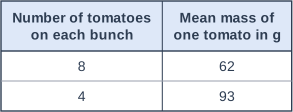
A gardener grew tomato plants of the same size in the same conditions. On some plants she left 8 tomatoes on each bunch. On the other plants she removed some of the young tomatoes, leaving 4 on each bunch.

The table shows her results.

Calculate the percentage increase in the mean mass of one tomato when the number on each bunch was reduced from 8 to 4.

Use the equation:

percentage increase = (increase in mass ÷ mass with 8 tomatoes) × 100

Explain why removing some of the tomatoes increased the mass of the tomatoes that were left.

Table with columns "Number of tomatoes on each bunch", "Mean mass of one tomato in g". Number of tomatoes on each bunch: 8; Mean mass of one tomato in g: 62 | Number of tomatoes on each bunch: 4; Mean mass of one tomato in g: 93.

Model answer

increase in mass = 93 − 62 = 31 g
percentage increase = (31 ÷ 62) × 100 = 50 %
The leaves on each plant make the same amount of sugar by photosynthesis. The sucrose is transported to the tomatoes in the phloem by translocation. With only 4 tomatoes on each bunch, the sucrose is shared between fewer tomatoes, so each one receives more and grows bigger.

Explanation

For the calculation, find the increase first and divide by the starting value (the mass with 8 tomatoes). For the explanation, link the leaves (where sucrose is made) to the fruits (where it is used or stored) by translocation in the phloem: fewer fruits means more sucrose for each. Saying only 'there is more room to grow' does not use the biology of the question.

Mark scheme
  1. 1 mark

    (increase =) 93 − 62 = 31 (g) / (31 ÷ 62) × 100; or a correct final answer of 50 % with no working

    An answer of 50 % with no working scores marking points 1 and 2. 31 ÷ 93 × 100 = 33 % (divided by the wrong mass) scores 1 mark (for the increase of 31 g). 93 ÷ 62 × 100 = 150 % scores 0.

  2. 1 mark

    evaluation: 50 (%)

    ignore units

  3. 2 marks

    An explanation including two from: the leaves (of each plant) make the same amount of sugar / sucrose by photosynthesis; the sucrose is transported to the tomatoes in the phloem / by translocation; the sucrose is shared between fewer tomatoes, so each tomato receives more (for growth / to store)

    1 mark for each of these three ideas, max 2. accept glucose / sugar for sucrose; do not accept xylem for phloem; ignore 'more space to grow' / 'more water for each tomato' on their own

Ready to try the rest? Every answer you write is marked against the mark scheme, so you can see exactly where the marks are.

Study Helper Hints first, answers after you try

Stuck on this one? Ask for a hint and I’ll point you in the right direction, without giving the answer away. Once you’ve checked your answer, I’ll show you how the marks are awarded.