
Level:
Correct: 0
Incorrect: 0
Marks: 0/0
Exam Practice
Course:
Topics:
Edexcel GCSE Combined Science (Foundation Biology Paper 2) Smart practice A mixed round aimed at your weak spots
Avg
score:
–
Topics
done:
0/28

Aerobic and anaerobic respiration

Practise 15 exam-style questions on Aerobic and anaerobic respiration for Edexcel GCSE Combined Science (Foundation Biology Paper 2). Write your answer as you would in the exam and get it marked in seconds against the mark scheme, point by point, with the Study Helper on hand if you get stuck.

  • 15 questions
  • 1–6 marks each
  • Instant marking
  • No sign-up needed
15 questions, marked as you go

Sample questions with model answers

Here are 4 of the questions in this topic, each with a model answer, an explanation of why it earns the marks and the mark scheme an examiner would use.

Question 1

1 mark

Respiration is an exothermic reaction.

Which of these happens because respiration is exothermic?

Choose your answer.

  • A a person breathes out carbon dioxide
  • B lactic acid builds up in a sprinter's muscles
  • C a person's heart rate rises during exercise
  • D a person's body stays warmer than the cold air around them

Model answer

D - a person's body stays warmer than the cold air around them.

Explanation

Exothermic means that energy is released to the surroundings as heat. Respiration goes on in body cells all the time, and the heat it releases keeps the body warm. The other options are true facts about respiration or exercise, but they are not caused by respiration being exothermic.

Mark scheme
  1. 1 mark

    D / a person's body stays warmer than the cold air around them

    The only correct answer is D: an exothermic reaction transfers energy to the surroundings as heat, and the heat released by respiration in body cells keeps the body warmer than cold air. A is not correct because carbon dioxide is a product of aerobic respiration; breathing it out does not show that energy is released as heat; B is not correct because lactic acid is the product of anaerobic respiration in muscle cells; C is not correct because the heart rate rises to supply more oxygen and glucose to the muscles. Accept the letter or the option. If more than one option is given, do not award the mark.
Question 2

2 marks

Here are five statements about respiration.

A Anaerobic respiration needs oxygen.
B Aerobic respiration releases more energy from each glucose molecule than anaerobic respiration.
C Anaerobic respiration in human muscle cells produces carbon dioxide.
D Respiration releases energy for metabolic processes, such as making proteins.
E Respiration is an endothermic reaction.

Give the letters of the two correct statements.

Model answer

B and D

Explanation

Aerobic respiration releases much more energy from each glucose molecule than anaerobic respiration, and the energy is used for metabolic processes such as making proteins. Anaerobic respiration does not need oxygen, and in muscle cells its only product is lactic acid. Respiration is exothermic, not endothermic.

Mark scheme
  1. 1 mark

    B

    Max 1 if more than two answers are given. The letters can be in either order. accept the statements written out instead of the letters.

  2. 1 mark

    D

    A is wrong because anaerobic respiration does not use oxygen; C is wrong because anaerobic respiration in muscle cells produces lactic acid only; E is wrong because respiration is exothermic (it releases energy).

Question 3

3 marks

In winter, the honeybees in a hive crowd together in a tight cluster. Many of the bees contract their flight muscles again and again without moving their wings. This is called shivering.

The temperature at the centre of the cluster stays between about 20 °C and 35 °C, even when the air outside the hive is below 0 °C. During the winter the bees feed on honey, which is a store of sugar.

Explain how shivering keeps the centre of the cluster warm.

Model answer

Contracting the flight muscles needs energy, so the bees' muscle cells respire faster, using sugar from the honey. Respiration is an exothermic reaction, so it releases energy as heat, which warms the cluster. Because the bees are packed closely together, less of this heat is lost to the cold air.

Explanation

Shivering makes muscles work, which increases the rate of respiration. Respiration is exothermic, so faster respiration releases more heat. Good answers link the muscles, respiration and heat in a chain. Heat does not come from friction between muscles.

Mark scheme
  1. 1 mark

    muscle contraction needs energy / the shivering muscles need (more) energy

    An explanation linking three from the five marking points; max 3. Max 2 if the answer does not say that respiration releases heat / is exothermic (marking point 4).

  2. 1 mark

    so (more) respiration takes place in the (flight) muscle cells / the muscle cells respire faster

    accept the bees respire more.

  3. 1 mark

    sugar / glucose from the honey is used in respiration

    accept the honey is the fuel / food for respiration.

  4. 1 mark

    respiration is exothermic / releases energy as heat (thermal energy)

    accept respiration gives out heat. Do not accept 'friction' / 'the muscles rubbing together' as the source of the heat.

  5. 1 mark

    the bees are packed close together, so less heat is lost (to the cold air)

    accept the cluster traps / keeps in the heat.

Question 4

4 marks

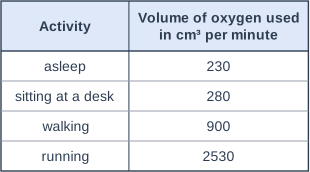
Scientists measured the volume of oxygen used by one adult, Bronwen, while she did different activities. The table shows the results.

Calculate how many times more oxygen Bronwen used per minute when she was running than when she was asleep.

Bronwen's cells still used oxygen while she was asleep. Explain why.

Table with columns "Activity", "Volume of oxygen used in cm³ per minute". Activity: asleep; Volume of oxygen used in cm³ per minute: 230 | Activity: sitting at a desk; Volume of oxygen used in cm³ per minute: 280 | Activity: walking; Volume of oxygen used in cm³ per minute: 900 | Activity: running; Volume of oxygen used in cm³ per minute: 2530.

Model answer

2530 ÷ 230 = 11
Bronwen used 11 times more oxygen when running than when asleep.

Her cells respire all the time, even while she is asleep. Aerobic respiration uses oxygen to release the energy her cells need for metabolic processes, such as her heart beating, her breathing muscles contracting and keeping her body warm.

Explanation

'How many times more' means divide the larger value by the smaller one; subtracting gives the difference instead. Oxygen is used even during sleep because cellular respiration is continuous: the heart, breathing muscles and every other cell still need energy. Say that energy is released, not made.

Mark scheme
  1. 1 mark

    2530 ÷ 230; or a correct final answer of 11 with no working

    An answer of 11 with no working scores marking points 1 and 2. 2530 − 230 = 2300 (the difference) and 230 ÷ 2530 = 0.09 score 0 for marking points 1 and 2. Using the sitting value instead (2530 ÷ 280 = 9.0) scores 0 for marking points 1 and 2.

  2. 1 mark

    11 (times)

    accept 11.0. Ignore units.

  3. 1 mark

    her cells respire all the time / continuously (even when she is asleep)

    accept respiration never stops / aerobic respiration (which uses oxygen) happens all the time in her cells.

  4. 1 mark

    to release energy (that cells need) for metabolic processes / to stay alive, e.g. the heart beating / breathing / keeping warm / making new molecules / active transport

    accept any named process that uses energy from respiration, e.g. heart muscle contracting, breathing muscles contracting, keeping her body temperature at 37 °C, growth or repair. Do not accept 'to make energy'.

Ready to try the rest? Every answer you write is marked against the mark scheme, so you can see exactly where the marks are.

Study Helper Hints first, answers after you try

Stuck on this one? Ask for a hint and I’ll point you in the right direction, without giving the answer away. Once you’ve checked your answer, I’ll show you how the marks are awarded.