
Level:
Correct: 0
Incorrect: 0
Marks: 0/0
Exam Practice
Course:
Topics:
Edexcel GCSE Combined Science (Foundation Biology Paper 2) Smart practice A mixed round aimed at your weak spots
Avg
score:
–
Topics
done:
0/28

Photosynthesis and limiting factors

Practise 15 exam-style questions on Photosynthesis and limiting factors for Edexcel GCSE Combined Science (Foundation Biology Paper 2). Write your answer as you would in the exam and get it marked in seconds against the mark scheme, point by point, with the Study Helper on hand if you get stuck.

  • 15 questions
  • 1–6 marks each
  • Instant marking
  • No sign-up needed
15 questions, marked as you go

Sample questions with model answers

Here are 4 of the questions in this topic, each with a model answer, an explanation of why it earns the marks and the mark scheme an examiner would use.

Question 1

1 mark

Photosynthesis is an endothermic reaction.

Which energy transfer happens during photosynthesis?

Choose your answer.

  • A chemical energy to light energy
  • B thermal energy to light energy
  • C light energy to chemical energy in glucose
  • D chemical energy to thermal energy

Model answer

C (light energy to chemical energy in glucose)

Explanation

An endothermic reaction takes in energy from its surroundings. In photosynthesis the energy taken in is light energy, which is absorbed by chlorophyll and stored as chemical energy in the glucose made. Respiration does the opposite: it releases the energy stored in glucose.

Mark scheme
  1. 1 mark

    C / light energy to chemical energy in glucose

    The only correct answer is C: photosynthesis takes in light energy from the surroundings (so it is endothermic) and stores it as chemical energy in glucose. A is not correct because this is the reverse of photosynthesis (light is taken in, not given out); B is not correct because photosynthesis does not use thermal energy to make light; D is not correct because releasing chemical energy as thermal energy is what happens in an exothermic reaction such as respiration. Accept the letter or the option. If more than one option is given, do not award the mark.
Question 2

2 marks

There is no light at the bottom of the deep ocean, so no plants or algae can grow there. Many animals live there.

Suggest where the food for these animals comes from.

Model answer

The food comes from algae (phytoplankton) that photosynthesise near the surface, where there is light. When these algae, and the animals that eat them, die or produce waste, the dead material sinks to the bottom of the ocean, where the deep-sea animals eat it.

Explanation

Almost all food chains start with photosynthetic organisms, the main producers of food and biomass. Deep-sea animals depend on producers that live where there is light, near the surface: their biomass reaches the deep ocean when dead organisms and waste sink. A common error is to suggest that plants grow on the dark sea floor.

Mark scheme
  1. 1 mark

    from producers / algae / phytoplankton (or seaweed) photosynthesising near the surface, where there is light

    accept from plants and algae in shallow water / at the top of the ocean. accept (for this mark) bacteria that make food using energy from chemicals (at hot vents on the sea floor). Do not accept 'from plants on the sea floor'.

  2. 1 mark

    dead organisms / waste / biomass (or animals that have eaten the producers) sink / fall down to the bottom

    accept dead algae and animals sink to the sea floor and are eaten; accept food passes down a food chain from the surface. Do not accept 'the animals photosynthesise'.

Question 3

3 marks

Reef-building corals live in tropical seas. Tiny algae live inside the coral's cells. The algae photosynthesise, and the coral gets most of its food from the algae.

These corals only grow in shallow, clear water.

Explain why.

Model answer

The algae need light for photosynthesis. Light intensity decreases with depth, and in cloudy water less light gets through. So in deep or cloudy water the algae photosynthesise more slowly and make less glucose, and the coral cannot get enough food from them.

Explanation

Link the coral's food to the algae, and the algae to light. Light intensity is a limiting factor for photosynthesis: as light passes through water, some is absorbed, so deeper or murkier water has less light. Good answers explain the effect on the food the coral receives, not just that light is needed.

Mark scheme
  1. 1 mark

    the algae need light for photosynthesis

    accept light provides the energy for photosynthesis by the algae

  2. 1 mark

    the light intensity decreases with depth / in cloudy (murky) water less light gets through

    accept deep water / muddy water absorbs or blocks the light; accept there is more light in shallow, clear water

  3. 1 mark

    so in deep or cloudy water the algae photosynthesise more slowly / make less glucose, so the coral gets less food

    accept light intensity would be the limiting factor in deep water; accept the coral would starve / could not get enough food

Question 4

4 marks

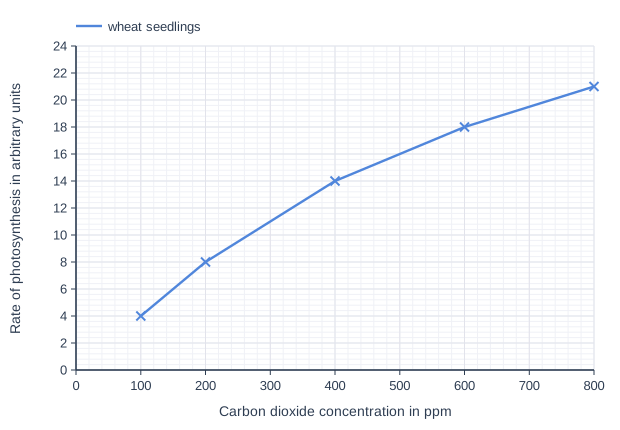
Scientists grew wheat seedlings in sealed chambers with different concentrations of carbon dioxide in the air. The light intensity and the temperature were kept the same.

The graph shows the rate of photosynthesis at each carbon dioxide concentration.

Calculate the percentage increase in the rate of photosynthesis when the carbon dioxide concentration was increased from 200 ppm to 400 ppm.

Explain why increasing the carbon dioxide concentration increased the rate of photosynthesis.

Line graph of rate of photosynthesis in arbitrary units (y-axis, 0 to 24) against carbon dioxide concentration in ppm (x-axis, 0 to 800). "wheat seedlings" joins the points (100, 4), (200, 8), (400, 14), (600, 18), (800, 21).

Model answer

increase in rate = 14 − 8 = 6 arbitrary units
percentage increase = 6 ÷ 8 × 100 = 75 %

Carbon dioxide is a reactant in photosynthesis: it is used to make glucose. At low concentrations, carbon dioxide is in short supply and limits the rate, so increasing the concentration means more carbon dioxide is available to react and photosynthesis happens faster.

Explanation

Read the rates at 200 ppm (8 units) and 400 ppm (14 units) from the graph. Find the increase, divide it by the starting rate (8) and multiply by 100. Dividing by the new rate is a common mistake. Carbon dioxide is one of the two reactants of photosynthesis, so when it is the factor in shortest supply, more of it speeds up the reaction.

Mark scheme
  1. 1 mark

    working: (14 − 8) ÷ 8 × 100 / 6 ÷ 8 × 100; or a correct final answer of 75 % with no working

    An answer of 75 % with no working scores marking points 1 and 2. 6 ÷ 14 × 100 = 42.9 (divided by the new rate) scores marking point 1 only if the increase of 6 is seen. 14 ÷ 8 × 100 = 175 scores 0. An increase of 6 (arbitrary units) seen on its own scores marking point 1.

  2. 1 mark

    evaluation: 75 (%)

    ignore units

  3. 1 mark

    carbon dioxide is a reactant in photosynthesis / is used to make glucose

    accept carbon dioxide is a raw material for photosynthesis

  4. 1 mark

    so with more carbon dioxide (available) the reaction is faster / more glucose is made each minute / carbon dioxide concentration was the limiting factor

    accept carbon dioxide was in short supply at the lower concentration, so it limited the rate. Do not accept 'plants breathe in carbon dioxide'.

Ready to try the rest? Every answer you write is marked against the mark scheme, so you can see exactly where the marks are.

Study Helper Hints first, answers after you try

Stuck on this one? Ask for a hint and I’ll point you in the right direction, without giving the answer away. Once you’ve checked your answer, I’ll show you how the marks are awarded.