
Level:
Correct: 0
Incorrect: 0
Marks: 0/0
Exam Practice
Course:
Topics:
Edexcel GCSE Combined Science (Foundation Biology Paper 2) Smart practice A mixed round aimed at your weak spots
Avg
score:
–
Topics
done:
0/28

The carbon and water cycles

Practise 16 exam-style questions on The carbon and water cycles for Edexcel GCSE Combined Science (Foundation Biology Paper 2). Write your answer as you would in the exam and get it marked in seconds against the mark scheme, point by point, with the Study Helper on hand if you get stuck.

  • 16 questions
  • 1–6 marks each
  • Instant marking
  • No sign-up needed
16 questions, marked as you go

Sample questions with model answers

Here are 4 of the questions in this topic, each with a model answer, an explanation of why it earns the marks and the mark scheme an examiner would use.

Question 1

1 mark

In areas of drought, potable water can be produced from sea water by desalination.

Which method of desalination forces sea water through a partially permeable membrane at high pressure?

Choose your answer.

  • A chlorination
  • B distillation
  • C filtration through sand
  • D reverse osmosis

Model answer

D - reverse osmosis.

Explanation

There are two main methods of desalination. Distillation boils the sea water and condenses the water vapour, leaving the salt behind. Reverse osmosis uses high pressure to force water through a partially permeable membrane that does not let the salt through. Filtration and chlorination are used to treat fresh water, but neither removes dissolved salt.

Mark scheme
  1. 1 mark

    D / reverse osmosis

    The only correct answer is D: in reverse osmosis, high pressure forces water molecules through a partially permeable membrane, but the salt cannot pass through, so the water collected is potable. A is not correct because chlorination kills microorganisms but does not remove salt; B is not correct because distillation removes the salt by boiling the sea water and condensing the water vapour, and uses no membrane; C is not correct because filtration through sand only removes solid particles, and dissolved salt passes through the sand. Accept the letter or the option. If more than one option is given, do not award the mark.
Question 2

2 marks

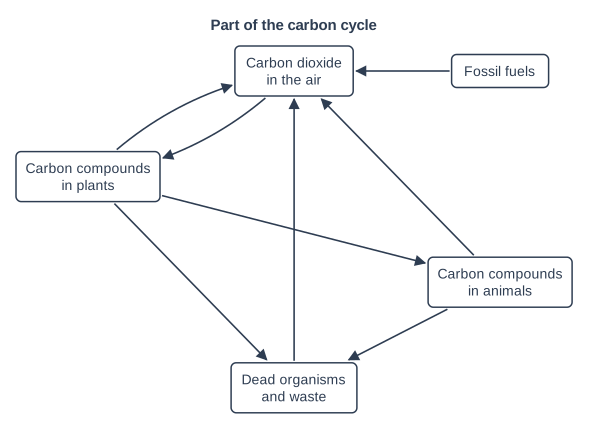
The diagram shows part of the carbon cycle. Each arrow is labelled with a letter.

Give the letter of the arrow that shows photosynthesis.

Give the letter of the arrow that shows respiration by decomposers.

Part of the carbon cycle. Diagram of 5 boxes joined by 8 arrows. The boxes are: "Carbon dioxide in the air" (top row, centre), "Fossil fuels" (top row, right), "Carbon compounds in plants" (second row, left), "Carbon compounds in animals" (third row, right), "Dead organisms and waste" (bottom row, centre). Arrows go from "Carbon dioxide in the air" to "Carbon compounds in plants", labelled P; from "Carbon compounds in plants" to "Carbon dioxide in the air", labelled Q; from "Carbon compounds in plants" to "Carbon compounds in animals", labelled R; from "Carbon compounds in animals" to "Carbon dioxide in the air", labelled S; from "Carbon compounds in plants" to "Dead organisms and waste", labelled T; from "Carbon compounds in animals" to "Dead organisms and waste", labelled U; from "Dead organisms and waste" to "Carbon dioxide in the air", labelled V; from "Fossil fuels" to "Carbon dioxide in the air", labelled W.

Model answer

Photosynthesis is arrow P.
Respiration by decomposers is arrow V.

Explanation

Photosynthesis is the only process that takes carbon dioxide out of the air, so it is the arrow from the air to the plants (P). Decomposers feed on dead organisms and waste and release carbon dioxide when they respire, so their arrow goes from the dead organisms and waste to the air (V). Arrows Q and S are respiration by plants and by animals.

Mark scheme
  1. 1 mark

    photosynthesis: P

    Accept 'arrow P'. If more than one letter is given for photosynthesis, do not award this mark.

  2. 1 mark

    respiration by decomposers: V

    Accept 'arrow V'. Do not accept Q (respiration by plants) or S (respiration by animals). If more than one letter is given for this process, do not award this mark.

Question 3

3 marks

Coal is a fossil fuel. Much of the coal in the UK formed from giant tree ferns and other plants that grew in swamps about 300 million years ago.

Describe how carbon from the air became part of the coal, and how burning the coal returns this carbon to the air.

Model answer

The tree ferns took in carbon dioxide from the air and used it in photosynthesis to make carbon compounds such as glucose and cellulose. When the plants died, they were buried in the swamp mud before they could decay, so decomposers did not release their carbon. Over millions of years the remains turned into coal. When coal is burned, the combustion releases the carbon back into the air as carbon dioxide.

Explanation

Carbon enters plants as carbon dioxide during photosynthesis. Normally decomposers would return it to the air, but these plants were buried before they decayed, so the carbon was locked away in coal for millions of years. Combustion releases it as carbon dioxide. Say 'carbon dioxide', not just 'carbon', when you describe what plants take in and what burning releases.

Mark scheme
  1. 1 mark

    the (tree fern) plants took in carbon dioxide (from the air) for photosynthesis / made carbon compounds such as glucose, starch or cellulose from carbon dioxide

    A description including three from the four points; max 3. Max 2 if the answer does not say that burning (combustion) releases carbon dioxide. The name carbon dioxide is needed: do not accept 'plants took in carbon from the air' for this mark.

  2. 1 mark

    the dead plants were buried (in mud) before they (fully) decayed / were not broken down by decomposers

    Accept 'the dead plants did not rot'. Ignore 'the plants died' on its own.

  3. 1 mark

    over millions of years the buried remains turned into coal / the carbon (compounds) stayed locked in the coal

    Accept 'heat and pressure turned the remains into coal'.

  4. 1 mark

    burning / combustion of the coal releases the carbon as carbon dioxide (into the air)

    Carbon dioxide (CO₂) must be named. Ignore references to energy or heat being released.

Question 4

4 marks

Kuwait is a hot, dry country with no permanent rivers or lakes. Most of the potable water in Kuwait is produced from sea water by desalination, mainly by distillation.

Describe how distillation produces potable water from sea water.

Explain why the UK does not need to produce most of its potable water by desalination.

Model answer

In distillation, the sea water is heated until the water boils and turns into steam. The salt does not evaporate, so it is left behind. The steam is cooled and condenses back into liquid water, which contains no salt and is collected as potable water.

The UK has plenty of rain, so its rivers, reservoirs and ground water are normally full of fresh water. Treating fresh water is much cheaper than distillation, which needs a lot of energy to heat the sea water.

Explanation

Distillation works because only the water evaporates: the salt stays behind, and the water vapour is condensed back into liquid. It needs a lot of energy, so countries only rely on it when they have little fresh water. In the UK, precipitation in the water cycle normally refills rivers and reservoirs, which provide most of our potable water.

Mark scheme
  1. 1 mark

    the sea water is heated / boiled so that the water evaporates / turns into steam (water vapour)

    An answer including four from the five points; max 4. Max 3 if the answer only describes distillation or only explains about the UK.

  2. 1 mark

    the salt does not evaporate / is left behind (in the remaining salty water)

    Accept salts / minerals for salt. Accept 'the salt stays in the container'.

  3. 1 mark

    the steam / water vapour is cooled so that it condenses into (pure / fresh) liquid water, which is collected

    Condensing or cooling the vapour back into liquid water is needed. Ignore 'the water is collected' on its own.

  4. 1 mark

    the UK has a lot of rain (precipitation), so its rivers, reservoirs and ground water contain enough fresh water

    Accept 'the UK gets enough fresh water from the water cycle / from rain'. Ignore 'the UK is not dry' on its own.

  5. 1 mark

    distillation needs a lot of energy (to heat the water), so it is expensive / making potable water from fresh water is cheaper

    Accept 'burning fuel to heat the water is expensive' or 'it releases a lot of carbon dioxide if the energy comes from fossil fuels'.

Ready to try the rest? Every answer you write is marked against the mark scheme, so you can see exactly where the marks are.

Study Helper Hints first, answers after you try

Stuck on this one? Ask for a hint and I’ll point you in the right direction, without giving the answer away. Once you’ve checked your answer, I’ll show you how the marks are awarded.