Level:
Correct: 0
Incorrect: 0
Marks: 0/0
Exam Practice
Course:
Topics:
Edexcel GCSE Combined Science (Foundation Biology Paper 2) Smart practice A mixed round aimed at your weak spots
Avg
score:
–
Topics
done:
0/28

Core practical: quadrats and belt transects

Practise 16 exam-style questions on Core practical: quadrats and belt transects for Edexcel GCSE Combined Science (Foundation Biology Paper 2). Write your answer as you would in the exam and get it marked in seconds against the mark scheme, point by point, with the Study Helper on hand if you get stuck.

  • 16 questions
  • 1–6 marks each
  • Instant marking
  • No sign-up needed
16 questions, marked as you go

Sample questions with model answers

Here are 4 of the questions in this topic, each with a model answer, an explanation of why it earns the marks and the mark scheme an examiner would use.

Question 1

1 mark

Amara used a belt transect to investigate how the percentage cover of moss changes from the shady ground beside a garden fence to the sunny middle of a lawn. At each quadrat she estimated the percentage cover of moss and measured the light intensity.

Which variable must Amara keep the same at every point along the transect?

Choose your answer.

  • A the light intensity
  • B the percentage cover of moss
  • C the size of the quadrat
  • D the distance from the fence

Model answer

C the size of the quadrat

Explanation

In a belt transect the distance along the tape is changed and the organisms are recorded at each distance. The light intensity is measured because it changes along the transect. A control variable, such as the size of the quadrat or the way the cover is estimated, must stay the same so that the results from different quadrats can be compared.

Mark scheme
  1. 1 mark

    C / the size of the quadrat

    The only correct answer is C: the same size of quadrat must be used at every point, so that the percentage cover in each quadrat can be compared fairly. A is not correct because the light intensity changes along the transect: it is the abiotic factor Amara is measuring; B is not correct because the percentage cover of moss is what she is measuring (the dependent variable); D is not correct because the distance from the fence changes along the transect (the independent variable). Accept the letter or the option. If more than one option is given, do not award the mark.
Question 2

2 marks

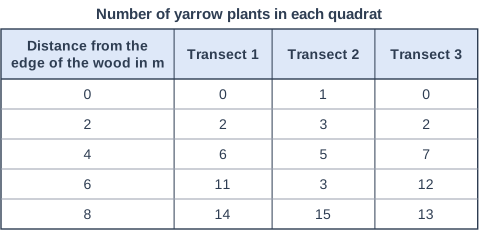
Callum used three belt transects to investigate how the number of yarrow plants changes from the shady edge of a wood out into a sunny meadow. Each transect started at the edge of the wood, and he placed a 1 m² quadrat every 2 m along it.

The table shows the number of yarrow plants in each quadrat. One of the results at 6 m is anomalous.

Calculate the mean number of yarrow plants per quadrat at 6 m. Do not include the anomalous result in your calculation.

Number of yarrow plants in each quadrat. Table with columns "Distance from the edge of the wood in m", "Transect 1", "Transect 2", "Transect 3". Distance from the edge of the wood in m: 0; Transect 1: 0; Transect 2: 1; Transect 3: 0 | Distance from the edge of the wood in m: 2; Transect 1: 2; Transect 2: 3; Transect 3: 2 | Distance from the edge of the wood in m: 4; Transect 1: 6; Transect 2: 5; Transect 3: 7 | Distance from the edge of the wood in m: 6; Transect 1: 11; Transect 2: 3; Transect 3: 12 | Distance from the edge of the wood in m: 8; Transect 1: 14; Transect 2: 15; Transect 3: 13.

Model answer

The anomalous result is 3 (transect 2), because it is much lower than 11 and 12.
Mean = (11 + 12) ÷ 2
= 11.5 yarrow plants per quadrat

Explanation

An anomalous result does not fit the pattern of the other results: at 6 m the other two transects had 11 and 12 plants, but transect 2 had only 3, perhaps because the quadrat was on a path or a bare patch. Leave it out and divide by the number of results used (2, not 3). Including it gives a mean of 8.7, which is too low.

Mark scheme
  1. 1 mark

    (11 + 12) ÷ 2 / 23 ÷ 2; or a correct final answer of 11.5 with no working

    An answer of 11.5 with no working scores 2 marks. (11 + 3 + 12) ÷ 3 = 8.7 (the anomalous result, 3 in transect 2, is included) scores 0. A mean that leaves out a different result scores 0.

  2. 1 mark

    11.5 (yarrow plants per quadrat)

    accept 12 only if 11.5 is seen. Ignore units.

Question 3

3 marks

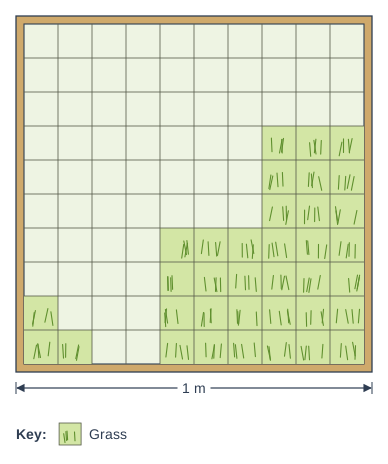
Maya placed a quadrat on the ground under a large horse chestnut tree in a park. The quadrat has sides of 1 m and is divided into 100 equal squares. In the diagram, the squares shaded as grass are covered by grass. The other squares are bare soil.

The ground under the tree has an area of 45 m². Maya assumed that her quadrat was typical of all the ground under the tree.

Estimate the area of ground under the tree that is covered by grass.

View from above of a square quadrat with sides marked 1 m, divided by strings into a grid of 10 × 10 equal small squares. A key shows Grass as light green shading with short strokes. Grass covers a group of whole small squares in patches across the quadrat; the covered squares can be counted on the diagram.

Model answer

Number of squares covered by grass = 36, so the percentage cover = 36 %
Area covered by grass = 36 ÷ 100 × 45
= 16.2 m²

Explanation

The quadrat has 100 squares, so the number of squares covered by grass is the percentage cover (36 %). To scale up, find 36 % of the whole area: 0.36 × 45 = 16.2 m². A common mistake is to multiply 36 by 45 without dividing by 100, which gives an area larger than the whole ground under the tree.

Mark scheme
  1. 1 mark

    percentage cover of grass = 36 (%) / 36 squares out of 100; or a correct final answer of 16.2 m² with no working

    An answer of 16.2 m² with no working scores 3 marks. Allow 35 % or 37 % (a miscount of one square), with ecf for marking points 2 and 3. 36 × 45 = 1620 (the percentage not divided by 100) scores marking point 1 only. 45 ÷ 36 or 45 ÷ 0.36 (wrong method) scores marking point 1 only if 36 % is shown.

  2. 1 mark

    36 ÷ 100 × 45 / 0.36 × 45; or a correct final answer of 16.2 m² with no working

    ecf from their percentage cover.

  3. 1 mark

    16.2 (m²)

    accept 16 (m²). ecf: allow 15.75 or 15.8 (from 35 %) and 16.65 or 16.7 (from 37 %). Ignore units.

Question 4

4 marks

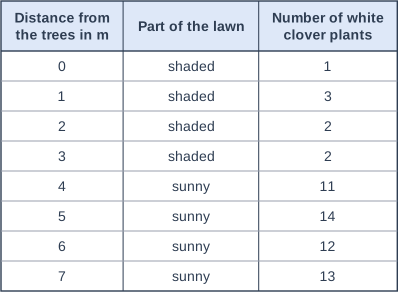
Ffion used a belt transect to investigate the number of white clover plants on a lawn, from the shade of a row of tall conifer trees to the sunny middle of the lawn. She placed 1 m² quadrats side by side along the transect.

The lawn has a shaded part next to the trees, with an area of 160 m², and a sunny part, with an area of 480 m².

The table shows her results and which part of the lawn each quadrat was in.

Use the results to estimate the total number of white clover plants on the lawn.

Table with columns "Distance from the trees in m", "Part of the lawn", "Number of white clover plants". Distance from the trees in m: 0; Part of the lawn: shaded; Number of white clover plants: 1 | Distance from the trees in m: 1; Part of the lawn: shaded; Number of white clover plants: 3 | Distance from the trees in m: 2; Part of the lawn: shaded; Number of white clover plants: 2 | Distance from the trees in m: 3; Part of the lawn: shaded; Number of white clover plants: 2 | Distance from the trees in m: 4; Part of the lawn: sunny; Number of white clover plants: 11 | Distance from the trees in m: 5; Part of the lawn: sunny; Number of white clover plants: 14 | Distance from the trees in m: 6; Part of the lawn: sunny; Number of white clover plants: 12 | Distance from the trees in m: 7; Part of the lawn: sunny; Number of white clover plants: 13.

Model answer

Shaded part: mean = (1 + 3 + 2 + 2) ÷ 4 = 2 per m²
Number in shaded part = 2 × 160 = 320
Sunny part: mean = (11 + 14 + 12 + 13) ÷ 4 = 12.5 per m²
Number in sunny part = 12.5 × 480 = 6000
Total = 320 + 6000 = 6320 white clover plants

Explanation

The clover is spread unevenly, so each part of the lawn is scaled up separately using its own mean and its own area, and the two estimates are then added. Each quadrat is 1 m², so each mean is a number per m². Using one mean for the whole lawn gives 4640, which underestimates the clover because most of the lawn is sunny.

Mark scheme
  1. 1 mark

    mean for the shaded part = (1 + 3 + 2 + 2) ÷ 4 = 2 (per m²); or a correct final answer of 6320 with no working

    An answer of 6320 with no working scores 4 marks. The two means may be found in either order. A method that uses the mean of all eight quadrats for the whole lawn (58 ÷ 8 = 7.25; 7.25 × 640 = 4640) does not use the two parts of the lawn and scores 0.

  2. 1 mark

    mean for the sunny part = (11 + 14 + 12 + 13) ÷ 4 = 12.5 (per m²); or a correct final answer of 6320 with no working

    accept 50 ÷ 4 = 12.5.

  3. 1 mark

    2 × 160 = 320 and 12.5 × 480 = 6000; or a correct final answer of 6320 with no working

    Both products are needed for this mark. ecf from their two means.

  4. 1 mark

    6320 (white clover plants)

    ecf: the sum of their two products. Ignore units.

Ready to try the rest? Every answer you write is marked against the mark scheme, so you can see exactly where the marks are.

Study Helper Hints first, answers after you try

Stuck on this one? Ask for a hint and I’ll point you in the right direction, without giving the answer away. Once you’ve checked your answer, I’ll show you how the marks are awarded.