
Level:
Correct: 0
Incorrect: 0
Marks: 0/0
Exam Practice
Course:
Topics:
Edexcel GCSE Combined Science (Foundation Biology Paper 2) Smart practice A mixed round aimed at your weak spots
Avg
score:
–
Topics
done:
0/28

Diffusion, osmosis and active transport

Practise 14 exam-style questions on Diffusion, osmosis and active transport for Edexcel GCSE Combined Science (Foundation Biology Paper 2). Write your answer as you would in the exam and get it marked in seconds against the mark scheme, point by point, with the Study Helper on hand if you get stuck.

  • 14 questions
  • 1–6 marks each
  • Instant marking
  • No sign-up needed
14 questions, marked as you go

Sample questions with model answers

Here are 4 of the questions in this topic, each with a model answer, an explanation of why it earns the marks and the mark scheme an examiner would use.

Question 1

1 mark

Cells in the lining of the stomach move hydrogen ions into the stomach. The concentration of hydrogen ions in the stomach is much higher than the concentration inside the cells, so the cells must use active transport.

Which part of these cells releases the energy needed for active transport?

Choose your answer.

  • A mitochondria
  • B nucleus
  • C ribosomes
  • D cell membrane

Model answer

A (mitochondria)

Explanation

Active transport moves substances against a concentration gradient, from a lower to a higher concentration, so it needs energy. This energy comes from respiration, and aerobic respiration happens in the mitochondria. Cells that carry out a lot of active transport usually contain many mitochondria.

Mark scheme
  1. 1 mark

    A / mitochondria

    The only correct answer is A: aerobic respiration takes place in the mitochondria, and respiration releases the energy used for active transport. B is not correct because the nucleus contains the genetic material that controls the cell; C is not correct because ribosomes are where proteins are made; D is not correct because the cell membrane is where the ions cross into the stomach, but it does not release the energy. Accept the letter or the option. If more than one option is given, do not award the mark.
Question 2

2 marks

Frogs take in most of their water through their skin, not by drinking.

Explain why water moves from pond water into the cells of a frog's skin.

Model answer

The pond water has a higher water concentration than the cytoplasm of the frog's skin cells, because the cells contain more dissolved substances. So water moves from the pond into the skin cells by osmosis, across their partially permeable cell membranes.

Explanation

Osmosis is the net movement of water across a partially permeable membrane, from a higher water concentration to a lower water concentration. Pond water contains very few dissolved substances, so its water concentration is higher than that of the cytoplasm of the frog's cells. A common error is to write 'from a high concentration to a low concentration' without saying that it is the water concentration.

Mark scheme
  1. 1 mark

    the pond water has a higher water concentration than the (cytoplasm of the) skin cells / the skin cells contain a more concentrated solution than the pond water

    accept the pond water is more dilute than the contents of the cells / contains fewer dissolved substances than the cells; accept water moves down a water concentration gradient (into the cells). Do not accept 'from a high concentration to a low concentration' unless it is clear that it is the water concentration. Do not accept 'the cells need water' on its own.

  2. 1 mark

    (so) water moves into the cells by osmosis (across the partially permeable cell membrane)

    osmosis must be named, or described as the net movement of water across a partially permeable membrane. Do not accept active transport. This mark can be awarded even if the first mark is not.

Question 3

2 marks

Cells in the root of a sugar beet plant store sucrose in their vacuoles. The sucrose is moved into the vacuoles by active transport.

In an experiment, 1 g of sugar beet tissue took up sucrose at a mean rate of 0.012 mg per minute.

Calculate the mass of sucrose taken up by 1 g of the tissue in 5 hours.

Model answer

time = 5 × 60 = 300 minutes
mass = rate × time = 0.012 × 300
= 3.6 mg

Explanation

The rate is given per minute, so first change 5 hours into minutes (300 minutes), then multiply the rate by the time. A common error is to multiply by 5 without changing the hours into minutes, which gives an answer 60 times too small. The sucrose is moved into the vacuoles against a concentration gradient, so the cells use energy from respiration to do this.

Mark scheme
  1. 1 mark

    substitution: 0.012 × 300 / 0.012 × 5 × 60 / time = 5 × 60 = 300 minutes; or a correct final answer of 3.6 mg with no working

    An answer of 3.6 mg with no working scores 2 marks. 0.012 × 5 = 0.06 (the hours not changed to minutes) scores 1 mark, as the method is correct but the time is in the wrong unit. 0.012 ÷ 300 = 0.00004 scores 0. 300 ÷ 0.012 = 25 000 scores 0.

  2. 1 mark

    evaluation: 3.6 (mg)

    accept 3.60; accept 0.0036 g; ignore units unless a wrong unit is given with a value that does not match it

Question 4

4 marks

A scientist investigated the uptake of phosphate ions by yeast cells. The concentration of phosphate ions inside the yeast cells was always higher than in the solution around them.

She set up three flasks of yeast in phosphate solution:
- flask 1: no glucose added
- flask 2: glucose added
- flask 3: glucose and a poison that stops respiration added

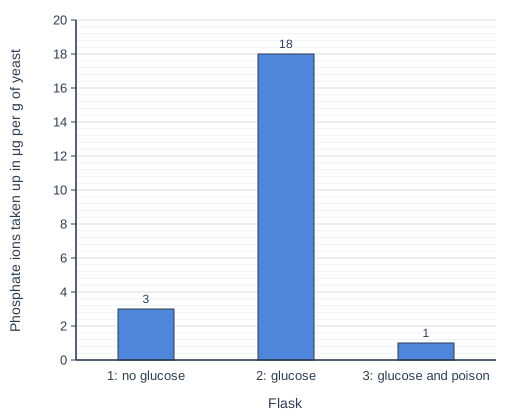
The bar chart shows the mass of phosphate ions taken up by the yeast in each flask in 1 hour.

Explain the results.

Bar chart of phosphate ions taken up in μg per g of yeast for each flask: 1: no glucose 3, 2: glucose 18, 3: glucose and poison 1.

Model answer

The phosphate ions move into the yeast cells against the concentration gradient, so they are taken up by active transport, which needs energy from respiration. In flask 2 the yeast had glucose to respire, so plenty of energy was released and it took up the most phosphate (18 μg per g). In flask 1 there was no glucose, so the yeast could respire very little and took up only 3 μg per g. In flask 3 the poison stopped respiration, so no energy was released for active transport and only 1 μg per g was taken up, even though glucose was there.

Explanation

Start by naming the process: the ions move from a lower to a higher concentration, so it is active transport, which uses energy from respiration. Then link each flask to how much respiration could happen: glucose is the fuel for respiration, and the poison stops respiration altogether. Good answers quote values from the bar chart. A common error is to say that glucose gives the yeast energy directly, without mentioning respiration.

Mark scheme
  1. 1 mark

    phosphate ions are taken up by active transport (because they move from a lower to a higher concentration / against the concentration gradient)

    An explanation including four from the five points; max 4. Do not accept diffusion / osmosis of phosphate ions.

  2. 1 mark

    active transport needs energy from respiration

    accept active transport uses energy released by respiration (in the mitochondria)

  3. 1 mark

    glucose is used in respiration, so with glucose (flask 2) more energy is released and more phosphate is taken up

    accept glucose is the substance that is broken down in respiration to release energy. accept the yeast in flask 1 had little glucose to respire / could respire only its own small stores, so little energy and little uptake.

  4. 1 mark

    the poison stops respiration, so no energy is released and (almost) no phosphate is taken up in flask 3

    accept without respiration there is no energy for active transport, even though glucose is present

  5. 1 mark

    use of data, e.g. 18 μg per g with glucose compared with 3 μg per g without glucose / 1 μg per g with the poison / six times as much with glucose

    accept any correct comparison using values from the bar chart; ignore units

Ready to try the rest? Every answer you write is marked against the mark scheme, so you can see exactly where the marks are.

Study Helper Hints first, answers after you try

Stuck on this one? Ask for a hint and I’ll point you in the right direction, without giving the answer away. Once you’ve checked your answer, I’ll show you how the marks are awarded.