
Level:
Correct: 0
Incorrect: 0
Marks: 0/0
Exam Practice
Course:
Topics:
Edexcel GCSE Combined Science (Foundation Biology Paper 2) Smart practice A mixed round aimed at your weak spots
Avg
score:
–
Topics
done:
0/28

Communities, interdependence and abiotic factors

Practise 16 exam-style questions on Communities, interdependence and abiotic factors for Edexcel GCSE Combined Science (Foundation Biology Paper 2). Write your answer as you would in the exam and get it marked in seconds against the mark scheme, point by point, with the Study Helper on hand if you get stuck.

  • 16 questions
  • 1–6 marks each
  • Instant marking
  • No sign-up needed
16 questions, marked as you go

Sample questions with model answers

Here are 4 of the questions in this topic, each with a model answer, an explanation of why it earns the marks and the mark scheme an examiner would use.

Question 1

1 mark

Wrens are very small birds that feed on insects and spiders.

What is the most likely effect of a very cold, snowy winter on the population of wrens in a wood?

Choose your answer.

  • A the population increases because there are fewer predators
  • B the population decreases because many wrens die from cold or lack of food
  • C the population stays the same because temperature is a biotic factor
  • D the population increases because wrens need less food in cold weather

Model answer

B - the population decreases because many wrens die from cold or lack of food.

Explanation

Temperature is an abiotic factor. In a very cold winter small birds such as wrens need more energy to keep warm but can find less food, so many die and the population falls. Remember that abiotic factors are non-living (temperature, light, water, pollutants) and biotic factors are living (competition, predation).

Mark scheme
  1. 1 mark

    B / the population decreases because many wrens die from cold or lack of food

    The only correct answer is B: low temperature is an abiotic factor; small birds lose heat quickly, and snow and cold make insects and spiders hard to find, so many wrens die and the population falls. A is not correct because, even if some predators died, the cold and the lack of food would kill many wrens, so the wren population would not grow; C is not correct because temperature is an abiotic (non-living) factor, and it does affect populations; D is not correct because birds need more food in cold weather to keep warm, not less. Accept the letter or the option. If more than one option is given, do not award the mark.
Question 2

2 marks

Natterjack toads live on sand dunes in a few places in the UK. They lay their eggs in shallow pools that form after rain in spring. Tadpoles can only live in water, and they take several weeks to change into young toads.

In some years there is very little rain in spring and early summer.

Explain how a dry spring could affect the population of natterjack toads.

Model answer

In a dry spring the shallow pools dry up before the tadpoles have had time to change into young toads. The tadpoles die, so very few young toads join the population that year and the number of natterjack toads decreases.

Explanation

Water is an abiotic factor. Natterjack toads breed in temporary pools, so the survival of their young depends on the pools lasting long enough. Good answers link the lack of rain to the pools drying out, then to the death of the tadpoles and a smaller population.

Mark scheme
  1. 1 mark

    the (shallow) pools dry up / have no water before the tadpoles have changed into toads

    An explanation linking two points. accept fewer pools form / there are fewer places to lay eggs.

  2. 1 mark

    so the tadpoles die / fewer young toads are produced, so the population (of natterjack toads) decreases

    accept fewer toads survive to breed, so there are fewer toads in later years. Do not accept 'the adult toads die of thirst' on its own.

Question 3

3 marks

Some caves in the Peak District have wide entrances. Mosses, liverworts and ferns grow on the rocks just inside the entrance.

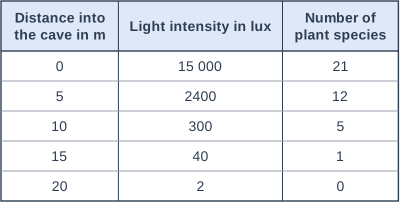
Students measured the light intensity at different distances into one cave. They also recorded the number of plant species growing on the rocks at each distance.

The table shows their results.

Describe how the light intensity and the number of plant species change with distance into the cave.

Explain why no plants grow 20 m into the cave.

Table with columns "Distance into the cave in m", "Light intensity in lux", "Number of plant species". Distance into the cave in m: 0; Light intensity in lux: 15 000; Number of plant species: 21 | Distance into the cave in m: 5; Light intensity in lux: 2400; Number of plant species: 12 | Distance into the cave in m: 10; Light intensity in lux: 300; Number of plant species: 5 | Distance into the cave in m: 15; Light intensity in lux: 40; Number of plant species: 1 | Distance into the cave in m: 20; Light intensity in lux: 2; Number of plant species: 0.

Model answer

The further into the cave, the lower the light intensity: it falls from 15 000 lux at the entrance to only 2 lux at 20 m. The number of plant species also falls, from 21 at the entrance to none at 20 m.

At 20 m there is too little light for plants to photosynthesise enough, so they cannot make enough glucose to survive and grow.

Explanation

Light is an abiotic factor. Plants are producers and need light for photosynthesis, so they can only live where enough light reaches them. Describe both trends with data from the table, then link the lack of light to photosynthesis and glucose.

Mark scheme
  1. 1 mark

    the further into the cave, the lower the light intensity (from 15 000 lux at the entrance to 2 lux at 20 m)

    accept it gets darker further into the cave. Ignore figures quoted without a trend.

  2. 1 mark

    the further into the cave, the fewer plant species there are (from 21 at the entrance to none at 20 m)

    accept fewer plant species where there is less light. ORA.

  3. 1 mark

    (at 20 m) there is too little light for (enough) photosynthesis, so plants cannot make enough glucose / food to survive / grow

    The answer must link low light to photosynthesis. Do not accept 'plants need light to breathe / respire' or 'it is too cold'.

Question 4

4 marks

Mycorrhizal fungi grow in the soil around the roots of many trees, such as Scots pine. The fungus takes in mineral ions and water from the soil and passes some of them to the tree. The tree passes some of the sugars it makes in photosynthesis to the fungus.

Scientists grew Scots pine seedlings in sterilised soil, with and without the fungus. After 6 months:
- the mean dry mass of the seedlings grown with the fungus was 3.6 g
- the mean dry mass of the seedlings grown without the fungus was 1.5 g.

Calculate how many times greater the mean mass of the seedlings grown with the fungus was.

Suggest why the seedlings grown with the fungus grew more.

The fungus cannot photosynthesise. Suggest why the fungus would not survive well in soil with no plant roots.

Model answer

3.6 ÷ 1.5 = 2.4, so the mean mass was 2.4 times greater with the fungus.

The fungus passed extra mineral ions and water from the soil to the seedlings, so they could make more proteins and photosynthesise more, and so grow more.

The fungus cannot make its own sugars, so it depends on the plant roots to supply sugars. Without plant roots it would have no source of food.

Explanation

'How many times greater' means divide the larger mass by the smaller one. This relationship is mutualism: both species benefit. The tree gets mineral ions and water; the fungus gets sugars made by the tree in photosynthesis, so the survival of the fungus depends on the tree.

Mark scheme
  1. 1 mark

    3.6 ÷ 1.5; or a correct final answer of 2.4 with no working

    An answer of 2.4 with no working scores marking points 1 and 2. 3.6 − 1.5 = 2.1 (the difference) and 1.5 ÷ 3.6 = 0.42 score 0 for marking points 1 and 2.

  2. 1 mark

    2.4 (times)

    Ignore units.

  3. 1 mark

    the fungus gave the seedlings more mineral ions / water (from the soil), so they could make more proteins / photosynthesise more / grow more

    accept the seedlings got extra minerals / nutrients / water from the fungus. Do not accept 'the fungus gave the seedlings sugar / food'.

  4. 1 mark

    the fungus depends on the plant for sugars / food (because it cannot make its own by photosynthesis)

    accept the fungus would have no source of sugar / glucose / energy without the plant roots. Ignore 'it needs the plant' with no reason.

Ready to try the rest? Every answer you write is marked against the mark scheme, so you can see exactly where the marks are.

Study Helper Hints first, answers after you try

Stuck on this one? Ask for a hint and I’ll point you in the right direction, without giving the answer away. Once you’ve checked your answer, I’ll show you how the marks are awarded.