
Level:
Correct: 0
Incorrect: 0
Marks: 0/0
Exam Practice
Course:
Topics:
Edexcel GCSE Combined Science (Foundation Biology Paper 2) Smart practice A mixed round aimed at your weak spots
Avg
score:
–
Topics
done:
0/28

Nitrates and the nitrogen cycle

Practise 13 exam-style questions on Nitrates and the nitrogen cycle for Edexcel GCSE Combined Science (Foundation Biology Paper 2). Write your answer as you would in the exam and get it marked in seconds against the mark scheme, point by point, with the Study Helper on hand if you get stuck.

  • 13 questions
  • 1–6 marks each
  • Instant marking
  • No sign-up needed
13 questions, marked as you go

Sample questions with model answers

Here are 4 of the questions in this topic, each with a model answer, an explanation of why it earns the marks and the mark scheme an examiner would use.

Question 1

1 mark

Some plants have small swellings called root nodules on their roots. The root nodules contain nitrogen-fixing bacteria.

Name the group of plants that have root nodules containing nitrogen-fixing bacteria.

Model answer

Legumes (such as peas, beans and clover).

Explanation

Legumes, such as peas, beans and clover, have root nodules containing nitrogen-fixing bacteria. The bacteria convert nitrogen gas from the air into nitrogen compounds that the plant can use to make proteins, so legumes grow well in soil with few nitrates.

Mark scheme
  1. 1 mark

    legumes / leguminous plants

    Accept the pea family / the bean family. Accept a named legume, e.g. peas, beans, clover, lupins, lentils. Ignore 'nitrogen-fixing plants'. Do not accept a plant that is not a legume, e.g. wheat or grass.
Question 2

2 marks

About 78% of the air is nitrogen gas. A wheat crop is surrounded by this nitrogen gas, but the wheat plants can still be short of nitrogen.

Explain why.

Model answer

Plants cannot absorb or use nitrogen gas directly, because it is very unreactive. Wheat can only take in nitrogen as nitrate ions from the soil through its roots, so if the soil contains little nitrate the plants are short of nitrogen.

Explanation

The nitrogen gas in the air is useless to wheat, because plants can only take in nitrogen as nitrates dissolved in the soil water. If earlier crops used up the nitrates and were harvested, or rain washed them away, the wheat goes short. A common mistake is to think that plants take in nitrogen gas through their leaves.

Mark scheme
  1. 1 mark

    plants / wheat cannot absorb or use nitrogen gas (directly) / nitrogen gas is unreactive

    An explanation linking two from the three points; max 2. Ignore 'plants do not need nitrogen gas'.

  2. 1 mark

    plants (can only) absorb nitrogen as nitrates / nitrate ions from the soil (through their roots)

    Accept 'plants get nitrogen from nitrates in the soil'. Do not accept 'plants absorb nitrogen through their leaves'.

  3. 1 mark

    the soil may contain too little nitrate, e.g. earlier crops absorbed it and were harvested / no fertiliser was added / nitrates were washed out by rain / wheat has no root nodules to supply its own nitrogen compounds

    Any one reason why the soil supply of nitrate may be low. Accept 'wheat is not a legume'.

Question 3

3 marks

Cows grazing in a field produce urine and dung. These contain nitrogen compounds, such as urea and proteins.

Describe how the nitrogen in the urine and dung becomes nitrates that the grass can absorb.

Model answer

Decomposers, such as bacteria and fungi in the soil, break down the urea and the proteins in the dung. This releases ammonia into the soil. Nitrifying bacteria then convert the ammonia into nitrates, which dissolve in the soil water and are absorbed by the roots of the grass.

Explanation

Nitrogen in waste returns to the soil in two bacterial steps: decomposers break down urea and proteins into ammonia, and nitrifying bacteria convert ammonia into nitrates. Only then can the grass roots absorb it. Naming the wrong bacteria, such as denitrifying bacteria (which remove nitrates), is a common error.

Mark scheme
  1. 1 mark

    decomposers / decomposing bacteria / fungi / microorganisms break down / feed on the urea / proteins / dung

    A description including three from the four points; max 3. Accept 'the dung is decayed by bacteria'. Allow 'decomposers release nitrates into the soil' for this mark.

  2. 1 mark

    (producing) ammonia / ammonium compounds

    Accept ammonium ions. Do not accept amino acids or nitrogen gas.

  3. 1 mark

    nitrifying bacteria convert the ammonia (ammonium compounds) into nitrates

    The type of bacteria must be nitrifying. Do not accept denitrifying or nitrogen-fixing bacteria.

  4. 1 mark

    the nitrates dissolve in the soil water and are absorbed by the (root hair cells of the) grass roots

    Accept 'absorbed by active transport'.

Question 4

4 marks

A farmer divided a wheat field into six equal areas with the same soil. She added a different mass of nitrogen, as fertiliser, to each area.

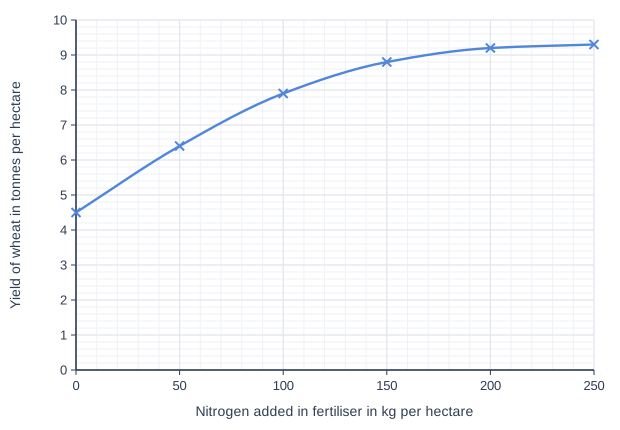
The graph shows the yield of wheat from each area.

Describe the effect of the fertiliser on the yield of wheat. Use data from the graph.

Explain why the fertiliser has this effect, and why the farmer decided not to add more than 200 kg of nitrogen per hectare in future.

Line graph of yield of wheat in tonnes per hectare (y-axis, 0 to 10) against nitrogen added in fertiliser in kg per hectare (x-axis, 0 to 250). The line is a smooth curve through (0, 4.5), (50, 6.4), (100, 7.9), (150, 8.8), (200, 9.2), (250, 9.3).

Model answer

As more fertiliser is added, the yield of wheat increases, from 4.5 tonnes per hectare with no fertiliser to 9.3 tonnes per hectare with 250 kg. The increase gets smaller and smaller: going from 200 kg to 250 kg only raises the yield by 0.1 tonnes per hectare.

The wheat absorbs the nitrates and uses them to make proteins for growth, so it produces more grain. Above 200 kg, something else limits growth, so extra fertiliser gives almost no more wheat. The extra fertiliser would cost more than the extra wheat is worth, and nitrate that the wheat does not absorb may be washed into rivers and cause pollution.

Explanation

Describe the pattern with data: the yield rises steeply at first and then levels off. Explain the rise by linking nitrates to making proteins for growth. A farmer stops where extra fertiliser no longer pays for itself; unused nitrate is also wasted, as it can be washed out of the soil into rivers.

Mark scheme
  1. 1 mark

    the yield increases as more fertiliser is added (from 4.5 tonnes per hectare with none to 9.3 tonnes per hectare with 250 kg)

    An answer including four from the six points; max 4. Max 3 if no data from the graph are used. Accept readings within 0.1 tonnes per hectare of the values shown.

  2. 1 mark

    the increase in yield gets smaller as more fertiliser is added / the yield levels off above about 150-200 kg per hectare (e.g. only 0.1 tonnes per hectare more from 200 to 250 kg)

    Accept 'the first 50 kg raises the yield by 1.9 tonnes per hectare, but the last 50 kg only by 0.1 tonnes per hectare'.

  3. 1 mark

    the nitrates are absorbed and used to make proteins (amino acids) for growth, so the wheat grows more / produces more grain

    The link between nitrates and proteins (or amino acids) is needed. Ignore 'fertiliser helps plants grow' on its own.

  4. 1 mark

    adding more than 200 kg gives (almost) no extra yield, so the extra fertiliser wastes money / costs more than the extra wheat is worth

    Accept 'it is not worth the cost'.

  5. 1 mark

    fertiliser that the crop does not absorb may be washed into rivers / streams (and cause pollution)

    Accept 'causes eutrophication' for pollution; an explanation of eutrophication is not needed.

  6. 1 mark

    at high masses of fertiliser, another factor limits the growth of the wheat (e.g. light, water, carbon dioxide or other mineral ions)

    Accept 'nitrate is no longer the limiting factor'.

Ready to try the rest? Every answer you write is marked against the mark scheme, so you can see exactly where the marks are.

Study Helper Hints first, answers after you try

Stuck on this one? Ask for a hint and I’ll point you in the right direction, without giving the answer away. Once you’ve checked your answer, I’ll show you how the marks are awarded.