
Level:
Correct: 0
Incorrect: 0
Marks: 0/0
Exam Practice
Course:
Topics:
Edexcel GCSE Combined Science (Foundation Biology Paper 2) Smart practice A mixed round aimed at your weak spots
Avg
score:
–
Topics
done:
0/28

The heart and circulatory system

Practise 14 exam-style questions on The heart and circulatory system for Edexcel GCSE Combined Science (Foundation Biology Paper 2). Write your answer as you would in the exam and get it marked in seconds against the mark scheme, point by point, with the Study Helper on hand if you get stuck.

  • 14 questions
  • 1–6 marks each
  • Instant marking
  • No sign-up needed
14 questions, marked as you go

Sample questions with model answers

Here are 4 of the questions in this topic, each with a model answer, an explanation of why it earns the marks and the mark scheme an examiner would use.

Question 1

1 mark

Which part of the heart separates the blood on the left side of the heart from the blood on the right side?

Choose your answer.

  • A aorta
  • B atrium
  • C septum
  • D valve

Model answer

C - septum.

Explanation

The septum divides the heart into two pumps: the right side pumps deoxygenated blood to the lungs and the left side pumps oxygenated blood to the body. Keeping the two sides apart means the blood sent to the body carries as much oxygen as possible.

Mark scheme
  1. 1 mark

    C / septum

    The only correct answer is C: the septum is the wall of muscle between the left and right sides of the heart, so oxygenated and deoxygenated blood do not mix. A is not correct because the aorta is the artery that carries blood from the left ventricle to the body; B is not correct because an atrium is one of the two upper chambers; D is not correct because valves stop blood flowing backwards between a chamber and the next chamber or blood vessel. Accept the letter or the option. If more than one option is given, do not award the mark.
Question 2

2 marks

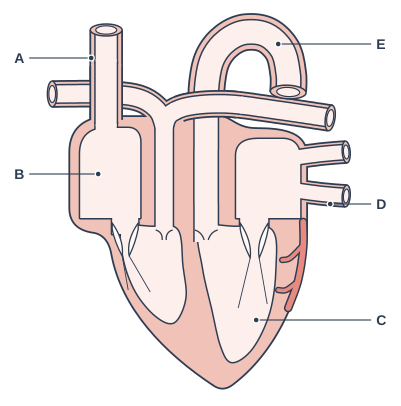
The diagram shows a human heart cut open from top to bottom and viewed from the front. Five parts are labelled A to E.

Give the letter of the chamber that pumps blood to all parts of the body except the lungs.

Give the letter of the blood vessel that brings oxygenated blood from the lungs to the heart.

Diagram of a vertical section through the heart, seen from the front. Four chambers are shown: two smaller upper chambers and two larger lower chambers, with a thick wall of muscle down the middle between the two lower chambers. The lower chamber on the right of the drawing has a much thicker muscular wall than the lower chamber on the left. Flaps held by thin threads lie between each upper chamber and the lower chamber below it, and small flaps sit at the bases of the two large vessels that leave the lower chambers. A large vessel enters the top of the upper left chamber; a vessel leaves the top of the lower left chamber and divides into two branches; two vessels enter the upper right chamber from the right; a large vessel leaves the top of the lower right chamber and arches over the top of the heart. A narrow branching vessel lies on the outer surface of the heart wall on the right. Label A points to the large vessel entering the top of the upper left chamber; label B points to the upper chamber on the left of the drawing; label C points to the lower chamber on the right of the drawing, which has the thickest wall; label D points to one of the two vessels entering the upper right chamber from the right; label E points to the large vessel that leaves the top of the lower right chamber and arches over the top of the heart.

Model answer

C

D

Explanation

C is the left ventricle: it has the thickest wall and pumps blood into the aorta (E), which carries it to the body. D is a pulmonary vein, which brings oxygenated blood from the lungs into the left atrium. In a diagram of the heart seen from the front, the left side of the heart is on the right of the drawing, which is a common source of mistakes.

Mark scheme
  1. 1 mark

    C

    Accept 'C, the left ventricle'. Do not accept a name with no letter.

  2. 1 mark

    D

    Accept 'D, the pulmonary vein'. Do not accept a name with no letter.

Question 3

2 marks

In some older people, the valve at the base of the aorta becomes stiff and narrow, so it does not open fully. Over time, the wall of the left ventricle becomes thicker.

Suggest why the wall of the left ventricle becomes thicker.

Model answer

The narrow valve makes it harder for blood to leave the left ventricle, so the left ventricle has to contract more strongly and produce a higher pressure to push blood through it. The extra work makes the muscle in its wall grow bigger, so the wall becomes thicker.

Explanation

A thicker muscular wall lets a chamber produce a higher pressure. A narrowed valve resists the flow of blood out of the left ventricle, so the muscle has to work harder with every beat, and like other muscles it grows larger. The idea that a thick wall produces more pressure is the same reason the left ventricle is normally thicker than the right ventricle.

Mark scheme
  1. 1 mark

    the left ventricle has to pump harder / produce a higher pressure to push blood through the narrow valve (into the aorta)

    Accept 'the left ventricle has to contract more strongly to get the same amount of blood into the aorta'. Ignore 'the heart works harder' unless linked to pushing blood through the valve.

  2. 1 mark

    so the (heart) muscle in its wall grows / gets bigger / stronger

    Accept 'more muscle builds up in the wall'. Do not accept 'the wall gets thicker to withstand the pressure' on its own (this repeats the question without a reason).

Question 4

4 marks

Keira dissected a lamb's heart. She cut across the two ventricles and used a ruler to measure the thickness of each ventricle wall at one point.

ventricle P: 5 mm
ventricle Q: 14 mm

Which ventricle, P or Q, is the left ventricle? Explain your answer.

Give one safety precaution Keira should take during the dissection.

Keira measured each wall at only one point. Suggest how she could improve her method.

Model answer

Q is the left ventricle. The left ventricle has the thicker wall because it pumps blood all around the body, so it needs more muscle to produce a higher pressure than the right ventricle, which only pumps blood to the lungs.

She should wear gloves.

She should measure the thickness of each wall at several places and calculate a mean for each ventricle.

Explanation

The ventricle with the thicker wall is the left ventricle: more muscle produces a higher pressure, which is needed to pump blood round the whole body. A single measurement may not be typical, because the wall is not the same thickness everywhere, so several measurements and a mean give a more representative value. Dissection needs gloves, careful use of sharp tools and hand washing.

Mark scheme
  1. 1 mark

    Q

    Accept 'Q, because it has the thicker wall'.

  2. 1 mark

    the left ventricle (has a thicker wall because it) pumps blood all around the body / to more organs / at a higher pressure (than the right ventricle, which pumps blood only to the lungs)

    Award only if marking point 1 is awarded. Accept 'more muscle to produce more pressure to pump blood round the body'. 'It has the thicker wall' on its own is not enough for this mark: a reason linked to the function of the left ventricle is needed.

  3. 1 mark

    any one from: wear gloves; wash hands after the dissection; cut away from the body / fingers; use the scalpel carefully on a dissecting board / cutting board; disinfect the bench and equipment afterwards

    1 mark for any one of these, max 1. Accept 'wear eye protection'. Ignore 'be careful' or 'be sensible' with no detail.

  4. 1 mark

    measure each wall at several points / in several places and calculate a mean

    Accept 'repeat the measurements and find an average'. Accept 'measure the ventricles of several hearts and calculate means'. Allow 'use a more precise measuring instrument, e.g. callipers'.

Ready to try the rest? Every answer you write is marked against the mark scheme, so you can see exactly where the marks are.

Study Helper Hints first, answers after you try

Stuck on this one? Ask for a hint and I’ll point you in the right direction, without giving the answer away. Once you’ve checked your answer, I’ll show you how the marks are awarded.