
Level:
Correct: 0
Incorrect: 0
Marks: 0/0
Exam Practice
Course:
Topics:
Edexcel GCSE Combined Science (Foundation Biology Paper 2) Smart practice A mixed round aimed at your weak spots
Avg
score:
–
Topics
done:
0/28

Core practical: light intensity and photosynthesis

Practise 15 exam-style questions on Core practical: light intensity and photosynthesis for Edexcel GCSE Combined Science (Foundation Biology Paper 2). Write your answer as you would in the exam and get it marked in seconds against the mark scheme, point by point, with the Study Helper on hand if you get stuck.

  • 15 questions
  • 1–6 marks each
  • Instant marking
  • No sign-up needed
15 questions, marked as you go

Sample questions with model answers

Here are 4 of the questions in this topic, each with a model answer, an explanation of why it earns the marks and the mark scheme an examiner would use.

Question 1

1 mark

A student shone a lamp on some pondweed in a beaker of water. Bubbles of gas came out of the cut end of the pondweed stem. The bubbles contain a gas that is made by photosynthesis.

Which gas is made by photosynthesis?

Choose your answer.

  • A carbon dioxide
  • B nitrogen
  • C oxygen
  • D water vapour

Model answer

C - oxygen.

Explanation

The word equation for photosynthesis is carbon dioxide + water → glucose + oxygen. The oxygen leaves the pondweed as bubbles, so counting the bubbles (or measuring the volume of gas) shows how fast photosynthesis is happening. Carbon dioxide and water are the reactants, so they are used up, not given off.

Mark scheme
  1. 1 mark

    C / oxygen

    The only correct answer is C: photosynthesis makes glucose and oxygen, and the oxygen is given off as bubbles. A is not correct because carbon dioxide is a reactant that is used up in photosynthesis, not a product; B is not correct because nitrogen is not made by photosynthesis; D is not correct because water is a reactant in photosynthesis, and water vapour is not a product. Accept the letter or the option. If more than one option is given, do not award the mark.
Question 2

2 marks

Orla is planning the core practical with algal balls and hydrogencarbonate indicator. She writes:

'My independent variable is the colour of the indicator after one hour. My dependent variable is the distance of the bottles from the lamp.'

Explain what is wrong with Orla's plan.

Model answer

Orla has swapped her variables. The distance of the bottles from the lamp is the independent variable, because it is the variable she changes. The colour of the indicator after one hour is the dependent variable, because it is what she measures and it depends on the distance.

Explanation

The independent variable is the one you change on purpose (here the distance from the lamp, which changes the light intensity). The dependent variable is the one you measure to see the effect (here the colour of the indicator, which shows the rate of photosynthesis). Saying only 'the variables are the wrong way round' scores 1 mark; naming which variable is which scores both.

Mark scheme
  1. 1 mark

    the distance (of the bottles) from the lamp is the independent variable / is the variable she changes

    accept light intensity for the distance. If neither marking point is awarded, award 1 mark for 'she has the two variables the wrong way round / swapped'. Max 2.

  2. 1 mark

    the colour of the indicator is the dependent variable / is what she measures (because it depends on the distance)

    accept the colour (change) of the indicator / the rate of photosynthesis is the dependent variable / is what she observes or records; ignore 'the colour is a control variable' (wrong)

Question 3

2 marks

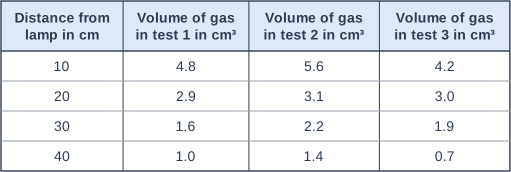
Megan measured the volume of gas given off by some pondweed in 10 minutes, with a lamp at four different distances. She did each test three times.

The table shows her results.

At which distance were Megan's results most repeatable?

Give a reason for your answer.

Table with columns "Distance from lamp in cm", "Volume of gas in test 1 in cm³", "Volume of gas in test 2 in cm³", "Volume of gas in test 3 in cm³". Distance from lamp in cm: 10; Volume of gas in test 1 in cm³: 4.8; Volume of gas in test 2 in cm³: 5.6; Volume of gas in test 3 in cm³: 4.2 | Distance from lamp in cm: 20; Volume of gas in test 1 in cm³: 2.9; Volume of gas in test 2 in cm³: 3.1; Volume of gas in test 3 in cm³: 3.0 | Distance from lamp in cm: 30; Volume of gas in test 1 in cm³: 1.6; Volume of gas in test 2 in cm³: 2.2; Volume of gas in test 3 in cm³: 1.9 | Distance from lamp in cm: 40; Volume of gas in test 1 in cm³: 1.0; Volume of gas in test 2 in cm³: 1.4; Volume of gas in test 3 in cm³: 0.7.

Model answer

20 cm. The three results at 20 cm (2.9, 3.1 and 3.0 cm³) are the closest together: their range is only 0.2 cm³, which is smaller than at any other distance.

Explanation

Results are repeatable when the repeats are very close to each other. The ranges are 1.4 cm³ at 10 cm, 0.2 cm³ at 20 cm, 0.6 cm³ at 30 cm and 0.7 cm³ at 40 cm, so 20 cm has the smallest range. The size of the volumes does not matter: what matters is how close the three repeats are.

Mark scheme
  1. 1 mark

    20 cm

    do not accept any other distance

  2. 1 mark

    the three results at 20 cm are closest together / have the smallest range (0.2 cm³)

    accept the results only differ by 0.2 cm³ / have the smallest spread / are the most similar to each other; do not accept 'the mean is 3.0' or 'they are the highest / lowest volumes' or 'there is no anomaly' on its own

Question 4

4 marks

A scientist collected the gas given off by some pondweed in a gas syringe.

With the lamp 10 cm away, she collected 3.6 cm³ of gas in 4 minutes.
With the lamp 30 cm away, she collected 2.4 cm³ of gas in 10 minutes.

Calculate the percentage decrease in the rate of gas production when the lamp was moved from 10 cm to 30 cm.

Use the equations:

rate of gas production = volume of gas ÷ time

percentage decrease = (decrease in rate ÷ rate at 10 cm) × 100

Model answer

rate at 10 cm = 3.6 ÷ 4 = 0.9 cm³ per minute
rate at 30 cm = 2.4 ÷ 10 = 0.24 cm³ per minute
decrease in rate = 0.9 − 0.24 = 0.66 cm³ per minute
percentage decrease = (0.66 ÷ 0.9) × 100
= 73 % (73.3 %)

Explanation

The gas was collected for different times, so you must work out each rate (volume ÷ time) before comparing them. Comparing the volumes directly gives 33 %, which is wrong because the gas at 30 cm was collected for longer. Divide the decrease by the rate at 10 cm (the starting value), not by the rate at 30 cm.

Mark scheme
  1. 1 mark

    (rate at 10 cm =) 3.6 ÷ 4 = 0.9 (cm³ per minute); or a correct final answer of 73 % with no working

    An answer of 73 % (or 73.3 %) with no working scores 4 marks. Accept rates worked out in other consistent units (e.g. 3.6 ÷ 240 = 0.015 cm³ per second and 2.4 ÷ 600 = 0.004 cm³ per second), which give the same percentage. (3.6 − 2.4) ÷ 3.6 × 100 = 33 % (volumes compared without working out the rates) scores 0. 0.66 ÷ 0.24 × 100 = 275 % (divided by the rate at 30 cm) scores 2 marks (marking points 1 and 2). 26.7 % (the rate at 30 cm as a percentage of the rate at 10 cm) scores 2 marks.

  2. 1 mark

    (rate at 30 cm =) 2.4 ÷ 10 = 0.24 (cm³ per minute); or a correct final answer of 73 % with no working

    ignore units for the rates

  3. 1 mark

    (0.9 − 0.24) ÷ 0.9 × 100 / 0.66 ÷ 0.9 × 100; or a correct final answer of 73 % with no working

    ecf: allow this mark for a correct percentage decrease worked out from incorrect rates (decrease in rate ÷ their rate at 10 cm × 100)

  4. 1 mark

    evaluation: 73 (%) / 73.3 (%)

    accept 73.33; ignore units

Ready to try the rest? Every answer you write is marked against the mark scheme, so you can see exactly where the marks are.

Study Helper Hints first, answers after you try

Stuck on this one? Ask for a hint and I’ll point you in the right direction, without giving the answer away. Once you’ve checked your answer, I’ll show you how the marks are awarded.