Level:
Correct: 0
Incorrect: 0
Marks: 0/0
Exam Practice
Course:
Topics:
Edexcel GCSE Combined Science (Foundation Biology Paper 2) Smart practice A mixed round aimed at your weak spots
Avg
score:
–
Topics
done:
0/28

Blood and blood vessels

Practise 16 exam-style questions on Blood and blood vessels for Edexcel GCSE Combined Science (Foundation Biology Paper 2). Write your answer as you would in the exam and get it marked in seconds against the mark scheme, point by point, with the Study Helper on hand if you get stuck.

  • 16 questions
  • 1–6 marks each
  • Instant marking
  • No sign-up needed
16 questions, marked as you go

Sample questions with model answers

Here are 4 of the questions in this topic, each with a model answer, an explanation of why it earns the marks and the mark scheme an examiner would use.

Question 1

1 mark

The walls of blood capillaries are only one cell thick.

Why is this important?

Choose your answer.

  • A substances have only a short distance to diffuse
  • B the walls can withstand blood at high pressure
  • C blood cannot flow backwards
  • D blood is carried quickly back to the heart

Model answer

A - substances have only a short distance to diffuse.

Explanation

Capillaries are where substances are exchanged between the blood and the body cells. A wall only one cell thick makes the diffusion distance short, so exchange is fast. A thin wall could not withstand high pressure, which is why arteries have thick walls instead.

Mark scheme
  1. 1 mark

    A / substances have only a short distance to diffuse

    The only correct answer is A: a wall one cell thick gives a short diffusion distance, so substances such as oxygen, glucose and carbon dioxide are exchanged quickly between the blood and the body cells. B is not correct because a thin wall cannot withstand high pressure (arteries have thick walls to do this); C is not correct because it is valves, in veins and in the heart, that stop blood flowing backwards; D is not correct because veins carry blood back to the heart, and blood flows slowly through capillaries. Accept the letter or the option. If more than one option is given, do not award the mark.
Question 2

2 marks

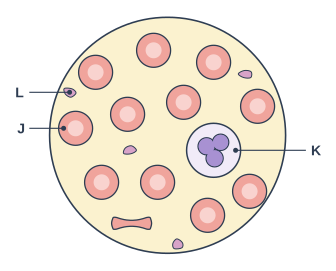
The diagram shows a sample of human blood seen with a light microscope.

Give the letter of the cell that can engulf and digest bacteria.

Give the letter of the part of the blood that helps the blood to clot at a cut.

Diagram: a circular field of view of a pale yellow liquid containing many round pale red discs with paler centres (one more is seen from the side, showing that it is thinner in the middle than at the edges), one larger pale cell with a purple lobed structure inside it, and four small irregular fragments. Label J points to one of the many round pale red discs with paler centres; label K points to the larger pale cell with a purple lobed structure inside it; label L points to one of the small irregular fragments.

Model answer

K

L

Explanation

K is a white blood cell (a phagocyte): it is larger than the red blood cells and has a nucleus with lobes. Phagocytes engulf bacteria and digest them. L is a platelet, a small fragment of a cell that helps to form a clot. J is a red blood cell: a biconcave disc with no nucleus, which carries oxygen.

Mark scheme
  1. 1 mark

    K

    Accept 'K, a white blood cell / phagocyte'. Do not accept a name with no letter, or J or L.

  2. 1 mark

    L

    Accept 'L, a platelet'. Do not accept a name with no letter, or J or K.

Question 3

3 marks

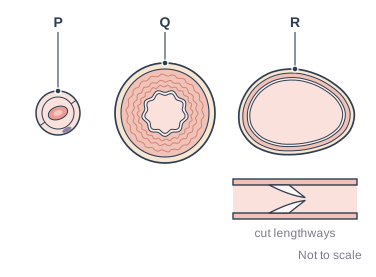
The diagram shows three types of blood vessel, P, Q and R. The drawing is not to scale.

Give the letter of the blood vessel that carries blood at the highest pressure.

Give one feature, shown in the diagram, that allows this vessel to carry blood at high pressure.

Give the letter of the blood vessel where substances are exchanged between the blood and the body cells.

Diagram of three blood vessels in cross-section, side by side. The left vessel has a very thin wall, a single layer of cells, round a central space just wide enough for one red disc (drawn inside it); it is drawn much smaller than the others. The middle vessel has a thick wall (a thin outer layer, a thick middle layer with wavy lines drawn in it, and a thin lining) round a narrow central space. The right vessel has a thin wall round a wide central space; its outline is slightly flattened. Below the right vessel, a short length of the same kind of vessel is drawn cut lengthways (captioned "cut lengthways"), showing a pair of pocket-shaped flaps inside it. A note says "Not to scale". Label P points to the left vessel, the small one whose wall is a single thin layer of cells; label Q points to the middle vessel, with a thick wall and a narrow central space; label R points to the right vessel, with a thin wall and a wide central space.

Model answer

Q

It has a thick wall with a thick layer of muscle and elastic fibres.

P

Explanation

Q is an artery: it has a thick wall of muscle and elastic fibres and a narrow lumen, so it can withstand the high pressure of blood pumped out of the heart. R is a vein (thin wall, wide lumen and a valve). P is a capillary: its wall is only one cell thick, so substances diffuse between the blood and the body cells there.

Mark scheme
  1. 1 mark

    Q

    Accept 'Q, the artery'. Do not accept a name with no letter.

  2. 1 mark

    (vessel Q has a) thick wall / thick layer of muscle (and elastic fibres)

    Accept 'thick muscular wall', 'thick elastic wall'. Allow 'narrow lumen'. Do not accept 'thick cell wall'. Award this mark for a correct feature of vessel Q even if the letter in marking point 1 is wrong.

  3. 1 mark

    P

    Accept 'P, the capillary'. Do not accept a name with no letter.

Question 4

4 marks

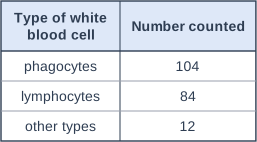
A scientist looked at a sample of a patient's blood with a microscope. She counted 200 white blood cells and recorded the type of each one. The table shows her results.

Calculate the percentage of the white blood cells that were lymphocytes.

In healthy adults, about 20% to 40% of white blood cells are lymphocytes. The patient had a viral infection.

Explain how lymphocytes help the body to destroy the viruses.

Table with columns "Type of white blood cell", "Number counted". Type of white blood cell: phagocytes; Number counted: 104 | Type of white blood cell: lymphocytes; Number counted: 84 | Type of white blood cell: other types; Number counted: 12.

Model answer

percentage = (84 ÷ 200) × 100 = 42%

Lymphocytes produce antibodies. The antibodies attach to the antigens on the surface of the viruses, which helps to destroy them.

Explanation

Divide the number of lymphocytes by the total number of white blood cells counted (200) and multiply by 100. Dividing by the number of phagocytes, or leaving out the 'other types', gives the wrong answer. Lymphocytes defend the body by making antibodies, while phagocytes are the white blood cells that engulf pathogens: do not mix them up, and do not confuse antibodies with antibiotics.

Mark scheme
  1. 1 mark

    substitution: (84 ÷ 200) × 100; or a correct final answer of 42% with no working

    An answer of 42% with no working scores marking points 1 and 2. Marking points 3 and 4 are for the explanation and are never awarded for a number. 84 ÷ 104 × 100 = 80.8% (using the number of phagocytes), 84 ÷ 188 × 100 = 44.7% (leaving out the other types) and 200 ÷ 84 = 2.4 score 0. 84 ÷ 200 = 0.42 (not multiplied by 100) scores marking point 1 only.

  2. 1 mark

    evaluation: 42 (%)

    Ignore the % sign or its absence.

  3. 1 mark

    lymphocytes produce / make / release antibodies

    Do not accept antibiotics or antigens. Do not accept 'lymphocytes engulf the viruses' (phagocytes do this).

  4. 1 mark

    the antibodies attach to (antigens on) the viruses / are specific to the virus, which helps to destroy the viruses

    Accept 'antibodies stick to the viruses', 'antibodies make the viruses clump together', 'antibodies help phagocytes to engulf the viruses', 'antibodies destroy / neutralise the viruses'. The point must say what the antibodies do to the viruses.

Ready to try the rest? Every answer you write is marked against the mark scheme, so you can see exactly where the marks are.

Study Helper Hints first, answers after you try

Stuck on this one? Ask for a hint and I’ll point you in the right direction, without giving the answer away. Once you’ve checked your answer, I’ll show you how the marks are awarded.