
Level:
Correct: 0
Incorrect: 0
Marks: 0/0
Exam Practice
Course:
Topics:
Edexcel GCSE Combined Science (Foundation Biology Paper 2) Smart practice A mixed round aimed at your weak spots
Avg
score:
–
Topics
done:
0/28

Exchange surfaces and surface area to volume

Practise 15 exam-style questions on Exchange surfaces and surface area to volume for Edexcel GCSE Combined Science (Foundation Biology Paper 2). Write your answer as you would in the exam and get it marked in seconds against the mark scheme, point by point, with the Study Helper on hand if you get stuck.

  • 15 questions
  • 1–6 marks each
  • Instant marking
  • No sign-up needed
15 questions, marked as you go

Sample questions with model answers

Here are 4 of the questions in this topic, each with a model answer, an explanation of why it earns the marks and the mark scheme an examiner would use.

Question 1

1 mark

Gas exchange happens between the air in the alveoli and the blood in the capillaries around them.

Which of these describes the movement of carbon dioxide during gas exchange?

Choose your answer.

  • A from the air into the blood, because its concentration is higher in the air
  • B from the blood into the air, by active transport
  • C from the blood into the air, because its concentration is higher in the blood
  • D from the air into the blood, by osmosis

Model answer

C - from the blood into the air, because its concentration is higher in the blood.

Explanation

Gases are exchanged in the alveoli by diffusion, from a higher to a lower concentration. Oxygen diffuses from the air into the blood, and carbon dioxide diffuses from the blood into the air. Active transport and osmosis are not involved in gas exchange.

Mark scheme
  1. 1 mark

    C / from the blood into the air, because its concentration is higher in the blood

    The only correct answer is C: carbon dioxide made by respiration in body cells is carried to the lungs in the blood, where its concentration is higher than in the air in the alveoli, so it diffuses from the blood into the air. A is not correct because the concentration of carbon dioxide is lower in the air in the alveoli, so it does not move into the blood; B is not correct because carbon dioxide moves by diffusion, which does not need energy from respiration; D is not correct because osmosis is the movement of water, and carbon dioxide moves out of the blood, not in. Accept the letter or the option. If more than one option is given, do not award the mark.
Question 2

2 marks

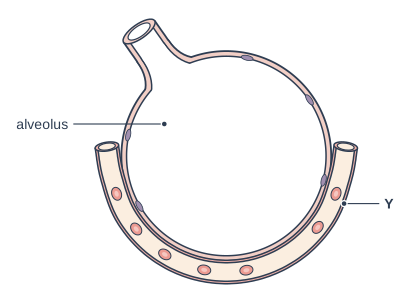
The diagram shows an alveolus in the lungs, with a blood vessel labelled Y next to it.

Name the type of blood vessel labelled Y.

Name the gas that diffuses from the air in the alveolus into the blood in Y.

Diagram of a tiny air sac and a blood vessel, in section. A large rounded sac is shown cut open; it opens at the top left into a short tube. Its wall is very thin, with a few small flattened dark shapes in it. A narrow tube, also with a very thin wall, curves closely round the outside of the sac; it contains small red discs in a pale liquid. The label "alveolus" points to the large rounded air-filled sac; label Y points to the narrow tube curving round the outside of the sac.

Model answer

Y is a capillary.
Oxygen diffuses from the air in the alveolus into the blood.

Explanation

Each alveolus is surrounded by capillaries, tiny blood vessels with walls only one cell thick. Oxygen diffuses from the air in the alveolus, where its concentration is high, into the blood, where its concentration is lower. Carbon dioxide diffuses the other way.

Mark scheme
  1. 1 mark

    capillary

    Accept capillaries. Do not accept artery or vein.

  2. 1 mark

    oxygen

    Accept O₂ or O2. Do not accept carbon dioxide or air.

Question 3

3 marks

Organisms must transport substances into and out of their bodies.

Here are four substances.

carbon dioxide   glucose   urea   water

Give the name of the substance that matches each description. Use each substance once.

P absorbed into the blood from the small intestine and used by human cells in respiration
Q taken into the leaves of a plant from the air, for photosynthesis
R a waste substance made in the liver and removed from the blood by the kidneys
S taken into the roots of a plant from the soil by osmosis

Model answer

P glucose
Q carbon dioxide
R urea
S water

Explanation

Glucose is a dissolved food molecule absorbed from the small intestine and used in respiration. Plants take in carbon dioxide from the air through their leaves and water from the soil through their roots. Urea is a waste substance made in the liver; it is carried in the blood to the kidneys and removed in urine.

Mark scheme
  1. 3 marks

    P glucose; Q carbon dioxide; R urea; S water

    3 marks for all four correct; 2 marks for three correct; 1 mark for two correct; 0 marks for one or none correct. Accept 'sugar' or 'dissolved food' for glucose and CO₂ (or CO2) for carbon dioxide. If a substance is given for more than one description, mark only those that are correct.

Question 4

4 marks

A scientist modelled a cell as a cube with sides of 10 μm. The surface area : volume ratio of this cell is 0.6 : 1.

The cell grows until its sides are 20 μm long.

Calculate the surface area : volume ratio of the cell after it has grown.

Explain why the cell would not be able to take in oxygen fast enough if it kept on growing larger.

Model answer

Surface area = 6 × 20 × 20 = 2400 μm²
Volume = 20 × 20 × 20 = 8000 μm³
Ratio = 2400 ÷ 8000 = 0.3, so 0.3 : 1

As the cell grows, its surface area : volume ratio halves, from 0.6 : 1 to 0.3 : 1, because its volume increases faster than its surface area. Oxygen enters by diffusion across the cell membrane, but the whole volume of the cell needs oxygen for respiration. So a very large cell would not have enough surface for the oxygen it needs, and its centre would be too far from the surface.

Explanation

Work out the surface area (six faces) and the volume, then divide. Doubling the side makes the surface area 4 times bigger but the volume 8 times bigger, so the ratio halves. This is one reason why cells stay small, and why large organisms are made of many small cells with exchange surfaces and transport systems.

Mark scheme
  1. 1 mark

    surface area = 6 × 20 × 20 = 2400 (μm²) and volume = 20 × 20 × 20 = 8000 (μm³); or a correct final answer of 0.3 : 1 with no working

    An answer of 0.3 : 1 with no working scores marking points 1 and 2. Also accept 6 ÷ 20 = 0.3 (for a cube the ratio is 6 ÷ the length of the side) or 0.6 ÷ 2 = 0.3 (doubling the side halves the ratio) for marking points 1 and 2. 400 ÷ 8000 = 0.05 (surface area of only one face) scores 0 for marking points 1 and 2. 8000 ÷ 2400 = 3.3 (division the wrong way round) scores marking point 1 only.

  2. 1 mark

    (2400 ÷ 8000 =) 0.3 : 1

    Accept 0.3. Ignore units.

  3. 1 mark

    the surface area : volume ratio decreases / halves (as the cell grows) / the volume increases faster than the surface area

    Accept 'there is less surface area for each μm³ of the cell'.

  4. 1 mark

    oxygen enters only by diffusion across the surface (cell membrane), but the whole volume of the cell needs oxygen (for respiration), so there would not be enough surface to supply it

    Accept 'not enough membrane to supply all the cytoplasm with oxygen'. Also accept the idea that the centre of the cell would be too far from the surface for oxygen to diffuse there quickly enough.

Ready to try the rest? Every answer you write is marked against the mark scheme, so you can see exactly where the marks are.

Study Helper Hints first, answers after you try

Stuck on this one? Ask for a hint and I’ll point you in the right direction, without giving the answer away. Once you’ve checked your answer, I’ll show you how the marks are awarded.