
Level:
Correct: 0
Incorrect: 0
Marks: 0/0
Exam Practice
Course:
Topics:
Edexcel GCSE Combined Science (Foundation Biology Paper 2) Smart practice A mixed round aimed at your weak spots
Avg
score:
–
Topics
done:
0/28

Root hair cells, xylem and phloem

Practise 13 exam-style questions on Root hair cells, xylem and phloem for Edexcel GCSE Combined Science (Foundation Biology Paper 2). Write your answer as you would in the exam and get it marked in seconds against the mark scheme, point by point, with the Study Helper on hand if you get stuck.

  • 13 questions
  • 1–6 marks each
  • Instant marking
  • No sign-up needed
13 questions, marked as you go

Sample questions with model answers

Here are 4 of the questions in this topic, each with a model answer, an explanation of why it earns the marks and the mark scheme an examiner would use.

Question 1

1 mark

The diagram shows a flowering plant. Part of the stem is magnified to show two transport tissues, R and S.

Give the letter of the tissue that transports sucrose around the plant.
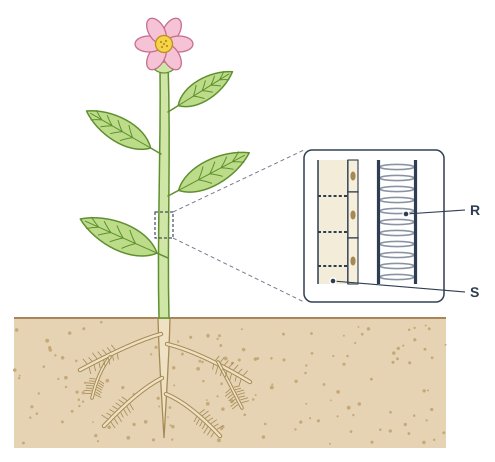
Diagram of a plant, with part of it magnified. A plant grows in soil. It has a coloured structure with petals at the top of an upright green stalk, flat green structures on both sides of the stalk, and branching structures in the soil with fine hairs near the tips of the thin branches. A dashed box on the stalk is shown magnified on the right: it shows two tubes running up and down - on the left, a tube divided by perforated cross-walls, with narrow cells beside it; on the right, a wider hollow tube with thick ringed walls and no cross-walls. Label R points to the wide hollow tube with thick ringed walls, on the right of the magnified view; label S points to the tube divided by perforated cross-walls, with narrow cells beside it, on the left of the magnified view.

Model answer

S

Explanation

Tissue S is phloem: it is made of living cells joined end to end, with small companion cells beside them, and it transports sucrose around the plant. Tissue R is xylem: hollow tubes of dead cells with rings of lignin in their walls, which carry water and mineral ions. Learn to recognise both from their structure.

Mark scheme
  1. 1 mark

    S

    accept S (phloem); do not accept R; do not accept 'phloem' without the letter S; if both letters are given, do not award the mark
Question 2

2 marks

The wall of a root hair cell is thin.

Explain how this helps the root hair cell to take in water and mineral ions.

Model answer

A thin cell wall means there is only a short distance for water and mineral ions to pass through to get into the cell, so they are absorbed faster.

Explanation

An explanation needs the feature (thin wall), what it does (short distance) and the effect (faster absorption). Root hair cells still have a cell wall: saying they have no cell wall is wrong. 'It is easier' is too vague: say that absorption is faster.

Mark scheme
  1. 1 mark

    (there is only) a short distance for water and mineral ions to pass through (into the cell)

    accept a short distance to travel / short diffusion distance; do not accept 'there is no cell wall'; ignore 'the wall lets things in' on its own

  2. 1 mark

    so water and mineral ions are absorbed faster

    accept increases the rate of absorption / of osmosis / more can be absorbed in the same time; ignore 'more easily' on its own

Question 3

3 marks

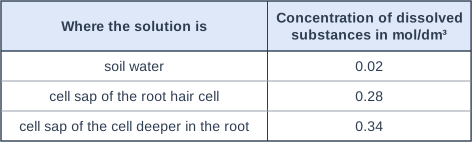
A scientist measured the concentration of dissolved substances in the soil water around a root, in the cell sap of a root hair cell, and in the cell sap of a cell deeper inside the same root.

The table shows her results.

Use the table to explain how water moves from the soil to the cell deeper inside the root.

Table with columns "Where the solution is", "Concentration of dissolved substances in mol/dm³". Where the solution is: soil water; Concentration of dissolved substances in mol/dm³: 0.02 | Where the solution is: cell sap of the root hair cell; Concentration of dissolved substances in mol/dm³: 0.28 | Where the solution is: cell sap of the cell deeper in the root; Concentration of dissolved substances in mol/dm³: 0.34.

Model answer

The soil water is the most dilute: it has only 0.02 mol/dm³ of dissolved substances, while the root hair cell sap has 0.28 mol/dm³. So water moves from the soil into the root hair cell by osmosis, across the partially permeable cell membrane. The cell deeper in the root is even more concentrated (0.34 mol/dm³), so water then moves by osmosis from the root hair cell into the deeper cell.

Explanation

In osmosis, water moves from a dilute solution to a more concentrated solution across a partially permeable membrane. The concentration of dissolved substances rises from the soil to the root hair cell to the deeper cell, so water moves in that direction. The concentrated cell sap in the root hair cell's large vacuole is what draws water in. Water does not need energy to enter: mineral ions, not water, are taken in by active transport.

Mark scheme
  1. 1 mark

    the soil water has the lowest concentration of dissolved substances / is the most dilute (0.02 mol/dm³), so water moves from the soil into the root hair cell (0.28 mol/dm³)

    Max 2 if no data from the table are used. accept the root hair cell sap is more concentrated than the soil water; accept water moves from a dilute solution to a more concentrated solution; do not accept 'water moves from a low concentration to a high concentration' unless it is clear this is the concentration of dissolved substances

  2. 1 mark

    (water moves) by osmosis (across the partially permeable cell membrane)

    osmosis must be named; do not accept active transport / diffusion of water without osmosis

  3. 1 mark

    then from the root hair cell into the deeper cell, because the deeper cell is more concentrated (0.34 mol/dm³ compared with 0.28 mol/dm³)

    accept the concentration increases from the soil to the root hair cell to the deeper cell, so water moves along this path (by osmosis); ignore 'water then goes to the xylem'

Question 4

4 marks

A scientist took equal masses of phloem tissue and xylem tissue from the stem of a plant. She measured the volume of oxygen that each sample took in during one hour, at the same temperature.

phloem: 92 mm³ of oxygen
xylem: 6 mm³ of oxygen

Explain why the phloem took in much more oxygen than the xylem.

Model answer

Phloem is made of living cells, but xylem vessels are made of dead cells. The living phloem cells carry out aerobic respiration, which uses oxygen and releases energy. The phloem uses this energy to transport sucrose around the plant. The dead xylem cells do not respire, and they do not need to, because water moves up the xylem without the xylem cells using energy. So the xylem takes in very little oxygen.

Explanation

The key difference is that phloem cells are alive and xylem vessels are dead. Living cells respire, using oxygen, and the phloem needs the energy released to move sucrose. Remember that respiration releases energy: it does not make energy.

Mark scheme
  1. 1 mark

    phloem is made of living cells / xylem (vessels) are dead cells

    Max 4. accept the phloem cells are alive / the xylem cells are not alive

  2. 1 mark

    living (phloem) cells carry out (aerobic) respiration, which uses oxygen

    accept the phloem cells respire (more); do not accept 'the phloem cells breathe'

  3. 1 mark

    respiration releases energy

    do not accept 'respiration makes / produces energy'

  4. 1 mark

    the energy is used (by the phloem) to transport sucrose (around the plant)

    accept to move / pump sugar along the phloem

  5. 1 mark

    the xylem does not need energy from its own cells to transport water / water moves up the xylem without the xylem cells using energy

    accept transport in the xylem is passive / water is pulled up the xylem by transpiration; do not award this mark for 'dead xylem cells do not respire / do not use oxygen' on its own (that is the reverse of marking points 1 and 2); ignore any explanation of the small volume taken in by the xylem sample (e.g. a few living cells in it), which is not needed

Ready to try the rest? Every answer you write is marked against the mark scheme, so you can see exactly where the marks are.

Study Helper Hints first, answers after you try

Stuck on this one? Ask for a hint and I’ll point you in the right direction, without giving the answer away. Once you’ve checked your answer, I’ll show you how the marks are awarded.