
Level:
Correct: 0
Incorrect: 0
Marks: 0/0
Exam Practice
Course:
Topics:
Edexcel GCSE Combined Science (Foundation Biology Paper 2) Smart practice A mixed round aimed at your weak spots
Avg
score:
–
Topics
done:
0/28

Heart rate, stroke volume and cardiac output

Practise 14 exam-style questions on Heart rate, stroke volume and cardiac output for Edexcel GCSE Combined Science (Foundation Biology Paper 2). Write your answer as you would in the exam and get it marked in seconds against the mark scheme, point by point, with the Study Helper on hand if you get stuck.

  • 14 questions
  • 1–6 marks each
  • Instant marking
  • No sign-up needed
14 questions, marked as you go

Sample questions with model answers

Here are 4 of the questions in this topic, each with a model answer, an explanation of why it earns the marks and the mark scheme an examiner would use.

Question 1

1 mark

A person's stroke volume is 0.07 dm³ and their heart rate is 60 beats per minute.

cardiac output = stroke volume × heart rate

What is the person's cardiac output?

Choose your answer.

  • A 0.42 dm³ per minute
  • B 60.07 dm³ per minute
  • C 857 dm³ per minute
  • D 4.2 dm³ per minute

Model answer

D - 4.2 dm³ per minute.

Explanation

Multiply the stroke volume by the heart rate: 0.07 × 60 = 4.2 dm³ per minute. A useful check is that a resting adult's cardiac output is usually about 4 to 6 dm³ per minute, so 0.42, 60.07 and 857 are all far too small or far too large.

Mark scheme
  1. 1 mark

    D / 4.2 dm³ per minute

    The only correct answer is D: 0.07 × 60 = 4.2 dm³ per minute. A is not correct because 0.42 has the decimal point in the wrong place; B is not correct because 60.07 comes from adding the two values instead of multiplying them; C is not correct because 857 comes from dividing 60 by 0.07. Accept the letter or the option. If more than one option is given, do not award the mark.
Question 2

2 marks

Cerys and Elif are friends.

At rest, Cerys's stroke volume is 65 cm³ and her heart rate is 78 beats per minute.
At rest, Elif's cardiac output is 5.2 dm³ per minute.

Use the equation:

cardiac output = stroke volume × heart rate

Which friend has the larger cardiac output at rest? Show your working.

Model answer

Cerys: cardiac output = 65 × 78 = 5070 cm³ per minute
Elif: 5.2 dm³ per minute = 5.2 × 1000 = 5200 cm³ per minute
5200 is more than 5070, so Elif has the larger cardiac output.

Explanation

Calculate Cerys's cardiac output first, then put both values in the same unit before comparing them (1 dm³ = 1000 cm³). Comparing 5070 with 5.2 without converting makes Cerys's value look about 1000 times bigger, which is the common error.

Mark scheme
  1. 1 mark

    Cerys's cardiac output = 65 × 78 = 5070 cm³ per minute / 5.07 dm³ per minute

    The answer 'Elif' with no working scores 0 (the question asks for working). 65 + 78 = 143 and 78 ÷ 65 = 1.2 score 0 for this point. Ignore units if the value is 5070 or 5.07.

  2. 1 mark

    Elif (has the larger cardiac output), because 5.2 dm³ = 5200 cm³, which is more than 5070 cm³ / because 5.07 dm³ is less than 5.2 dm³

    The comparison must use the same units for both values. Allow ecf: a correct conclusion from their value for Cerys compared with Elif's in the same units. Do not accept 'Cerys, because 5070 is bigger than 5.2' (the units have not been converted).

Question 3

3 marks

During a race, a runner's cardiac output was 22.5 dm³ per minute. Her stroke volume was 125 cm³.

cardiac output = stroke volume × heart rate

Calculate the runner's heart rate during the race.

Model answer

22.5 dm³ = 22.5 × 1000 = 22 500 cm³
heart rate = cardiac output ÷ stroke volume
heart rate = 22 500 ÷ 125 = 180 beats per minute

Explanation

The two volumes must be in the same unit before dividing: 1 dm³ = 1000 cm³, so 22.5 dm³ = 22 500 cm³. Then heart rate = cardiac output ÷ stroke volume. Forgetting to convert gives 0.18, which cannot be a heart rate.

Mark scheme
  1. 1 mark

    conversion: 22.5 dm³ = 22 500 cm³ / 125 cm³ = 0.125 dm³; or a correct final answer of 180 beats per minute with no working

    An answer of 180 beats per minute with no working scores 3 marks. 22.5 ÷ 125 = 0.18 (units not converted) scores marking point 2 only. 125 × 22.5 = 2812.5 and 125 ÷ 22.5 = 5.6 score 0.

  2. 1 mark

    rearrangement and substitution: (heart rate =) 22 500 ÷ 125 / 22.5 ÷ 0.125; or a correct final answer of 180 beats per minute with no working

    Accept heart rate = cardiac output ÷ stroke volume with the values substituted in any consistent units.

  3. 1 mark

    evaluation: 180 (beats per minute)

    Ignore units.

Question 4

4 marks

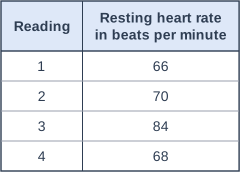
Anya measured her resting heart rate four times while sitting still. The table shows her results. One of the results is anomalous.

Calculate Anya's mean resting heart rate. Do not use the anomalous result.

Anya's resting stroke volume is 74 cm³.

cardiac output = stroke volume × heart rate

Calculate Anya's resting cardiac output in cm³ per minute.

Table with columns "Reading", "Resting heart rate in beats per minute". Reading: 1; Resting heart rate in beats per minute: 66 | Reading: 2; Resting heart rate in beats per minute: 70 | Reading: 3; Resting heart rate in beats per minute: 84 | Reading: 4; Resting heart rate in beats per minute: 68.

Model answer

The anomalous result is 84.
mean = (66 + 70 + 68) ÷ 3 = 204 ÷ 3 = 68 beats per minute
cardiac output = 74 × 68 = 5032 cm³ per minute

Explanation

84 is much higher than the other three results, so it is anomalous (perhaps Anya had just moved) and is left out. The mean of the other three is 68 beats per minute. Then multiply by the stroke volume. Including 84 gives a mean of 72, and dividing by 4 after leaving out 84 is another common error.

Mark scheme
  1. 1 mark

    mean: (66 + 70 + 68) ÷ 3 / 204 ÷ 3; or a correct final answer of 5032 cm³ per minute with no working

    An answer of 5032 cm³ per minute with no working scores 4 marks. A mean of 68 with no working scores marking points 1 and 2. Including the anomalous result gives (66 + 70 + 84 + 68) ÷ 4 = 72, which scores 0 for marking points 1 and 2 but can score marking points 3 and 4 by ecf (74 × 72 = 5328). (66 + 70 + 68) ÷ 4 = 51 also scores 0 for marking points 1 and 2 but can score marking points 3 and 4 by ecf (74 × 51 = 3774).

  2. 1 mark

    mean = 68 (beats per minute); or a correct final answer of 5032 cm³ per minute with no working

    Ignore units.

  3. 1 mark

    substitution: (cardiac output =) 74 × 68; or a correct final answer of 5032 cm³ per minute with no working

    Allow ecf: 74 × their mean.

  4. 1 mark

    evaluation: 5032 (cm³ per minute)

    Accept 5.032 dm³ per minute. Allow ecf from their mean (e.g. 5328 from a mean of 72). Ignore units.

Ready to try the rest? Every answer you write is marked against the mark scheme, so you can see exactly where the marks are.

Study Helper Hints first, answers after you try

Stuck on this one? Ask for a hint and I’ll point you in the right direction, without giving the answer away. Once you’ve checked your answer, I’ll show you how the marks are awarded.