
Level:
Correct: 0
Incorrect: 0
Marks: 0/0
Exam Practice
Course:
Topics:
Edexcel GCSE Combined Science (Foundation Biology Paper 2) Smart practice A mixed round aimed at your weak spots
Avg
score:
–
Topics
done:
0/28

Homeostasis and control of blood glucose

Practise 14 exam-style questions on Homeostasis and control of blood glucose for Edexcel GCSE Combined Science (Foundation Biology Paper 2). Write your answer as you would in the exam and get it marked in seconds against the mark scheme, point by point, with the Study Helper on hand if you get stuck.

  • 14 questions
  • 1–6 marks each
  • Instant marking
  • No sign-up needed
14 questions, marked as you go

Sample questions with model answers

Here are 4 of the questions in this topic, each with a model answer, an explanation of why it earns the marks and the mark scheme an examiner would use.

Question 1

1 mark

Insulin is a hormone released by the pancreas.

Which of these describes how insulin travels to its main target organ, and names that organ?

Choose your answer.

  • A along nerves to the liver
  • B in the blood to the kidneys
  • C in the blood to the liver
  • D along nerves to the muscles

Model answer

C - in the blood to the liver.

Explanation

Hormones are chemical messengers carried in the blood plasma from an endocrine gland to a target organ. Insulin is released by the pancreas, and its main target organ is the liver, although muscle cells respond to it too. A common mistake is to think that hormones travel along nerves: nerves carry electrical impulses, which are much faster.

Mark scheme
  1. 1 mark

    C / in the blood to the liver

    The only correct answer is C: like all hormones, insulin is carried in the blood (plasma), and its main target organ is the liver, where it causes glucose to be taken up and stored as glycogen. A is not correct because hormones are not carried along nerves; B is not correct because the kidneys are not the main target organ for insulin; D is not correct because hormones are not carried along nerves (muscle cells do respond to insulin, but it reaches them in the blood). Accept the letter or the option. If more than one option is given, do not award the mark.
Question 2

2 marks

Tomos has just eaten a chicken curry with plenty of rice, and his blood glucose concentration has risen.

The list gives five steps in the control of his blood glucose concentration, in a random order.

J insulin travels in the blood to the liver
K the pancreas detects the rise in blood glucose concentration
L liver cells take up glucose and convert it into glycogen
M blood glucose concentration falls back to normal
N the pancreas releases insulin into the blood

Give the sequence of letters that puts the steps in order, starting with the first step.

Model answer

K, N, J, L, M

Explanation

The pancreas first detects the rise in blood glucose concentration (K) and then releases insulin into the blood (N). Insulin is carried in the blood to its main target organ, the liver (J), where cells take up glucose and convert it into glycogen (L), so the blood glucose concentration falls back to normal (M). A common error is to put the release of insulin before the pancreas has detected the rise.

Mark scheme
  1. 2 marks

    K, N, J, L, M

    2 marks for all five letters in this order. 1 mark if the order has just one pair of neighbouring letters swapped (for example K, J, N, L, M or K, N, J, M, L). 0 marks for any other order. Accept the letters with or without commas or arrows.

Question 3

2 marks

Eating a meal causes an internal change in the body.

Idris eats a jacket potato. Potatoes contain a lot of starch.

Explain why Idris's blood glucose concentration rises after the meal.

Model answer

The starch in the potato is digested by enzymes (carbohydrases such as amylase) into glucose. The glucose is then absorbed from the small intestine into the blood, so his blood glucose concentration rises.

Explanation

Starch molecules are too large to be absorbed, so enzymes first break them down into glucose. The glucose is absorbed into the blood from the small intestine, which raises blood glucose concentration until insulin brings it back down. Saying that starch itself enters the blood is a common error.

Mark scheme
  1. 1 mark

    starch is digested / broken down (by enzymes / carbohydrases / amylase) into glucose / sugars

    Accept 'converted into glucose (in the gut)'. Do not accept 'starch is absorbed into the blood'.

  2. 1 mark

    glucose is absorbed into the blood (from the small intestine / gut)

    Accept 'glucose diffuses into the blood'. Accept 'intestine' or 'gut'.

Question 4

4 marks

Elin does not have diabetes. On two different mornings she ate a breakfast containing the same mass of carbohydrate: toast and jam on one morning, and porridge on the other.

Jam contains a lot of sugar, which is absorbed into the blood quickly. Porridge oats contain starch, which is digested more slowly.

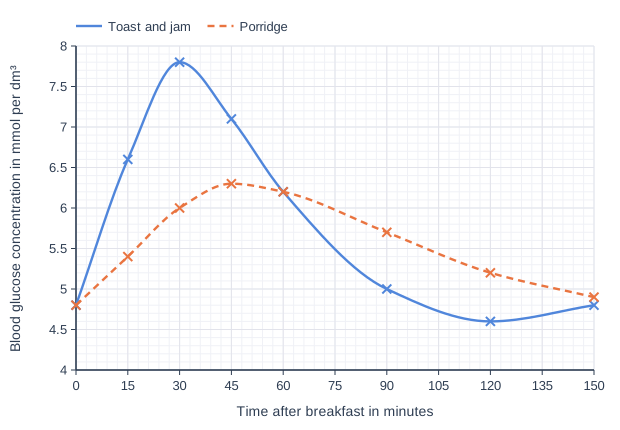
The graph shows her blood glucose concentration after each breakfast.

Compare the effects of the two breakfasts on Elin's blood glucose concentration. Use data from the graph.

Suggest why Elin's pancreas released more insulin after the toast and jam breakfast.

Line graph of blood glucose concentration in mmol per dm³ (y-axis, 4 to 8) against time after breakfast in minutes (x-axis, 0 to 150). "Toast and jam" is a smooth curve through (0, 4.8), (15, 6.6), (30, 7.8), (45, 7.1), (60, 6.2), (90, 5), (120, 4.6), (150, 4.8). "Porridge" (dashed) is a smooth curve through (0, 4.8), (15, 5.4), (30, 6), (45, 6.3), (60, 6.2), (90, 5.7), (120, 5.2), (150, 4.9).

Model answer

After toast and jam, Elin's blood glucose concentration rose faster and reached a higher peak: 7.8 mmol per dm³ at 30 minutes, compared with 6.3 mmol per dm³ at 45 minutes after porridge. It also fell back to the starting value sooner after toast and jam, while after porridge it stayed raised for longer (5.7 compared with 5.0 mmol per dm³ at 90 minutes).

The sugar in the jam was absorbed into her blood quickly, so her blood glucose concentration rose higher and faster. Her pancreas detected this higher concentration and released more insulin to bring it back down.

Explanation

A good comparison uses data from both curves at the same points, such as the two peaks and when they happened. The suggestion links the food to the size of the rise in blood glucose, and the size of the rise to the amount of insulin released: the pancreas releases more insulin when blood glucose concentration is higher. Describing only one curve does not make a comparison.

Mark scheme
  1. 1 mark

    after toast and jam, blood glucose concentration reached a higher peak (7.8 mmol per dm³ compared with 6.3 mmol per dm³ after porridge)

    Max 3 if no data from the graph are used. Marking points 1, 2 and 3: any two, max 2. Accept the reverse argument (porridge gave a lower peak). Allow readings of 7.7 to 7.9 and 6.2 to 6.4 mmol per dm³.

  2. 1 mark

    after toast and jam, blood glucose concentration rose faster / reached its peak sooner (at 30 minutes compared with 45 minutes)

    Accept the reverse argument. Allow 40 to 50 minutes for the porridge peak.

  3. 1 mark

    after toast and jam, blood glucose concentration fell back to the starting value sooner / after porridge it stayed raised for longer (for example 5.0 compared with 5.7 mmol per dm³ at 90 minutes)

    Accept the reverse argument. Accept 'the porridge curve rises and falls more gently'.

  4. 1 mark

    (suggestion) sugar from the jam is absorbed into the blood quickly, so blood glucose concentration rises higher / faster

    Accept the reverse argument: the starch in porridge is digested slowly, so glucose enters the blood more slowly.

  5. 1 mark

    the pancreas detects the higher blood glucose concentration and releases more insulin (to bring it back down)

    The idea that a bigger rise in blood glucose concentration causes more insulin to be released is needed.

Ready to try the rest? Every answer you write is marked against the mark scheme, so you can see exactly where the marks are.

Study Helper Hints first, answers after you try

Stuck on this one? Ask for a hint and I’ll point you in the right direction, without giving the answer away. Once you’ve checked your answer, I’ll show you how the marks are awarded.