
Level:
Correct: 0
Incorrect: 0
Marks: 0/0
Exam Practice
Course:
Topics:
Edexcel GCSE Combined Science (Foundation Biology Paper 2) Smart practice A mixed round aimed at your weak spots
Avg
score:
–
Topics
done:
0/28

Eukaryotic and prokaryotic cells

Practise 14 exam-style questions on Eukaryotic and prokaryotic cells for Edexcel GCSE Combined Science (Foundation Biology Paper 2). Write your answer as you would in the exam and get it marked in seconds against the mark scheme, point by point, with the Study Helper on hand if you get stuck.

  • 14 questions
  • 1–6 marks each
  • Instant marking
  • No sign-up needed
14 questions, marked as you go

Sample questions with model answers

Here are 4 of the questions in this topic, each with a model answer, an explanation of why it earns the marks and the mark scheme an examiner would use.

Question 1

1 mark

Bacteria that live in soil take in dissolved substances, such as sugars, from the water around them.

Which structure controls which substances enter and leave a bacterial cell?

Choose your answer.

  • A cell wall
  • B cell membrane
  • C flagellum
  • D plasmid

Model answer

B - cell membrane.

Explanation

In bacterial cells, as in plant and animal cells, it is the cell membrane, not the cell wall, that controls what goes into and out of the cell. The cell wall lies outside the membrane and gives strength and support. Students often confuse the two because both form the outside of the cell.

Mark scheme
  1. 1 mark

    B / cell membrane

    The only correct answer is B: the cell membrane controls which substances enter and leave the cell. A is not correct because the cell wall strengthens and supports the cell, and most dissolved substances pass straight through it; C is not correct because a flagellum moves the cell; D is not correct because a plasmid is a small ring of DNA that carries a few extra genes. Accept the letter or the option. If more than one option is given, do not award the mark.
Question 2

2 marks

Cotton fibres grow on the seeds of the cotton plant. Each fibre is a single, very long plant cell. When a fibre is mature, the cell dies and the fibre is made almost entirely of its thick cell wall.

Name the substance that plant cell walls are made of.

Give the function of the cell wall in a living plant cell.

Model answer

Plant cell walls are made of cellulose.
The cell wall strengthens and supports the cell and keeps its shape.

Explanation

Plant cell walls are made of cellulose, a tough material made from glucose, which is why cotton fibres are strong. The cell wall strengthens and supports the cell, but it is the cell membrane, just inside the wall, that controls which substances enter and leave. Starch is a different substance, used as a food store.

Mark scheme
  1. 1 mark

    (substance) cellulose

    accept phonetic spellings, e.g. 'cellulos'. Do not accept starch, glucose, lignin, chitin, protein, or carbohydrate on its own.

  2. 1 mark

    (function) strengthens the cell / supports the cell / gives the cell its shape / makes the cell rigid

    accept stops the cell bursting (when it takes in water). Do not accept 'controls what enters and leaves the cell' (this is the cell membrane). Ignore 'protects the cell' on its own.

Question 3

2 marks

A plant cell is a eukaryotic cell and a bacterium is a prokaryotic cell. Both contain DNA, but it is arranged differently in the two types of cell.

Describe two differences between the DNA in a plant cell and the DNA in a bacterial cell.

Model answer

In a plant cell the DNA is inside a nucleus, but in a bacterial cell the DNA is free in the cytoplasm, because bacteria have no nucleus.
A bacterial cell also has small rings of DNA called plasmids, but a plant cell does not.

Explanation

Eukaryotic cells, such as plant cells, keep their DNA as chromosomes inside a nucleus. Prokaryotic cells, such as bacteria, have no nucleus: they have one large loop of chromosomal DNA free in the cytoplasm, and often some small rings of DNA called plasmids, which carry a few extra genes. Each difference must say which cell has the feature, for example 'only the bacterial cell has plasmids'.

Mark scheme
  1. 1 mark

    the DNA of a plant cell is (enclosed) in a nucleus, but the DNA of a bacterial cell is free in the cytoplasm / a bacterial cell has no nucleus

    Any two from marking points 1 to 3, max 2. Each difference must be a comparison or make clear which cell has the feature, e.g. 'only the plant cell has its DNA in a nucleus'; a feature named with no cell scores 0. Credit any other correct difference in the DNA. Do not accept 'bacteria have no DNA' or 'bacteria have no chromosome'. Ignore references to structures that do not contain DNA, e.g. the cell wall, vacuole or ribosomes.

  2. 1 mark

    a bacterial cell (often) has plasmids / small rings of DNA (as well as its chromosomal DNA), but a plant cell does not

    accept only the bacterial cell has plasmid DNA.

  3. 1 mark

    the chromosomal DNA of a bacterial cell is a single (large) loop, but the DNA of a plant cell is in several / many chromosomes

    accept bacterial DNA is circular / a ring but plant DNA is not; accept a bacterium has one chromosome but a plant cell has many. 'The DNA of a plant cell is in chromosomes' on its own does not score.

Question 4

4 marks

Scientists studied the bacterium E. coli growing in different nutrient solutions at 37 °C. In some solutions the cells grew and divided faster than in others.

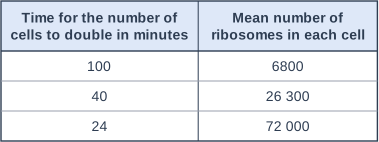
The table shows the time taken for the number of cells to double and the mean number of ribosomes in each cell, for three of the solutions (data from Bremer and Dennis, 1996).

Describe the relationship shown by the data. Use numbers from the table in your answer.

Suggest an explanation for this relationship.

Table with columns "Time for the number of cells to double in minutes", "Mean number of ribosomes in each cell". Time for the number of cells to double in minutes: 100; Mean number of ribosomes in each cell: 6800 | Time for the number of cells to double in minutes: 40; Mean number of ribosomes in each cell: 26 300 | Time for the number of cells to double in minutes: 24; Mean number of ribosomes in each cell: 72 000.

Model answer

The shorter the time the cells take to double, the more ribosomes there are in each cell. Cells that double every 100 minutes have 6800 ribosomes, but cells that double every 24 minutes have 72 000, about 10 times as many.
Ribosomes are where proteins are made. Cells that grow and divide quickly need to make a lot of protein, including enzymes, very fast to build the new cells, so they need more ribosomes.

Explanation

Read the table carefully: a shorter doubling time means the cells are dividing faster, so the relationship is 'faster division, more ribosomes'. Pair each number with its time when you quote data. The explanation links the function of ribosomes (making proteins) to the extra proteins needed to build new cells quickly.

Mark scheme
  1. 1 mark

    the faster the cells divide / the shorter the time for the number of cells to double, the more ribosomes there are in each cell

    accept ORA: the longer the time taken to double, the fewer ribosomes. Do not accept 'as the time increases, the number of ribosomes increases' (this is the wrong way round).

  2. 1 mark

    correct use of data, e.g. 6800 ribosomes when the cells double every 100 minutes but 72 000 when they double every 24 minutes

    The data must pair a time with its number of ribosomes, or be a correct comparison, e.g. cells that double every 24 minutes have about 10 times as many ribosomes as cells that double every 100 minutes (72 000 ÷ 6800 = 10.6; allow 10 to 11 times).

  3. 1 mark

    ribosomes make proteins / are where proteins are made

    accept ribosomes are the site of protein synthesis.

  4. 1 mark

    cells that grow and divide faster need to make more proteins / make proteins faster (to build new cells / for enzymes)

    accept new cells need proteins (and enzymes), so faster growth needs more ribosomes.

Ready to try the rest? Every answer you write is marked against the mark scheme, so you can see exactly where the marks are.

Study Helper Hints first, answers after you try

Stuck on this one? Ask for a hint and I’ll point you in the right direction, without giving the answer away. Once you’ve checked your answer, I’ll show you how the marks are awarded.