
Level:
Correct: 0
Incorrect: 0
Marks: 0/0
Exam Practice
Course:
Topics:
Edexcel GCSE Combined Science (Foundation Biology Paper 2) Smart practice A mixed round aimed at your weak spots
Avg
score:
–
Topics
done:
0/28

Specialised cells

Practise 12 exam-style questions on Specialised cells for Edexcel GCSE Combined Science (Foundation Biology Paper 2). Write your answer as you would in the exam and get it marked in seconds against the mark scheme, point by point, with the Study Helper on hand if you get stuck.

  • 12 questions
  • 1–6 marks each
  • Instant marking
  • No sign-up needed
12 questions, marked as you go

Sample questions with model answers

Here are 4 of the questions in this topic, each with a model answer, an explanation of why it earns the marks and the mark scheme an examiner would use.

Question 1

1 mark

Ciliated epithelial cells line the airways leading to the lungs. Each cell has a few hundred cilia, which beat all the time.

Which sub-cellular structure would you expect to find in large numbers in a ciliated epithelial cell?

Choose your answer.

  • A mitochondria
  • B chloroplasts
  • C plasmids
  • D permanent vacuoles

Model answer

A - mitochondria.

Explanation

Ciliated epithelial cells have many cilia on one surface, and the cilia beat all the time to move mucus or other fluid along. Beating uses a lot of energy, so the cells have many mitochondria to release energy by aerobic respiration. Chloroplasts, plasmids and permanent vacuoles are never found in human cells.

Mark scheme
  1. 1 mark

    A / mitochondria

    The only correct answer is A: beating cilia need a lot of energy, which is released by aerobic respiration in the mitochondria, so these cells contain many mitochondria, especially near the bases of the cilia. B is not correct because chloroplasts are found only in plant and algal cells, not in animal cells; C is not correct because plasmids are found in bacteria; D is not correct because permanent vacuoles are found in plant cells. Accept the letter or the option. If more than one option is given, do not award the mark.
Question 2

2 marks

The statements A to F describe some of the events when a human egg cell is fertilised. They are not in the correct order.

A the acrosome releases enzymes
B the sperm cell swims towards the egg cell, using its tail
C the enzymes break down the outer layer of the egg cell
D the nucleus of the sperm cell enters the egg cell
E the egg cell membrane changes, so that no other sperm cells can enter
F the haploid nucleus of the sperm cell joins with the haploid nucleus of the egg cell

The first event is B.

Write the letters of the other five events in the correct order.

Model answer

B, A, C, D, E, F

Explanation

The sperm cell first swims to the egg using its tail (B). At the egg, the acrosome releases enzymes (A), which break down the outer layer of the egg cell (C), so the sperm nucleus can enter (D). The egg cell membrane then changes so that no other sperm can get in (E), and the two haploid nuclei join (F); D F E is also accepted, because the specification describes the membrane change as happening after fertilisation. Think of it as a story: reach the egg, get in, keep others out, then the nuclei join.

Mark scheme
  1. 1 mark

    A and C in this order (A then C), both before D

    The full correct order is B A C D E F, which scores 2 marks; B A C D F E also scores 2 marks (see marking point 2). Award this mark if A comes before C and both come before D, wherever E and F are placed. If more than six letters are given, or a letter is repeated, do not award this mark.

  2. 1 mark

    E and F both after D (in either order)

    Award this mark if E and F both come after D, in either order, wherever A and C are placed. The membrane change really happens as soon as the sperm has entered, before the nuclei join (D E F), but the specification describes it as a change after fertilisation, so D F E is also accepted. For example, B A C D F E scores 2 marks, B A C E D F scores 1 mark (marking point 1 only) and B C A D E F scores 1 mark (marking point 2 only).

Question 3

2 marks

Human sperm cells can stay alive and keep swimming for several days inside the female reproductive system. They take in sugars from the fluid around them.

Explain how these sugars allow a sperm cell to swim.

Model answer

The sugars are used in aerobic respiration in the many mitochondria in the midpiece of the sperm cell. Respiration releases energy, which the tail uses to beat, so the sperm cell can swim.

Explanation

A sperm cell is adapted for swimming by having a tail and many mitochondria packed into the midpiece, just behind the head. The mitochondria use sugars in aerobic respiration to release energy for the tail. Always say energy is released, not made.

Mark scheme
  1. 1 mark

    the sugars / glucose are used in (aerobic) respiration (in the mitochondria / in the midpiece)

    accept the sugars are respired / the mitochondria use the sugars to release energy. 'The sugars are used by the mitochondria' with no reference to respiration or energy does not score. Do not accept 'the sugars are turned into energy'.

  2. 1 mark

    (respiration) releases energy for the tail to move / beat

    accept releases energy for swimming / for the tail. Do not accept 'makes energy' or 'creates energy'.

Question 4

4 marks

Zebrafish are small fish. A zebrafish egg cell contains a large store of nutrients, called yolk, in its cytoplasm. After fertilisation, the young fish develops inside the egg and it does not feed until after it hatches.

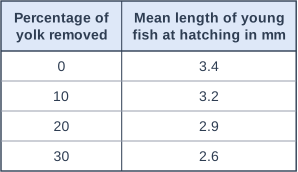
A scientist used a very fine needle to remove some of the yolk from fertilised zebrafish egg cells. She then measured the mean length of the young fish when they hatched.

The table shows her results.

Describe the effect of removing yolk on the length of the young fish. Use data from the table.

Explain this effect.

Table with columns "Percentage of yolk removed", "Mean length of young fish at hatching in mm". Percentage of yolk removed: 0; Mean length of young fish at hatching in mm: 3.4 | Percentage of yolk removed: 10; Mean length of young fish at hatching in mm: 3.2 | Percentage of yolk removed: 20; Mean length of young fish at hatching in mm: 2.9 | Percentage of yolk removed: 30; Mean length of young fish at hatching in mm: 2.6.

Model answer

The more yolk that was removed, the shorter the young fish were when they hatched. With no yolk removed the mean length was 3.4 mm, but with 30% of the yolk removed it was only 2.6 mm, which is 0.8 mm shorter.
The yolk in the cytoplasm is the store of nutrients that the young fish uses to grow, to make new cells and to release energy in respiration. It cannot feed until it hatches, so with less yolk it has fewer nutrients and cannot grow as much.

Explanation

Describe the pattern first, then quote paired data (a length with its percentage of yolk removed). The explanation is the adaptation of an egg cell: its cytoplasm stores nutrients for the embryo, and an embryo that cannot feed relies completely on that store. Lengths are means, so the results are for many fish.

Mark scheme
  1. 1 mark

    the more yolk removed, the shorter the young fish (at hatching)

    accept removing yolk makes the fish shorter / ORA.

  2. 1 mark

    correct use of data, e.g. 3.4 mm with no yolk removed but 2.6 mm with 30% removed / a decrease of 0.8 mm

    Data must pair a length with its percentage of yolk removed, or be a correct difference (3.4 - 2.6 = 0.8 mm; 3.4 - 3.2 = 0.2 mm; 3.2 - 2.9 = 0.3 mm; 2.9 - 2.6 = 0.3 mm).

  3. 1 mark

    the yolk / nutrients (in the cytoplasm) are used by the embryo / young fish to grow / to make new cells / for energy (in respiration)

    accept the yolk is the young fish's only food (before it hatches).

  4. 1 mark

    less yolk means fewer nutrients, so the young fish cannot grow as much (before it hatches)

    accept the young fish cannot feed until it hatches, so it cannot replace the missing nutrients.

Ready to try the rest? Every answer you write is marked against the mark scheme, so you can see exactly where the marks are.

Study Helper Hints first, answers after you try

Stuck on this one? Ask for a hint and I’ll point you in the right direction, without giving the answer away. Once you’ve checked your answer, I’ll show you how the marks are awarded.