Level:
Correct: 0
Incorrect: 0
Marks: 0/0
Exam Practice
Course:
Topics:
AQA GCSE Food Preparation and Nutrition Smart practice A mixed round aimed at your weak spots
Unit 1
Food preparation skills
Unit 2
Food, nutrition and health
Unit 3
Food science
Unit 4
Food safety
Unit 5
Food choice
Unit 6
Food provenance
Avg
score:
–
Topics
done:
0/37

Water

Practise 18 exam-style questions on Water for AQA GCSE Food Preparation and Nutrition. Write your answer as you would in the exam and get it marked in seconds against the mark scheme, point by point, with the Study Helper on hand if you get stuck.

  • 18 questions
  • 1–12 marks each
  • Instant marking
  • No sign-up needed
18 questions, marked as you go

Sample questions with model answers

Here are 4 of the questions in this topic, each with a model answer, an explanation of why it earns the marks and the mark scheme an examiner would use.

Question 1

1 mark

Many foods contain water and add to a person's fluid intake.

Which food has the highest water content?

Choose your answer.

  • Lettuce
  • Banana
  • Boiled rice
  • Cheddar cheese

Model answer

Lettuce

Explanation

Lettuce is about 95% water, like many salad vegetables and fruits. Banana is about 75% water, boiled rice about 70% and Cheddar cheese only about 36%. Students sometimes choose boiled rice because it is cooked in water, but it still contains much less water than salad vegetables.

Mark scheme
  1. 1 mark

    Lettuce

    If more than one option is given, 0 marks.
Question 2

3 marks

Water is an essential part of the diet, even though it provides no energy.

Give three functions of water in the body.

Do not repeat your answers.

Model answer

1. Water helps to control body temperature, because sweat cools the body as it evaporates.
2. It removes waste from the body in urine.
3. It helps digestion, for example saliva and digestive juices are mostly water.

Explanation

The specification names three functions: removing waste, cooling and helping digestion; transporting nutrients and lubricating joints are also creditable. Each answer must be a different function, so 'sweating' and 'cooling the body' only score once. Do not write that water gives energy, because it contains no calories.

Mark scheme
  1. 1 mark

    controls body temperature / cools the body (by sweating)

    Award 1 mark per valid point. Max 3. Answers should not be repeated: 'sweating' and 'cooling the body' are the same point. Do not credit 'keeps you hydrated', 'keeps you healthy' or 'gives energy'.

  2. 1 mark

    removes waste from the body / forms urine (via the kidneys) / helps to remove faeces

    Do not credit 'flushes out toxins' unless urine, the kidneys or faeces are mentioned.

  3. 1 mark

    helps digestion / forms saliva and digestive juices / helps food move through the digestive system / prevents constipation (with fibre)

  4. 1 mark

    transports nutrients/oxygen around the body (in the blood) / dissolves nutrients so they can be absorbed

  5. 1 mark

    lubricates joints/eyes / cushions and protects the brain and nervous system

  6. 1 mark

    needed by all body cells / makes up most of the body's fluids, e.g. blood

    Any other relevant and correct response can be credited.

Question 3

4 marks

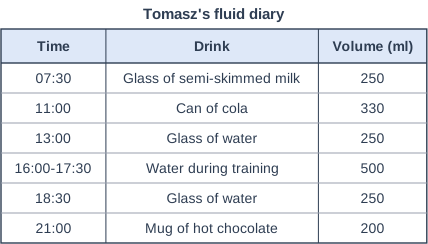
Tomasz is 16 and plays football. The table shows his fluid diary for a hot day when he had a 90-minute training session.

His coach advises players to drink about 2.5 litres of fluid on hot training days. 1 litre = 1000 ml.

Use the table to:
- calculate how many more millilitres of fluid Tomasz needed to drink to meet his coach's advice
- identify one drink in the diary that Tomasz should replace with a better choice, and give a reason.

Tomasz's fluid diary. Table with columns "Time", "Drink", "Volume (ml)". Time: 07:30; Drink: Glass of semi-skimmed milk; Volume (ml): 250 | Time: 11:00; Drink: Can of cola; Volume (ml): 330 | Time: 13:00; Drink: Glass of water; Volume (ml): 250 | Time: 16:00-17:30; Drink: Water during training; Volume (ml): 500 | Time: 18:30; Drink: Glass of water; Volume (ml): 250 | Time: 21:00; Drink: Mug of hot chocolate; Volume (ml): 200.

Model answer

Total = 250 + 330 + 250 + 500 + 250 + 200 = 1780 ml
2.5 litres = 2500 ml
2500 - 1780 = 720 ml more

Tomasz should replace the can of cola with water, because cola is high in free sugars, which can cause tooth decay.

Explanation

Convert 2.5 litres to 2500 ml before subtracting the diary total of 1780 ml. All non-alcoholic drinks count towards fluid intake, but sugary drinks like cola can damage teeth, so water, lower-fat milk or lower-sugar drinks are better choices. A common error is mixing litres and millilitres in the subtraction.

Mark scheme
  1. 1 mark

    total fluid drunk = 1780 ml / 1.78 litres

    Award full marks for the calculation with or without working. Award 1 mark per valid point; the reason mark can only be awarded with a correct drink.

  2. 1 mark

    720 ml (more)

    Accept 0.72 litres. ecf: 2500 minus an incorrect total, correctly worked. Do not credit an answer that subtracts 1780 from 2.5 without converting units.

  3. 1 mark

    the can of cola / the mug of hot chocolate

    Do not credit the milk or any of the water.

  4. 1 mark

    reason: cola is high in (free/added) sugar, which can cause tooth decay / adds unnecessary energy / contains caffeine; hot chocolate contains added sugar

    For the hot chocolate, the reason must refer to its added/free sugar. Credit a suitable replacement linked to the reason, e.g. water or lower-fat milk instead of cola. Do not credit 'it is unhealthy' without a reason. Any other relevant and correct response can be credited.

Question 4

6 marks

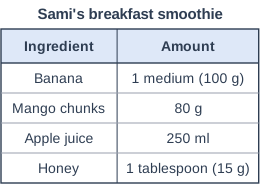
Sami is 14. Every morning he makes the smoothie shown in the table and drinks all of it with his breakfast. The recipe makes about 400 ml.

Explain how the smoothie adds to Sami's fluid intake, and how the recipe could be changed to make it a better choice of drink for him.

Sami's breakfast smoothie. Table with columns "Ingredient", "Amount". Ingredient: Banana; Amount: 1 medium (100 g) | Ingredient: Mango chunks; Amount: 80 g | Ingredient: Apple juice; Amount: 250 ml | Ingredient: Honey; Amount: 1 tablespoon (15 g).

Model answer

The smoothie adds to Sami's fluid intake because the apple juice and the fruit are mostly water, so about 400 ml of drink counts towards his 6-8 glasses a day. However, NHS advice is no more than 150 ml of fruit juice and smoothies in total a day. Juicing and blending fruit release free sugars, and the honey adds more free sugar, so the smoothie probably contains more than the 30 g of free sugars recommended as a daily maximum for his age. Free sugars can cause tooth decay and add extra energy.

To make it a better drink, Sami could replace the apple juice with semi-skimmed milk or plain yoghurt and some water or ice. This still provides fluid, adds calcium and protein for growth, and the lactose in milk is not a free sugar. He should leave out the honey, because the ripe banana and mango already make the smoothie sweet. He could add a water-rich vegetable such as cucumber or spinach and pour a 150 ml glass instead of 400 ml. Drinking it with breakfast is good, because it is less harmful to teeth with a meal, and he should make water his main drink for the rest of the day.

Explanation

Top-level answers explain both sides: the smoothie does provide fluid, but the amount and its free sugars are a problem; they then give specific changes to the recipe with a reason for each. Answers that only say 'use less juice' or 'it is unhealthy', without explaining free sugars, the 150 ml limit or the benefit of each swap, stay in a lower level.

Mark scheme
  1. 6 marks

    Levels of response (6 marks). AO2.
    Level 3 (5-6 marks): Responses show very good knowledge and understanding of how a smoothie adds to fluid intake and the advice on fruit juice, smoothies and free sugars. Detailed and factual explanations related to changes to Sami's smoothie recipe that would make it a better drink for him.
    Level 2 (3-4 marks): Responses show good knowledge and understanding of how a smoothie adds to fluid intake and the advice on fruit juice, smoothies and free sugars. Factual explanations, some of which relate to changes to Sami's smoothie recipe that would make it a better drink for him.
    Level 1 (1-2 marks): Responses show limited knowledge and understanding of how a smoothie adds to fluid intake and the advice on fruit juice, smoothies and free sugars. Limited explanation related to changes to Sami's smoothie recipe that would make it a better drink for him.
    0 marks: nothing to reward.

    Indicative content (not a checklist; credit other valid points): Fluid: the apple juice and fruit are mostly water, so the smoothie counts towards the 6-8 glasses (about 1.2 litres) of fluid a day; drinking it with breakfast is good, because juice and smoothies are less harmful to teeth with a meal. Problems: NHS advice is no more than 150 ml of fruit juice and smoothies in total a day, and Sami drinks about 400 ml; juicing and blending release free sugars, and honey is also a free sugar; free sugars can cause tooth decay and add extra energy; the smoothie is likely to provide more than the 30 g a day maximum of free sugars for his age; it should not replace water as his main drink. Changes: pour a 150 ml glass rather than 400 ml; replace the apple juice with water, ice, semi-skimmed or skimmed milk, plain yoghurt or an unsweetened calcium-fortified soya drink; milk and yoghurt still provide fluid and add calcium and protein for growth, and the lactose in milk is not a free sugar; leave out the honey, as ripe banana and mango are already sweet; add water-rich vegetables such as cucumber or spinach; keep drinking it with a meal; make water or lower-fat milk his main drinks for the rest of the day. Do not credit 'it is unhealthy' or 'make it healthier' unless explained.

Ready to try the rest? Every answer you write is marked against the mark scheme, so you can see exactly where the marks are.

Study Helper Hints first, answers after you try

Stuck on this one? Ask for a hint and I’ll point you in the right direction, without giving the answer away. Once you’ve checked your answer, I’ll show you how the marks are awarded.