
Level:
Correct: 0
Incorrect: 0
Marks: 0/0
Exam Practice
Course:
Topics:
AQA GCSE Food Preparation and Nutrition Smart practice A mixed round aimed at your weak spots
Unit 1
Food preparation skills
Unit 2
Food, nutrition and health
Unit 3
Food science
Unit 4
Food safety
Unit 5
Food choice
Unit 6
Food provenance
Avg
score:
–
Topics
done:
0/37

Food production: primary and secondary processing

Practise 20 exam-style questions on Food production: primary and secondary processing for AQA GCSE Food Preparation and Nutrition. Write your answer as you would in the exam and get it marked in seconds against the mark scheme, point by point, with the Study Helper on hand if you get stuck.

  • 20 questions
  • 1–12 marks each
  • Instant marking
  • No sign-up needed
20 questions, marked as you go

Sample questions with model answers

Here are 4 of the questions in this topic, each with a model answer, an explanation of why it earns the marks and the mark scheme an examiner would use.

Question 1

1 mark

Flour mills describe each type of flour by its extraction rate.

What does the extraction rate of a flour tell you?

Choose your answer.

  • The percentage of protein in the flour
  • The percentage of fibre in the flour
  • The percentage of the whole wheat grain that is used in the flour
  • The percentage of water removed from the grain during milling

Model answer

The percentage of the whole wheat grain that is used in the flour

Explanation

Wholemeal flour has an extraction rate of 100% because the whole grain (bran, germ and endosperm) is used. Brown flour is about 85% and white flour about 70-75%, because some or most of the bran and germ are sieved out. Extraction rate is linked to fibre, since a higher rate keeps more bran, but it is not the fibre content itself, which is a common mistake.

Mark scheme
  1. 1 mark

    The percentage of the whole wheat grain that is used in the flour

    If more than one option is given, 0 marks.
Question 2

4 marks

Milk sold in UK shops has been heat treated.

State the temperature and the time used to heat treat:
- pasteurised milk
- UHT milk.

Then give two reasons why milk is heat treated before it is sold.

Model answer

Pasteurised milk is heated to 72 °C for 15 seconds and then cooled quickly. UHT milk is heated to about 135-140 °C for 1-2 seconds.

Milk is heat treated to destroy harmful bacteria, such as salmonella and campylobacter, so that it is safe to drink. It also destroys most of the spoilage bacteria, so the milk keeps for longer before it goes sour.

Explanation

Pasteurisation uses a fairly low temperature for a short time, so it destroys harmful bacteria while the milk still tastes fresh. UHT treatment uses a much higher temperature for only a second or two, which destroys almost all bacteria, so the sealed carton keeps for months. A common mistake is to give the UHT temperature for pasteurised milk, or to say heat treatment adds nutrients.

Mark scheme
  1. 1 mark

    pasteurised milk: 72 °C for 15 seconds (then cooled quickly)

    Award 1 mark per valid point. The temperature and the time are both needed for each heat treatment mark. Accept 71.7 °C or 72-75 °C for 15 seconds (or for at least 15 seconds). Also accept the batch (holder) method, 63 °C for 30 minutes.

  2. 1 mark

    UHT milk: about 135-140 °C for 1-2 seconds

    Accept any temperature from 132 °C to 150 °C with a time of 1-5 seconds or 'a few seconds'. Do not credit the conditions for sterilised milk (110-120 °C for 20-30 minutes), or a temperature with no time.

  3. 1 mark

    to destroy harmful (pathogenic) bacteria, eg salmonella, campylobacter, E. coli, listeria, so the milk is safe to drink / does not cause food poisoning

    Do not credit 'to kill germs'. For pasteurised milk, do not credit 'to kill all bacteria': pasteurisation destroys most, not all, bacteria.

  4. 1 mark

    to extend the shelf life: it destroys most spoilage bacteria (and enzymes), so the milk keeps fresh for longer before it goes sour / UHT milk can be stored unopened at room temperature for months

    Do not credit 'to make it healthier' or 'to add nutrients'. The two reasons must be different: safety and shelf life. Any other relevant and correct response can be credited.

Question 3

4 marks

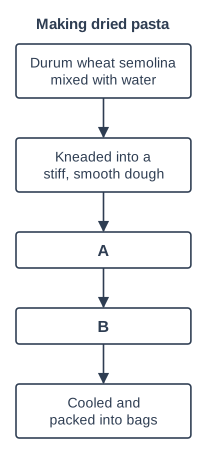
The flow chart shows how a factory makes dried pasta shapes.

Name the processes at stages A and B.

Then explain how stage B changes the texture of the pasta and the way it must be cooked.

Making dried pasta. Flow chart of 5 boxes joined by arrows, read from top to bottom. The first box is "Durum wheat semolina mixed with water", which leads to "Kneaded into a stiff, smooth dough", which leads to box A, which leads to box B, which leads to "Cooled and packed into bags".

Model answer

Stage A is extrusion: the dough is forced through a shaped metal die and cut to length. Stage B is drying, slowly in warm air.

Drying removes most of the water, so the pasta becomes hard and brittle and keeps its shape. It must therefore be boiled for longer than fresh pasta, about 10-12 minutes instead of 2-4 minutes, so that it can absorb water and soften.

Explanation

Dried pasta is made by mixing durum wheat semolina with water, shaping the stiff dough by extrusion and then drying it slowly until only about 12% water is left. This makes it hard and brittle, so it keeps its shape in the packet but needs a long boil to take up water again. A common mistake is to name stage B as baking or cooking rather than drying.

Mark scheme
  1. 1 mark

    stage A: extrusion / the dough is forced (pushed) through a shaped metal die and cut to length

    Award 1 mark per valid point or 2 marks for each point that is clearly explained. Accept 'shaping' or 'moulding' for stage A, and 'rolled into sheets and cut into shapes'. Do not credit 'cooking', 'boiling' or 'kneading' for stage A.

  2. 1 mark

    stage B: drying (slowly, in warm air) / dehydrating

    Do not credit 'baking', 'cooling' or 'freezing' for stage B.

  3. 1 mark

    drying removes most of the water (to about 12%), so the pasta becomes hard, brittle and rigid / keeps its shape

    Do not credit 'the pasta is dry' without saying how its texture changes.

  4. 1 mark

    so it must be boiled for longer than fresh pasta (about 10-12 minutes, compared with 2-4 minutes for fresh pasta) so that it can absorb water and soften (rehydrate)

    Accept any sensible times that show dried pasta takes clearly longer. Also credit: dried pasta absorbs water and swells as it cooks, roughly doubling in weight; cooked dried pasta has a firmer bite than fresh egg pasta. Any other relevant and correct response can be credited.

Question 4

6 marks

A fishing boat spends five days at sea catching cod. The cod are then sold at a fishing port to a processor, which supplies fishmongers.

Explain why each of these primary processing stages is carried out:
- the cod are gutted and washed on board soon after they are caught
- the cod are packed in crushed ice in the boat's hold
- the processor fillets and skins the cod.

Do not repeat your answers.

Model answer

Gutting removes the guts, which contain large numbers of bacteria and digestive enzymes. If they were left in, the bacteria and enzymes would spread into the flesh and start to break it down, so gutting soon after catching keeps the cod fresh for longer. Washing removes blood, slime and bacteria.

Packing in crushed ice keeps the cod at about 0 °C. This slows the growth of bacteria and the action of enzymes, so the fish does not spoil during the five days at sea, and the melting ice keeps it moist.

Filleting and skinning removes the bones, head and skin, so the fish is ready to cook and convenient for customers. The fillets can be cut into even portions and sold at a higher price, and the bones and heads can be used for fish stock or fishmeal.

Explanation

Each stage earns a mark for what it does and a second mark for why that matters, such as slowing bacteria and enzymes so that the fish stays fresh, or making it convenient for the consumer. Fish spoils very quickly, so the primary processing on the boat is mainly about removing sources of bacteria and enzymes and keeping the fish cold. A common mistake is to write 'to keep it fresh' for every stage without explaining how.

Mark scheme
  1. 1 mark

    gutting removes the guts, which contain large numbers of bacteria and digestive enzymes

    Award 1 mark per valid point or 2 marks for each point that is clearly explained. A maximum of two marks can be awarded for each stage. Answers should not be repeated. Do not credit 'to keep it fresh' or 'for hygiene' on their own, without saying how.

  2. 1 mark

    which would quickly spread into and break down (spoil) the flesh, so gutting soon after catching keeps the fish fresh and safe for longer; washing removes blood, slime and bacteria from the surface

  3. 1 mark

    the ice keeps the fish very cold, at about 0 °C

    Do not credit 'ice kills bacteria': chilling slows bacteria but does not kill them.

  4. 1 mark

    which slows the growth of bacteria and the action of enzymes, so the fish does not spoil (or smell) during the five days at sea; the melting ice also keeps the fish moist and washes away slime

    Also credit: fish is a high-risk food and the ice keeps it well below 5 °C, out of the danger zone.

  5. 1 mark

    filleting and skinning removes the bones, head and skin

  6. 1 mark

    so the fish is boneless and ready to cook, which is convenient and quick for consumers and fishmongers / the fish can be cut into even portions and sold at a higher price; the bones and heads can be used to make stock or fishmeal

    Also credit: removing bones makes the fish safer to eat, especially for young children; fillets are lighter and take up less space to transport. Any other relevant and correct response can be credited.

Ready to try the rest? Every answer you write is marked against the mark scheme, so you can see exactly where the marks are.

Study Helper Hints first, answers after you try

Stuck on this one? Ask for a hint and I’ll point you in the right direction, without giving the answer away. Once you’ve checked your answer, I’ll show you how the marks are awarded.