
Level:
Correct: 0
Incorrect: 0
Marks: 0/0
Exam Practice
Course:
Topics:
AQA GCSE Food Preparation and Nutrition Smart practice A mixed round aimed at your weak spots
Unit 1
Food preparation skills
Unit 2
Food, nutrition and health
Unit 3
Food science
Unit 4
Food safety
Unit 5
Food choice
Unit 6
Food provenance
Avg
score:
–
Topics
done:
0/37

Food labelling and marketing influences

Practise 22 exam-style questions on Food labelling and marketing influences for AQA GCSE Food Preparation and Nutrition. Write your answer as you would in the exam and get it marked in seconds against the mark scheme, point by point, with the Study Helper on hand if you get stuck.

  • 22 questions
  • 1–12 marks each
  • Instant marking
  • No sign-up needed
20 questions, marked as you go

Sample questions with model answers

Here are 4 of the questions in this topic, each with a model answer, an explanation of why it earns the marks and the mark scheme an examiner would use.

Question 1

1 mark

UK law requires a nutrition declaration on most prepacked foods.

Which of these must always be included in the nutrition declaration?

Choose your answer.

  • Fibre
  • Calcium
  • Salt
  • Cholesterol

Model answer

Salt

Explanation

The mandatory nutrition declaration is energy plus six nutrients: fat, saturates, carbohydrate, sugars, protein and salt. Fibre is the common wrong answer because many labels show it, but it is added voluntarily. Calcium is voluntary too, and may only be declared when the food contains a significant amount of it.

Mark scheme
  1. 1 mark

    Salt

    If more than one option is given, 0 marks. The nutrition declaration must give energy (kJ and kcal), fat, saturates, carbohydrate, sugars, protein and salt per 100 g or 100 ml. Fibre is often shown but is voluntary; vitamins and minerals such as calcium may be added voluntarily; cholesterol is not part of the declaration.
Question 2

3 marks

Explain the term 'provenance' when it is used on food labels.

Support your answer with two examples.

Model answer

Provenance means where a food comes from: where it was grown, reared, caught or made. For example, a pack of steak may say 'British beef', and a pasty may be labelled as a Cornish pasty, a protected name that tells you it was made in Cornwall.

Explanation

Provenance tells consumers the origin of a food, which some people use to support local farmers, reduce food miles or judge quality. The first mark is for a clear definition and the other two are for specific examples of origin. A common mistake is to confuse provenance with the shop where the food was bought.

Mark scheme
  1. 1 mark

    Definition: provenance is where a food comes from / where it was grown, reared, caught or made (its origin and history)

    Award 1 mark for a definition and 2 marks for relevant examples. Do not credit 'where you buy the food' or 'the shop it comes from'. Credit any two different examples; both may come from the same category below (e.g. 'British beef' and 'Cornish potatoes').

  2. 1 mark

    Example: a named country or region where the food was produced, e.g. 'British beef', 'Welsh lamb', 'Scottish salmon', 'grown in Kent', 'made with British milk'

  3. 1 mark

    Example: a named farm, producer or estate, e.g. 'eggs from our farm in Devon'

  4. 1 mark

    Example: a protected regional food name linked to a place, e.g. Cornish pasty, Melton Mowbray pork pie, Stilton cheese, Jersey Royal potatoes

  5. 1 mark

    Example: where fish was caught, e.g. 'line-caught in the North Atlantic', or a farm assurance logo showing the food can be traced back to the farm

    max 3 (1 definition + 2 examples). Any other relevant and correct response can be credited.

Question 3

4 marks

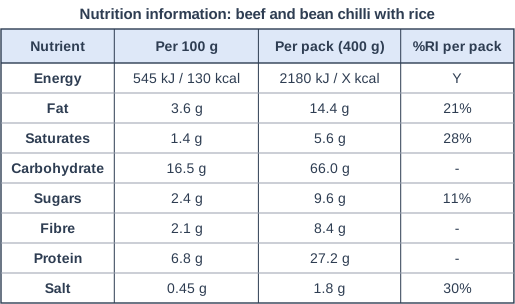
The table shows the nutrition information on the label of a 400 g pack of beef and bean chilli with rice. The pack is one portion. Two values are missing, X and Y.

Amount per pack = amount per 100 g × weight of pack ÷ 100
Percentage of reference intake (%RI) = amount per pack ÷ reference intake × 100
The adult reference intake for energy is 2,000 kcal.

Calculate X, the energy in kcal in one pack, and Y, the %RI for energy in one pack. Show your working.

Nutrition information: beef and bean chilli with rice. Table with columns "Nutrient", "Per 100 g", "Per pack (400 g)", "%RI per pack". Nutrient: Energy; Per 100 g: 545 kJ / 130 kcal; Per pack (400 g): 2180 kJ / X kcal; %RI per pack: Y | Nutrient: Fat; Per 100 g: 3.6 g; Per pack (400 g): 14.4 g; %RI per pack: 21% | Nutrient: Saturates; Per 100 g: 1.4 g; Per pack (400 g): 5.6 g; %RI per pack: 28% | Nutrient: Carbohydrate; Per 100 g: 16.5 g; Per pack (400 g): 66.0 g; %RI per pack: - | Nutrient: Sugars; Per 100 g: 2.4 g; Per pack (400 g): 9.6 g; %RI per pack: 11% | Nutrient: Fibre; Per 100 g: 2.1 g; Per pack (400 g): 8.4 g; %RI per pack: - | Nutrient: Protein; Per 100 g: 6.8 g; Per pack (400 g): 27.2 g; %RI per pack: - | Nutrient: Salt; Per 100 g: 0.45 g; Per pack (400 g): 1.8 g; %RI per pack: 30%.

Model answer

X = 130 × 400 ÷ 100 = 520 kcal
Y = 520 ÷ 2000 × 100 = 26%

Explanation

Values per 100 g are scaled to the 400 g pack by multiplying by 4, giving 520 kcal, and this is then compared with the 2,000 kcal reference intake. One pack provides 26% of an average adult's daily energy, about a quarter, which is reasonable for a main meal. A common mistake is to use the value per 100 g (130 kcal) to work out the %RI for the whole pack.

Mark scheme
  1. 1 mark

    X: 130 × 400 ÷ 100 / 130 × 4

    Award full marks for the correct answer with or without working.

  2. 1 mark

    X = 520 kcal

    Accept 521 kcal (2180 ÷ 4.184) or 519 kcal (2180 ÷ 4.2) if worked out from the energy in kJ.

  3. 1 mark

    Y: 520 ÷ 2000 × 100 (ecf their X ÷ 2000 × 100)

    ecf: credit a correct method using the student's own value of X. Also credit 2180 ÷ 8400 × 100 (using kJ and the 8,400 kJ reference intake).

  4. 1 mark

    Y = 26%

    Accept 25.9% to 26.1% (e.g. 25.95% or 26.0%). ecf from an incorrect X, e.g. X = 130 kcal gives Y = 6.5%. Do not credit Y worked out from the value per 100 g unless X was given as 130 kcal.

Question 4

6 marks

Many teenagers see food on social media every day. This includes recipe videos, posts by food influencers (some of whom are paid by food companies to promote products) and adverts that appear in their feeds.

Discuss how social media can influence the food choices of teenagers. Include both positive and negative influences.

Model answer

Social media can have a negative influence because food brands target teenagers with adverts and posts based on what they watch and like. Paid online adverts for less healthy foods have been restricted in the UK since January 2026, but brand adverts and brands' own posts still feature fast food, sugary drinks and snacks, and seeing them again and again makes teenagers more likely to buy them. Influencers are trusted by their followers, so when they are paid to promote a product it seems popular and fashionable, and teenagers may not realise it is really an advert. Viral trends, such as limited-edition sweets or giant milkshakes, create pressure to try them, and discount codes and links to delivery apps make buying quick. Some influencers also give diet advice without any qualifications, which could lead teenagers to cut out whole food groups.

However, social media can also be positive. Recipe videos can inspire teenagers to cook meals from scratch, learn new skills and try foods from other cuisines. Health campaigns share messages such as eating 5 A Day and cutting down on sugary drinks, and cheap recipe ideas help teenagers who are starting to cook for themselves.

Overall, the influence depends on the content teenagers follow and whether they check what they see against reliable sources, such as the NHS, and against food labels.

Explanation

Top-level answers give a balance of positive and negative influences and explain how each one changes what teenagers choose, for example by linking targeted adverts to more high-sugar foods being bought. They use specific examples, such as paid influencers, viral trends or recipe videos. A common weakness is a one-sided answer, or a list of types of social media with no explanation of their effect on food choice.

Mark scheme
  1. 6 marks

    Levels of response (6 marks). AO2.
    Level 3 (5-6 marks): Responses show very good knowledge and understanding of media influences on food choice, including advertising on social media. Detailed and factual explanations related to the positive and negative ways social media can influence teenagers' food choices.
    Level 2 (3-4 marks): Responses show good knowledge and understanding of media influences on food choice, including advertising on social media. Factual explanations, some of which relate to the positive and negative ways social media can influence teenagers' food choices.
    Level 1 (1-2 marks): Responses show limited knowledge and understanding of media influences on food choice, including advertising on social media. Limited explanation related to the positive and negative ways social media can influence teenagers' food choices.
    0 marks: nothing to reward.

    Indicative content (not a checklist; credit other valid points): Negative influences: food brands target teenagers with adverts and posts based on what they watch, like and search for; since January 2026 UK law has restricted paid-for online adverts for less healthy (high fat, salt or sugar) food and drink, but brand adverts, brands' own posts and shared videos still keep fast food, sugary drinks, sweets and snacks in teenagers' feeds (credit students who refer to these restrictions); influencers are trusted and feel like friends, so a paid promotion makes a product seem popular and teenagers may not realise it is an advert; viral food trends and challenges (e.g. giant milkshakes, extreme spicy snacks, limited-edition sweets) create pressure to try them and use up pocket money; seeing a product again and again makes it familiar and more likely to be bought; discount codes, competitions and links to delivery apps make buying quick and easy; food may be chosen because it looks good in photos rather than for its nutritional value; advice from unqualified people may promote cutting out food groups or buying unnecessary supplements, leading to an unbalanced diet. Positive influences: recipe videos can inspire teenagers to cook from scratch and learn practical skills; they can encourage trying new foods, international cuisines, more fruit and vegetables or plant-based meals; health campaigns (e.g. from the NHS) share messages such as 5 A Day and cutting down on sugar; budget recipes and tips on reducing food waste help students and families; content about local, seasonal, fairtrade or sustainable food can encourage ethical choices; reviews and comparisons can help teenagers choose products. Better answers note that the effect depends on the content and on whether teenagers check information against reliable sources and food labels. Any other relevant and correct response can be credited.

Ready to try the rest? Every answer you write is marked against the mark scheme, so you can see exactly where the marks are.

Study Helper Hints first, answers after you try

Stuck on this one? Ask for a hint and I’ll point you in the right direction, without giving the answer away. Once you’ve checked your answer, I’ll show you how the marks are awarded.