Level:
Correct: 0
Incorrect: 0
Marks: 0/0
Exam Practice
Course:
Topics:
AQA GCSE Food Preparation and Nutrition Smart practice A mixed round aimed at your weak spots
Unit 1
Food preparation skills
Unit 2
Food, nutrition and health
Unit 3
Food science
Unit 4
Food safety
Unit 5
Food choice
Unit 6
Food provenance
Avg
score:
–
Topics
done:
0/37

Informed choices: current guidelines for a healthy diet

Practise 20 exam-style questions on Informed choices: current guidelines for a healthy diet for AQA GCSE Food Preparation and Nutrition. Write your answer as you would in the exam and get it marked in seconds against the mark scheme, point by point, with the Study Helper on hand if you get stuck.

  • 20 questions
  • 1–12 marks each
  • Instant marking
  • No sign-up needed
20 questions, marked as you go

Sample questions with model answers

Here are 4 of the questions in this topic, each with a model answer, an explanation of why it earns the marks and the mark scheme an examiner would use.

Question 1

1 mark

In the Eatwell Guide, foods such as chocolate, cakes, biscuits and crisps are shown outside the main circle of food groups.

What does the Eatwell Guide advise about these foods?

Choose your answer.

  • Cut them out of the diet completely
  • Eat a small amount of them every day
  • Eat them freely if you are physically active
  • Eat them less often and in small amounts

Model answer

Eat them less often and in small amounts

Explanation

Foods high in fat, salt and sugar sit outside the main guide because they are not needed for a balanced diet, so the advice is to have them less often and in small amounts. They do not have to be cut out completely, and they are not an everyday food. Being active does not make it healthy to eat them freely, because they still add saturated fat, sugar and salt.

Mark scheme
  1. 1 mark

    Eat them less often and in small amounts

    If more than one option is given, 0 marks.
Question 2

4 marks

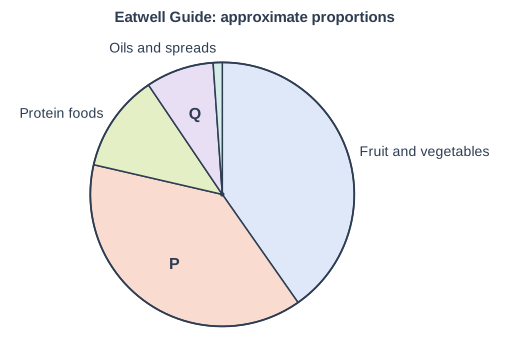
The pie chart shows the approximate proportions of the five main food groups in the Eatwell Guide. Two of the groups are labelled P and Q.

Name the food groups labelled P and Q. For each group, give one piece of Eatwell Guide advice about choosing foods from that group.

Eatwell Guide: approximate proportions. Pie chart. A circle divided into sectors, drawn clockwise from the top (12 o'clock): Fruit and vegetables, 145°; a sector labelled P, 138°; Protein foods, 43°; a sector labelled Q, 30°; Oils and spreads, 4°. (Angles are not printed on the chart; these are the drawn sizes, which can be measured with a protractor.)

Model answer

P is potatoes, bread, rice, pasta and other starchy carbohydrates. The advice is to choose wholegrain or higher-fibre versions, such as brown rice or wholemeal bread, with less added fat, salt and sugar. Q is dairy and alternatives. The advice is to choose lower-fat and lower-sugar options, such as semi-skimmed milk or plain lower-fat yoghurt.

Explanation

P is the second-largest segment, just over a third of the guide (about 37-38%, a little smaller than fruit and vegetables at about 39-40%), which is the starchy carbohydrate group; Q is the small segment (about 8%) for dairy and alternatives. The advice mark needs Eatwell advice that fits each group, such as higher-fibre starchy foods and lower-fat, lower-sugar dairy. A common mistake is to say 'eat less' of the starchy group, when the guide says to base meals on it.

Mark scheme
  1. 1 mark

    P: potatoes, bread, rice, pasta and other starchy carbohydrates / starchy foods / starchy carbohydrates

    Award 1 mark per valid point: 1 mark for naming each group and 1 mark for one piece of advice for each group. Accept 'carbohydrates', 'starch' or a list of starchy foods (bread, rice, potatoes, pasta). Do not credit 'sugars' or 'sugary foods'.

  2. 1 mark

    Advice for P: choose wholegrain / wholemeal / higher-fibre versions (e.g. brown rice, wholemeal bread) / leave the skins on potatoes / choose versions with less added fat, salt and sugar / base meals on these foods (just over a third of what we eat)

    The advice must suit group P, even if the group's name is wrong or missing. Accept 'they should make up just over a third of what we eat' or a proportion of about 37% or 38%. Do not credit 'eat less of them' or 'avoid carbohydrates'.

  3. 1 mark

    Q: dairy and alternatives / milk and dairy foods

    Accept 'dairy' or 'milk, cheese and yoghurt'. Do not credit 'calcium' or 'protein' (nutrients, not food groups).

  4. 1 mark

    Advice for Q: choose lower-fat and/or lower-sugar options (e.g. semi-skimmed or skimmed milk, reduced-fat cheese, plain lower-fat yoghurt) / choose unsweetened, calcium-fortified dairy alternatives (e.g. soya drinks) / have some dairy or dairy alternatives (such as soya drinks and yoghurts)

    The advice must suit group Q. Accept 'have some dairy, about 8% of what we eat'. Do not credit 'avoid dairy' or 'choose full-fat milk'. Any other relevant and correct response can be credited.

Question 3

4 marks

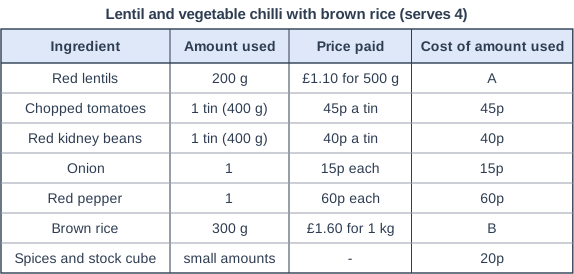
Amir is planning a lentil and vegetable chilli with brown rice for the four adults in his household. The table shows the ingredients, the prices he paid and the cost of the amount of each ingredient used. Two of the costs are shown as A and B.

Use: cost of amount used = (amount used ÷ pack size) × pack price.

Calculate the cost of one portion of the meal. Show your working.

Lentil and vegetable chilli with brown rice (serves 4). Table with columns "Ingredient", "Amount used", "Price paid", "Cost of amount used". Ingredient: Red lentils; Amount used: 200 g; Price paid: £1.10 for 500 g; Cost of amount used: A | Ingredient: Chopped tomatoes; Amount used: 1 tin (400 g); Price paid: 45p a tin; Cost of amount used: 45p | Ingredient: Red kidney beans; Amount used: 1 tin (400 g); Price paid: 40p a tin; Cost of amount used: 40p | Ingredient: Onion; Amount used: 1; Price paid: 15p each; Cost of amount used: 15p | Ingredient: Red pepper; Amount used: 1; Price paid: 60p each; Cost of amount used: 60p | Ingredient: Brown rice; Amount used: 300 g; Price paid: £1.60 for 1 kg; Cost of amount used: B | Ingredient: Spices and stock cube; Amount used: small amounts; Price paid: -; Cost of amount used: 20p.

Model answer

A = 200 ÷ 500 × £1.10 = £0.44
B = 300 ÷ 1000 × £1.60 = £0.48
Total = £0.44 + £0.45 + £0.40 + £0.15 + £0.60 + £0.48 + £0.20 = £2.72
Cost per portion = £2.72 ÷ 4 = £0.68 (68p)

Explanation

Only part of each pack is used, so the cost of the amount used is the fraction of the pack used multiplied by the pack price: two fifths of £1.10 for the lentils and three tenths of £1.60 for the rice. Add every cost to get £2.72, then divide by the four portions to get 68p. Common mistakes are adding the full pack prices, forgetting to divide by the number of portions, and writing the answer with the wrong unit, such as '£68'.

Mark scheme
  1. 1 mark

    A: 200 ÷ 500 × £1.10 = 44p (£0.44)

    Award 1 mark for each correct step. Award full marks for the correct answer with or without working. Accept equivalent methods, e.g. £1.10 ÷ 5 × 2 = 44p.

  2. 1 mark

    B: 300 ÷ 1000 × £1.60 = 48p (£0.48)

    Accept £1.60 × 0.3 = 48p.

  3. 1 mark

    total cost: 44p + 45p + 40p + 15p + 60p + 48p + 20p = £2.72

    ecf: allow a correct total using the student's own values of A and B. A total using the full pack prices of the lentils and rice (£4.50) scores 0 for A and B but 1 mark here if added correctly.

  4. 1 mark

    cost per portion: £2.72 ÷ 4 = 68p (£0.68)

    ecf: allow the student's total ÷ 4, given to the nearest penny. Accept 68p or £0.68. Do not credit '£68' or '0.68p'. Dividing by any number other than 4 scores 0 for this mark.

Question 4

6 marks

Kofi is 35 and drives a delivery van. On a typical working day he:
- skips breakfast
- buys a white baguette filled with bacon and cheese, a packet of crisps and a 500 ml bottle of cola from a petrol station for lunch
- drinks one glass of water during the whole day
- eats a large takeaway pizza for his evening meal
- does no physical activity.

Explain three changes Kofi could make so that his day follows the NHS eight tips for healthy eating.
Do not repeat your answers.

Model answer

1. Kofi should eat breakfast, such as porridge made with semi-skimmed milk and topped with a banana. This gives him energy and fibre for the morning and makes him less likely to snack, following the tip 'Do not skip breakfast'.
2. He should swap the cola for water or a sugar-free drink and drink 6-8 glasses of fluid through the day. A 500 ml bottle of cola contains a lot of free sugar, so this cuts his sugar intake and stops him getting thirsty.
3. He should get active, for example by taking a brisk walk in his lunch break or cycling after work. This uses more energy and helps him to be a healthy weight, as the tip 'Get active and be a healthy weight' advises.

Explanation

Each change must come from Kofi's day and be linked to one of the eight tips, with the reason it helps: this is what earns the second mark. Strong answers pick three different areas, for example breakfast, drinks and activity, rather than three food swaps that make the same point. Vague changes such as 'eat healthier food' earn nothing.

Mark scheme
  1. 1 mark

    swap the white baguette for wholemeal bread or a wholegrain wrap

    Award 1 mark per valid point or 2 marks for each point that is clearly explained. A maximum of two marks can be awarded for each change. Answers should not be repeated. max 6.

  2. 1 mark

    this is a higher-fibre starchy carbohydrate (following the tip to base meals on higher-fibre starchy carbohydrates) and keeps him full for longer

  3. 1 mark

    replace the bacon and cheese with a lower-fat filling, e.g. chicken, tuna, egg or hummus with salad

  4. 1 mark

    bacon and cheese are high in saturated fat and salt, so this follows the tips to cut down on saturated fat and eat less salt

  5. 1 mark

    swap the cola for water or a sugar-free drink and drink 6-8 glasses of fluid a day

  6. 1 mark

    the cola is high in free sugars, so this follows the tips to cut down on sugar and not get thirsty

    Accept 'the cola contains more sugar than the 30 g a day maximum'.

  7. 1 mark

    eat breakfast, e.g. porridge or wholegrain cereal with semi-skimmed milk and fruit

  8. 1 mark

    this gives energy and fibre for the morning and makes snacking less likely, following the tip 'Do not skip breakfast'

  9. 1 mark

    get active, e.g. a brisk walk in his lunch break, cycling or a sport after work

    Credit a reference to the NHS guideline of at least 150 minutes of moderate activity a week, but it is not required.

  10. 1 mark

    this uses more energy, helping him to be a healthy weight (following the tip 'Get active and be a healthy weight')

    Further creditable changes: swap the crisps for fruit or vegetable sticks (5 A Day, less salt and fat); have a homemade pizza with a wholemeal base, vegetable toppings and less cheese, or a smaller portion served with salad (less saturated fat and salt, more vegetables, less energy); have fish instead of the takeaway pizza on some evenings, aiming for two portions a week including one of oily fish such as salmon or mackerel; add salad to the baguette. Each change must be relevant to Kofi's day. Do not credit 'eat healthier food' or 'go on a diet'. Any other relevant and correct response can be credited.

Ready to try the rest? Every answer you write is marked against the mark scheme, so you can see exactly where the marks are.

Study Helper Hints first, answers after you try

Stuck on this one? Ask for a hint and I’ll point you in the right direction, without giving the answer away. Once you’ve checked your answer, I’ll show you how the marks are awarded.