
Level:
Correct: 0
Incorrect: 0
Marks: 0/0
Exam Practice
Course:
Topics:
AQA GCSE Food Preparation and Nutrition Smart practice A mixed round aimed at your weak spots
Unit 1
Food preparation skills
Unit 2
Food, nutrition and health
Unit 3
Food science
Unit 4
Food safety
Unit 5
Food choice
Unit 6
Food provenance
Avg
score:
–
Topics
done:
0/37

Food sources

Practise 20 exam-style questions on Food sources for AQA GCSE Food Preparation and Nutrition. Write your answer as you would in the exam and get it marked in seconds against the mark scheme, point by point, with the Study Helper on hand if you get stuck.

  • 20 questions
  • 1–12 marks each
  • Instant marking
  • No sign-up needed
20 questions, marked as you go

Sample questions with model answers

Here are 4 of the questions in this topic, each with a model answer, an explanation of why it earns the marks and the mark scheme an examiner would use.

Question 1

1 mark

In the UK, eggs can be sold as free range only if the hens

Choose your answer.

  • are kept in a large barn where they can move around freely indoors
  • are fed only on organic feed
  • live in enriched cages with a nest box and a perch
  • have continuous access to outdoor runs during the day

Model answer

have continuous access to outdoor runs during the day

Explanation

Free-range hens must be able to go outside during the day into runs that are mainly covered with vegetation, apart from times when disease-control rules, such as for bird flu, require birds to be kept inside. Hens that move freely inside a shed but never go outside are barn hens, and enriched cages are the most intensive system. Organic feed is a requirement for organic eggs, not for free-range eggs.

Mark scheme
  1. 1 mark

    have continuous access to outdoor runs during the day

    If more than one option is given, 0 marks.
Question 2

4 marks

Give four ways in which organic farming is different from conventional farming.

Model answer

1. Organic farmers do not use artificial fertilisers; they use manure and compost instead.
2. They do not spray crops with synthetic pesticides or weedkillers.
3. They rotate crops to keep the soil fertile and reduce pests.
4. Organic animals must be able to go outdoors, and they eat organic feed.

Explanation

Organic farming works with natural processes: manure, compost and crop rotation replace artificial fertilisers, and natural pest control replaces synthetic pesticides, while animals have outdoor access, organic feed and no routine antibiotics. Conventional farming may use artificial fertilisers and pesticides to get higher yields. A common mistake is to write 'no chemicals', which is too vague. 'No growth hormones' is credited, but hormone growth promoters are in fact banned in all UK farming, not just on organic farms.

Mark scheme
  1. 1 mark

    no artificial/synthetic fertilisers are used; soil is fed with manure/compost instead

    Award 1 mark per valid point. Max 4. Do not credit 'no chemicals' on its own: the answer must say which (fertilisers, pesticides, weedkillers). Do not credit 'healthier', 'more natural' or 'better quality' unless it is linked to a farming method. Also credit: organic processed foods may contain far fewer additives (no artificial colours or sweeteners); organic food must be inspected and certified by an approved body before it can be labelled organic; organic farms aim to encourage wildlife (e.g. keep hedgerows, use natural predators to control pests). Any other relevant and correct response can be credited.

  2. 1 mark

    synthetic/man-made pesticides and herbicides (weedkillers) are not used / only a few approved natural substances may be used; pests and weeds are controlled naturally, e.g. natural predators, hand or mechanical weeding

  3. 1 mark

    crops are rotated to keep the soil fertile and reduce pests and diseases (conventional farms may grow the same crop year after year)

  4. 1 mark

    GM crops/GM animal feed are not allowed

  5. 1 mark

    animals must have access to the outdoors / be free range / have more space

    Accept 'higher animal welfare standards' if a method is given, e.g. more space.

  6. 1 mark

    animals are given organic feed

  7. 1 mark

    antibiotics are not used routinely / only used to treat sick animals / growth hormones (growth promoters) are not allowed

    Credit antibiotics and growth hormones as one point only. Credit 'no growth hormones', as organic standards ban them, although hormone growth promoters are also banned in all UK farming.

Question 3

4 marks

A Year 10 class compared two samples of tomatoes in a rating test:
- Sample A: UK-grown tomatoes bought in August, when they are in season
- Sample B: imported tomatoes bought in January, when UK tomatoes are out of season.

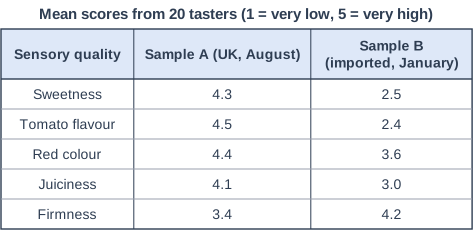
Twenty tasters rated each sample from 1 (very low) to 5 (very high). The table shows the mean scores.

Use the results to explain why the two samples were rated differently.

Mean scores from 20 tasters (1 = very low, 5 = very high). Table with columns "Sensory quality", "Sample A (UK, August)", "Sample B (imported, January)". Sensory quality: Sweetness; Sample A (UK, August): 4.3; Sample B (imported, January): 2.5 | Sensory quality: Tomato flavour; Sample A (UK, August): 4.5; Sample B (imported, January): 2.4 | Sensory quality: Red colour; Sample A (UK, August): 4.4; Sample B (imported, January): 3.6 | Sensory quality: Juiciness; Sample A (UK, August): 4.1; Sample B (imported, January): 3.0 | Sensory quality: Firmness; Sample A (UK, August): 3.4; Sample B (imported, January): 4.2.

Model answer

Sample A was much sweeter (4.3 compared with 2.5) and had more tomato flavour (4.5 compared with 2.4). In August, UK tomatoes are in season, so they can be left to ripen fully on the plant in the summer sun, which lets more natural sugars and flavour develop.

Sample B was firmer (4.2 compared with 3.4). Imported tomatoes are often picked before they are fully ripe so that they are firm enough to survive the long journey and storage without bruising. They finish ripening off the plant, so they are less sweet and less juicy.

Explanation

The results show a key advantage of seasonal food: produce that ripens fully on the plant and reaches the shop quickly has more flavour, sweetness and juiciness. Out-of-season imports are often picked before they are fully ripe so they last the journey, which makes them firmer but less flavoursome. Good answers quote the scores and give a reason for each difference; a common mistake is to say Sample A is 'fresher' or 'better quality' without linking it to the results.

Mark scheme
  1. 1 mark

    Sample A was sweeter and had more tomato flavour (4.3 and 4.5, compared with 2.5 and 2.4)

    Award 1 mark per valid point or 2 marks for each point that is clearly explained. Max 4. Each point mark needs a result from the table (the scores or a clear comparison, e.g. 'Sample B was firmer'). Also credit: Sample B may have been grown in winter with less sunlight, so less sugar and flavour developed; Sample B may be a variety chosen for a long shelf life rather than flavour; Sample B may have been kept chilled during transport and storage, which reduces tomato flavour. Do not credit 'Sample A is better quality' or 'fresher' unless it is linked to a result. Answers should not be repeated. Any other relevant and correct response can be credited.

  2. 1 mark

    because in-season tomatoes are left to ripen fully on the plant in summer sunshine, so more natural sugars and flavour develop

  3. 1 mark

    Sample B was firmer (4.2 compared with 3.4)

  4. 1 mark

    because imported tomatoes are often picked before they are fully ripe, so they are firm enough to survive a long journey and storage without bruising

  5. 1 mark

    Sample A was juicier and redder (4.1 and 4.4, compared with 3.0 and 3.6)

  6. 1 mark

    because it was sold soon after picking, so it had lost less moisture / Sample B may have ripened off the plant during transport and storage, so its colour did not fully develop

Question 4

6 marks

The Novak family are deciding whether to change from conventionally farmed food to organic food for their weekly food shop.

Explain the advantages and disadvantages for the family of buying organic food.

Model answer

Organic crops are grown without artificial fertilisers and with very few pesticides, which are mostly natural, so the family's fruit and vegetables would carry fewer pesticide residues. Organic animals must have outdoor access, more space and organic feed, and are not given antibiotics routinely, so if the Novaks care about animal welfare they would know the meat, eggs and milk came from well-treated animals. Organic farming does not allow GM crops or GM feed, and processed organic foods contain far fewer additives, such as no artificial colours. The food is certified, so the family can trust how it was produced.

However, organic food is usually much more expensive, because yields are lower, more labour is needed and the farmer pays for certification. On a weekly shop this could add a lot to the family's bill, and if money is tight they might end up buying fewer fruit and vegetables, which would be worse for their health. Some shops sell only a small range of organic foods, so they may not find everything they need. There is also no clear evidence that organic food is more nutritious, and conventional food is safe because pesticide residues are kept within legal limits, so the family could pay more without a nutritional benefit.

Explanation

Top-level answers explain why each advantage or disadvantage arises from organic farming methods and what it means for this family, such as their budget or their views on animal welfare. They cover both sides in detail. A common pitfall is to claim that organic food is healthier or more nutritious as a fact, or to list points such as 'more expensive' without explaining why.

Mark scheme
  1. 6 marks

    Levels of response (6 marks). AO2.
    Level 3 (5-6 marks): Responses show very good knowledge and understanding of organic and conventional farming methods. Detailed and factual explanations related to the advantages and disadvantages of organic food for the Novak family.
    Level 2 (3-4 marks): Responses show good knowledge and understanding of organic and conventional farming methods. Factual explanations, some of which relate to the advantages and disadvantages of organic food for the Novak family.
    Level 1 (1-2 marks): Responses show limited knowledge and understanding of organic and conventional farming methods. Limited explanation related to the advantages and disadvantages of organic food for the Novak family.
    0 marks: nothing to reward.

    Indicative content (not a checklist; credit other valid points): Advantages: crops are grown without artificial fertilisers and with very few, mostly natural, pesticides, so there are fewer pesticide residues on the food; higher animal welfare standards (outdoor access, more space, organic feed, no routine antibiotics), which matters if the family care about animal welfare; no GM crops or GM animal feed, for families who prefer to avoid GM; processed organic foods may contain far fewer additives (no artificial colours or sweeteners); some people find that organic food, such as slower-grown meat, has a better flavour; the food is inspected and certified, so the family know how it was produced; organic farms encourage wildlife and care for the soil (credit an environmental point). Disadvantages: organic food usually costs much more because yields are lower, more labour is needed (e.g. hand weeding), organic feed costs more and farms pay for certification; this could strain the family budget and might mean they buy fewer fruit and vegetables; less choice and availability in some shops; fruit and vegetables may look less uniform or have blemishes; some processed organic foods may have a shorter shelf life as fewer preservatives are allowed; there is no clear evidence that organic food is more nutritious, so the family may pay more without a nutritional benefit; conventional food is also safe, as pesticide residues are monitored and kept within legal limits; some organic food is imported, so it is not always local. Do not credit 'organic food is healthier' or 'more nutritious' stated as a fact. Top-level answers explain both advantages and disadvantages and relate them to the family, e.g. their budget and values.

Ready to try the rest? Every answer you write is marked against the mark scheme, so you can see exactly where the marks are.

Study Helper Hints first, answers after you try

Stuck on this one? Ask for a hint and I’ll point you in the right direction, without giving the answer away. Once you’ve checked your answer, I’ll show you how the marks are awarded.