Level:
Correct: 0
Incorrect: 0
Marks: 0/0
Exam Practice
Course:
Topics:
AQA GCSE Food Preparation and Nutrition Smart practice A mixed round aimed at your weak spots
Unit 1
Food preparation skills
Unit 2
Food, nutrition and health
Unit 3
Food science
Unit 4
Food safety
Unit 5
Food choice
Unit 6
Food provenance
Avg
score:
–
Topics
done:
0/37

Proteins: functional and chemical properties

Practise 20 exam-style questions on Proteins: functional and chemical properties for AQA GCSE Food Preparation and Nutrition. Write your answer as you would in the exam and get it marked in seconds against the mark scheme, point by point, with the Study Helper on hand if you get stuck.

  • 20 questions
  • 1–12 marks each
  • Instant marking
  • No sign-up needed
20 questions, marked as you go

Sample questions with model answers

Here are 4 of the questions in this topic, each with a model answer, an explanation of why it earns the marks and the mark scheme an examiner would use.

Question 1

1 mark

Ellie is whisking egg whites to make meringues.

Which of the following would stop the egg whites forming a stable foam?

Choose your answer.

  • Adding caster sugar a spoonful at a time
  • Adding a pinch of cream of tartar
  • Using egg whites at room temperature
  • A trace of egg yolk in the whites

Model answer

A trace of egg yolk in the whites

Explanation

Egg yolk contains fat, and even a trace of fat stops the egg-white proteins forming a film around the air bubbles, so the whites will not whisk up into a stable foam. Sugar added gradually and a little acid, such as cream of tartar, make the foam more stable, and whites at room temperature whisk to a larger volume. A common mistake is to think sugar stops a foam forming; added at the right time, it stabilises it.

Mark scheme
  1. 1 mark

    A trace of egg yolk in the whites

    If more than one option is given, 0 marks.

Question 2

3 marks

Explain the term coagulation.

You should support your answer with two examples of coagulation in food preparation.

Model answer

Coagulation is the setting of protein. When proteins are heated, or treated with acid, they denature and then join together and set, changing from a liquid to a solid, and the change cannot be reversed. For example, egg white sets and turns white when an egg is fried, and the egg mixture in a quiche sets in the oven.

Explanation

The definition mark needs the idea of protein setting after it has been denatured; saying it is irreversible strengthens it. The two examples must be different foods in which protein sets, such as eggs, meat, fish or a quiche filling. A common mistake is to describe gelatinisation, which is the thickening of liquid by starch, not the setting of protein.

Mark scheme
  1. 1 mark

    definition: the setting of protein / proteins that have been denatured (by heat, acid or mechanical action) join together and set, changing from a liquid or semi-liquid to a solid or semi-solid / it cannot be reversed (irreversible)

    Award 1 mark for a definition and 2 marks for relevant examples. The definition must refer to protein setting or to denatured proteins joining together. Do not credit 'when food goes solid' or 'when protein cooks' alone, and do not credit a description of gelatinisation (starch).

  2. 1 mark

    a first relevant example, eg egg white sets and turns white when an egg is fried, poached or boiled

  3. 1 mark

    a second, different example, eg a quiche filling or egg custard sets in the oven / meat or fish becomes firm and opaque when it is cooked / egg binds burgers or fishcakes / egg wash sets as a shiny glaze on pastry / an egg and breadcrumb coating sets / acid or rennet sets milk protein into curds (cheese, paneer) / gluten sets when a dough is baked / a whisked egg foam sets in a meringue or sponge

    Each example must name a food or dish in which protein sets. The same food cooked in two ways counts once (eg a fried egg and a boiled egg). Any other relevant and correct response can be credited.

Question 3

4 marks

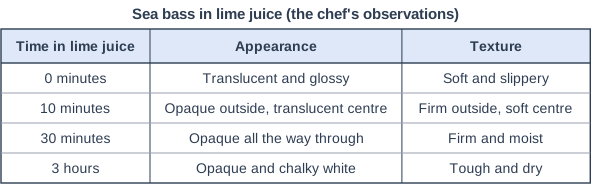
A restaurant chef makes ceviche by leaving 2 cm cubes of very fresh, raw sea bass in lime juice in the fridge. The fish has been frozen beforehand to kill any parasites, and it is not heated. The chef recorded how the fish changed over time. The table shows the chef's observations.

Using the table, explain the changes in the fish.

Sea bass in lime juice (the chef's observations). Table with columns "Time in lime juice", "Appearance", "Texture". Time in lime juice: 0 minutes; Appearance: Translucent and glossy; Texture: Soft and slippery | Time in lime juice: 10 minutes; Appearance: Opaque outside, translucent centre; Texture: Firm outside, soft centre | Time in lime juice: 30 minutes; Appearance: Opaque all the way through; Texture: Firm and moist | Time in lime juice: 3 hours; Appearance: Opaque and chalky white; Texture: Tough and dry.

Model answer

Lime juice contains citric acid, which denatures the proteins in the fish, so their structure unfolds. The unfolded proteins then join together and coagulate, so the fish turns from translucent and soft to opaque and firm, like cooked fish, even though it has not been heated. The acid works from the outside of each cube inwards, so after 10 minutes only the outer proteins have coagulated: the outside is opaque and firm, but the centre is still translucent and soft. By 30 minutes the acid has reached the centre, so the fish is opaque all the way through. After 3 hours the proteins have been denatured too much; they tighten and squeeze out water, so the fish becomes tough, dry and chalky, like overcooked fish. Although the fish looks cooked, the acid has not made it safe in the way that heat would.

Explanation

Acid denatures protein just as heat does, so the fish sets from the outside in, and marinating for too long has the same effect as overcooking. Top answers link the times in the table to what is happening to the proteins. A common mistake is to say the acid 'cooks' the fish and makes it safe: the acid changes the proteins but does not reliably kill bacteria or parasites, so the fish is still raw for food safety purposes and must be very fresh, frozen first to kill parasites and kept chilled.

Mark scheme
  1. 1 mark

    lime juice contains (citric) acid, which denatures / unfolds the proteins in the fish

    Award 1 mark per valid point or 2 marks for each point that is clearly explained. max 4. An answer that does not refer to the times or observations in the table can score a maximum of 3 marks. Do not credit 'the acid cooks the fish' unless denaturing or coagulating the protein is mentioned.

  2. 1 mark

    the unfolded proteins join together and coagulate (set), so the fish turns from translucent and soft to opaque and firm, like cooked fish, without being heated

  3. 1 mark

    the acid works from the outside of each cube inwards / takes time to reach the centre

  4. 1 mark

    so at 10 minutes only the outer proteins have coagulated (opaque and firm outside, translucent and soft centre), and by 30 minutes the acid has reached the centre, so the fish is opaque all the way through

  5. 1 mark

    after 3 hours the proteins have been denatured too much / over-coagulated, so they tighten and squeeze out water

  6. 1 mark

    making the fish tough, dry and chalky, like overcooked fish

    Do not credit food safety claims such as 'the acid kills the bacteria' or 'the fish is now cooked and safe to eat': the acid denatures the proteins so the fish looks cooked, but it does not reliably kill bacteria or parasites, so it does not make raw fish safe in the way that heat does, and these claims do not explain the changes. Any other relevant and correct response can be credited.

Question 4

6 marks

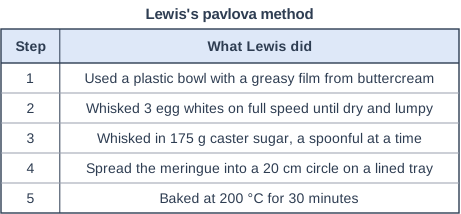
Lewis made a pavlova. The table shows his method. The baked pavlova had three problems:
- it had a small volume
- it had a grainy, lumpy texture
- it was brown and cracked, with sticky beads of syrup on its surface.

For each problem, identify the step in Lewis's method that caused it, and explain how that step caused the problem. Use your knowledge of egg-white foams.

Do not repeat your answers.

Lewis's pavlova method. Table with columns "Step", "What Lewis did". Step: 1; What Lewis did: Used a plastic bowl with a greasy film from buttercream | Step: 2; What Lewis did: Whisked 3 egg whites on full speed until dry and lumpy | Step: 3; What Lewis did: Whisked in 175 g caster sugar, a spoonful at a time | Step: 4; What Lewis did: Spread the meringue into a 20 cm circle on a lined tray | Step: 5; What Lewis did: Baked at 200 °C for 30 minutes.

Model answer

Small volume: step 1. The greasy film of buttercream left in the plastic bowl is a fat. Fat stops the unfolded egg-white proteins linking together to form a film around the air bubbles, so the bubbles burst and little air is trapped.

Grainy, lumpy texture: step 2. Whisking on full speed until the whites were dry and lumpy over-whisked them. The proteins were denatured too much and bonded too tightly, so the film around the bubbles became stiff and broke, and the foam separated into lumps that the sugar could not be whisked into smoothly.

Brown and cracked, with beads of syrup: step 5. 200 °C is far too hot; meringue should be dried slowly at about 120 °C. The egg-white proteins coagulated too quickly and too much, so they shrank and squeezed out water containing dissolved sugar, which formed sticky beads of syrup. The outside set quickly and cracked as the air inside expanded, and the sugar caramelised, turning the meringue brown.

Explanation

Each problem is worth up to two marks: one for identifying the step that caused it and one for explaining how it affected the egg-white proteins, the air or the sugar. Strong answers use the science of foams (proteins forming a film around air bubbles, over-denaturing, over-coagulation and syneresis) rather than just saying what Lewis should have done. A common mistake is to blame step 3, where the sugar was in fact added correctly, or to repeat 'not enough air' for every problem without explaining why.

Mark scheme
  1. 1 mark

    small volume: step 1 / the greasy film (fat) from the buttercream in the plastic bowl

    Award 1 mark per valid point or 2 marks for each point that is clearly explained. A maximum of two marks can be awarded for each problem. Answers should not be repeated. For each problem, the first mark is for identifying the step or what was wrong with it; the second mark needs the effect on the proteins, the air or the sugar, linked to that problem. Also credit step 2 as the cause of the small volume (an over-whisked foam loses air), but the same explanation cannot be credited for two problems. Do not credit step 3 or step 4 as a cause: the sugar was added correctly and spreading the meringue did not cause these problems. Also credit for step 1: plastic bowls can hold a film of grease even after washing, so a clean, grease-free glass or metal bowl should be used.

  2. 1 mark

    fat stops the unfolded egg-white proteins linking together to form a film around the air bubbles, so the bubbles burst and little air is trapped

  3. 1 mark

    grainy, lumpy texture: step 2 / the whites were over-whisked until dry and lumpy before the sugar was added

  4. 1 mark

    the proteins were denatured too much / bonded too tightly, so the film around the bubbles became stiff and broke and the foam separated into lumps / the sugar could not be whisked in smoothly

  5. 1 mark

    brown, cracked, beads of syrup: step 5 / 200 °C is far too hot for meringue, which should be dried slowly at a low temperature (about 100-140 °C)

    Accept any low oven temperature from about 100 °C to 150 °C.

  6. 1 mark

    the egg-white proteins coagulated too quickly and too much, shrank and squeezed out water containing dissolved sugar as sticky beads of syrup (syneresis) / the outside set and cracked as the air inside expanded / the sugar caramelised and turned brown

    Credit any one of these effects for the second mark for this problem. Any other relevant and correct response can be credited.

Ready to try the rest? Every answer you write is marked against the mark scheme, so you can see exactly where the marks are.

Study Helper Hints first, answers after you try

Stuck on this one? Ask for a hint and I’ll point you in the right direction, without giving the answer away. Once you’ve checked your answer, I’ll show you how the marks are awarded.