Many people think of microorganisms in food only as a cause of food poisoning and spoilage. However, bacteria, yeasts and moulds are also used on purpose to make foods.
Explain how bacteria, yeasts and moulds are each used in food production. Use a different food as an example for each type of microorganism.
Model answer
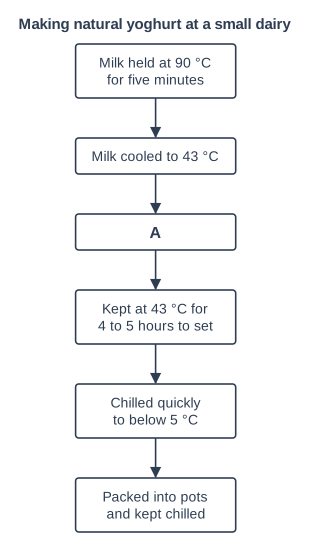
Bacteria are used to make natural yoghurt. A starter culture of lactic acid bacteria is added to heat-treated milk that has been cooled to about 43 °C, and the milk is kept warm for about 4-6 hours. The bacteria ferment lactose, the sugar in milk, into lactic acid, so the pH falls to about 4.6. The acid makes the milk proteins coagulate, so the yoghurt thickens and sets, and it gives a sharp flavour and helps to preserve it. The yoghurt is then chilled to slow the bacteria down.
Yeast, a single-celled fungus, is used to make bread rise. Given warmth, moisture, food and time, it ferments sugars in the dough to produce carbon dioxide and alcohol. The carbon dioxide is trapped by the gluten, so the dough rises, and fermentation also develops flavour. In the oven the yeast is killed at about 60 °C and the alcohol evaporates.
A mould is used to make blue cheese such as Stilton. Mould spores are added to the milk, and the ripening cheese is pierced with stainless steel needles so that air can reach the inside. The mould needs oxygen, so it grows along the channels, forming blue veins, and it breaks down fat and protein to give a strong flavour and creamy texture.
Explanation
Level 3 answers cover all three types of microorganism, each with a correct food and a clear explanation of what the microorganism does and the conditions it needs. Weaker answers simply list foods ('yoghurt uses bacteria') without explaining the changes, or describe only one type in detail. A common mistake is to say the mould in blue cheese makes it rise or that yeast is used to make yoghurt.