Level:
Correct: 0
Incorrect: 0
Marks: 0/0
Exam Practice
Course:
Topics:
AQA GCSE Food Preparation and Nutrition Smart practice A mixed round aimed at your weak spots
Unit 1
Food preparation skills
Unit 2
Food, nutrition and health
Unit 3
Food science
Unit 4
Food safety
Unit 5
Food choice
Unit 6
Food provenance
Avg
score:
–
Topics
done:
0/37

Preparing, cooking and serving food

Practise 20 exam-style questions on Preparing, cooking and serving food for AQA GCSE Food Preparation and Nutrition. Write your answer as you would in the exam and get it marked in seconds against the mark scheme, point by point, with the Study Helper on hand if you get stuck.

  • 20 questions
  • 1–12 marks each
  • Instant marking
  • No sign-up needed
20 questions, marked as you go

Sample questions with model answers

Here are 4 of the questions in this topic, each with a model answer, an explanation of why it earns the marks and the mark scheme an examiner would use.

Question 1

1 mark

Ravi is roasting a pork shoulder joint on the bone. He uses a temperature probe to check that it is cooked.

Where should he put the tip of the probe?

Choose your answer.

  • Touching the bone
  • Just under the crackling
  • In the juices in the tin
  • In the thickest part, away from the bone

Model answer

In the thickest part, away from the bone

Explanation

The thickest part of the joint heats up last, so if it has reached 75 °C the rest of the meat will have too. The bone, the surface and the hot juices in the tin heat up faster than the meat, so a probe touching them gives a falsely high reading. The FSA advises that pork is cooked right through, not just on the outside, so the centre must be checked.

Mark scheme
  1. 1 mark

    In the thickest part, away from the bone

    If more than one option is given, 0 marks.
Question 2

3 marks

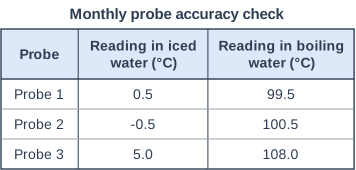
A school canteen checks its temperature probes every month by putting each probe in iced water and then in boiling water. The Food Standards Agency (FSA) advises that an accurate probe reads between -1 °C and 1 °C in iced water, and between 99 °C and 101 °C in boiling water.

The table shows this month's results.

Identify the probe that should not be used. Explain how using this probe to check reheated food could lead to food poisoning.

Monthly probe accuracy check. Table with columns "Probe", "Reading in iced water (°C)", "Reading in boiling water (°C)". Probe: Probe 1; Reading in iced water (°C): 0.5; Reading in boiling water (°C): 99.5 | Probe: Probe 2; Reading in iced water (°C): -0.5; Reading in boiling water (°C): 100.5 | Probe: Probe 3; Reading in iced water (°C): 5.0; Reading in boiling water (°C): 108.0.

Model answer

Probe 3 should not be used. Both of its readings are too high (5.0 °C in iced water and 108.0 °C in boiling water), so it shows a higher temperature than the food really is. Reheated food could show 75 °C on this probe when its core is several degrees cooler, so bacteria in the food may not be destroyed and could cause food poisoning.

Explanation

Probe 3 is the only probe outside both accepted ranges. Because it reads high, it gives false reassurance: food seems to have reached 75 °C when it has not. Good answers explain the direction of the error rather than just saying the probe is broken.

Mark scheme
  1. 1 mark

    Probe 3

    Award 1 mark per valid point: 1 mark for identifying Probe 3 and a maximum of two marks for the explanation. max 3.

  2. 1 mark

    it reads too high / shows a higher temperature than the real temperature (5.0 °C in iced water and 108.0 °C in boiling water, both above the ranges)

    Do not credit 'it is broken' or 'it is wrong' without saying how the readings are wrong.

  3. 1 mark

    so reheated food could show 75 °C when its core is really cooler, so it has not been heated enough to destroy bacteria

    Accept 82 °C (the reheating temperature required in Scotland) in place of 75 °C. Accept the FSA's equivalent core temperatures and times (70 °C for 2 minutes, 75 °C for 30 seconds, 80 °C for 6 seconds) wherever 75 °C is credited.

  4. 1 mark

    bacteria survive in the under-heated food and can multiply, causing food poisoning when it is eaten

    Any other relevant and correct response can be credited.

Question 3

4 marks

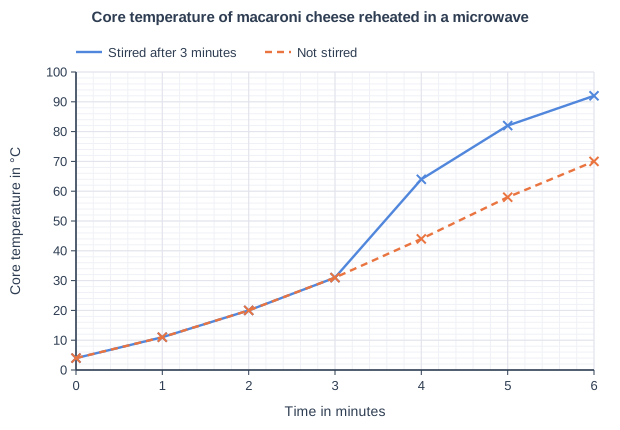
Imani reheated two identical chilled portions of macaroni cheese in a microwave oven. She stirred one portion straight after its 3-minute reading and did not stir the other. She measured the core temperature of each portion every minute with a clean probe.

The graph shows her results.

Use the graph to:
- state the core temperature of each portion after 5 minutes
- explain which portion was safe to eat after 5 minutes, and why stirring made a difference.

Core temperature of macaroni cheese reheated in a microwave. Line graph of core temperature in °C (y-axis, 0 to 100) against time in minutes (x-axis, 0 to 6). "Stirred after 3 minutes" joins the points (0, 4), (1, 11), (2, 20), (3, 31), (4, 64), (5, 82), (6, 92). "Not stirred" (dashed) joins the points (0, 4), (1, 11), (2, 20), (3, 31), (4, 44), (5, 58), (6, 70).

Model answer

After 5 minutes the stirred portion was 82 °C and the unstirred portion was 58 °C. Only the stirred portion was safe to eat, because its core had passed 75 °C, the reheating temperature that destroys bacteria; the unstirred portion was still in the danger zone, so bacteria could survive. Microwaves heat the outer edges first and leave cold spots in the centre. Stirring moved hot food from the edges into the middle so the heat spread evenly, which is why the stirred portion's core jumped from 31 °C to 64 °C in the minute after it was stirred.

Explanation

Read each value at 5 minutes on the time axis: 82 °C for the stirred portion and 58 °C for the unstirred one. The judgement must use the 75 °C reheating temperature, and the explanation should mention the uneven heating and cold spots in microwaved food. A common mistake is to say stirring 'makes the food hotter' rather than spreading the heat.

Mark scheme
  1. 1 mark

    stirred portion: 82 °C

    Award 1 mark per valid point: 1 mark for each correct temperature, and a maximum of two marks for the explanation. max 4. Accept 81-83 °C.

  2. 1 mark

    portion not stirred: 58 °C

    Accept 57-59 °C.

  3. 1 mark

    the stirred portion was safe because its core had reached at least 75 °C / the unstirred portion had not reached 75 °C and was still in the danger zone (5-63 °C), so bacteria could survive and multiply

    Accept reference to 82 °C (the reheating temperature in Scotland) for the stirred portion. Accept the FSA's equivalent core temperatures and times (70 °C for 2 minutes, 75 °C for 30 seconds, 80 °C for 6 seconds) wherever 75 °C is credited.

  4. 1 mark

    microwaves heat the outer edges of food first and leave cold spots in the centre; stirring moves hot food from the edges into the middle so the heat spreads evenly

    Credit use of the graph, e.g. the stirred portion's core rose from 31 °C to 64 °C in the minute after stirring, while the unstirred core rose only from 31 °C to 44 °C.

  5. 1 mark

    the unstirred portion should be stirred, heated for longer and checked again with the probe until the core reaches 75 °C

    Do not credit 'stirring makes it hotter' without explaining that it spreads the heat. Any other relevant and correct response can be credited. Accept the FSA's equivalent core temperatures and times (70 °C for 2 minutes, 75 °C for 30 seconds, 80 °C for 6 seconds) wherever 75 °C is credited.

Question 4

6 marks

The Okafor family is having a barbecue in the garden on a hot day. The menu is:
- raw pork sausages
- lamb kebabs (raw diced lamb on skewers)
- corn on the cob
- green salad and potato salad
- bread rolls.

Explain three food safety rules the family should follow when preparing, cooking and serving this food.
Do not repeat your answers.

Model answer

Rule 1: Use separate tongs and plates for raw and cooked meat. Otherwise bacteria from the raw sausages and lamb are carried onto the cooked meat, which will not be heated again before it is eaten.

Rule 2: Cook the sausages and kebabs until they are steaming hot all the way through, with no pink meat and clear juices, or check the centre reaches 75 °C with a clean probe. Mincing the sausage meat and pushing skewers through the lamb can carry bacteria from the surface into the middle, and a barbecue can blacken the outside while the middle is still raw.

Rule 3: Keep the potato salad and green salad in the fridge or a cool box until they are served. On a hot day they would sit in the danger zone, where bacteria multiply quickly, and potato salad made with mayonnaise is a high-risk food.

Explanation

Each rule earns one mark and its explanation a second, so three clearly explained rules gain full marks. The best answers cover different stages (preparing, cooking and serving) and link each rule to the barbecue foods. A common mistake is to repeat the same idea, such as 'cook the meat properly' twice, or to give health and safety rules about burns.

Mark scheme
  1. 1 mark

    use separate tongs/utensils and plates for raw and for cooked meat

    Award 1 mark per valid point or 2 marks for each point that is clearly explained. A maximum of two marks can be awarded for each rule. max 6. Answers should not be repeated.

  2. 1 mark

    so bacteria from the raw meat are not transferred to the cooked meat, which will not be heated again

  3. 1 mark

    cook the sausages and kebabs until steaming hot all the way through, with no pink meat and juices running clear / core at least 75 °C checked with a clean probe

    Accept 70 °C for 2 minutes, 75 °C for 30 seconds or 80 °C for 6 seconds. Do not credit 'cook the meat properly/thoroughly' without saying how this is checked.

  4. 1 mark

    because mincing the sausage meat and pushing skewers through the diced lamb can carry bacteria from the surface into the middle, and a barbecue can char the outside while the inside is still raw

  5. 1 mark

    pre-cook the sausages/kebabs in the oven and put them straight on the barbecue to finish / wait until the coals glow red with a powdery grey surface before cooking / turn the meat often

  6. 1 mark

    so the centre cooks thoroughly before the outside burns

  7. 1 mark

    keep the raw meat, potato salad and green salad in the fridge or a cool box until they are needed, and put leftovers back quickly

  8. 1 mark

    because on a hot day food left out is in the danger zone (5-63 °C), where bacteria multiply quickly; potato salad (cooked potato, often in mayonnaise) is a high-risk food

  9. 1 mark

    keep raw meat covered and away from the salads and bread rolls / wash hands after handling raw meat and before touching ready-to-eat food

    This point can earn a second mark when explained, e.g. bacteria from the raw meat would reach ready-to-eat food that will not be cooked.

  10. 1 mark

    cover food on the table to keep flies and other pests off

    This point can earn a second mark when explained, e.g. flies carry bacteria from waste onto food. Do not credit health and safety points (e.g. lighting the barbecue safely, burns). Any other relevant and correct response can be credited.

Ready to try the rest? Every answer you write is marked against the mark scheme, so you can see exactly where the marks are.

Study Helper Hints first, answers after you try

Stuck on this one? Ask for a hint and I’ll point you in the right direction, without giving the answer away. Once you’ve checked your answer, I’ll show you how the marks are awarded.