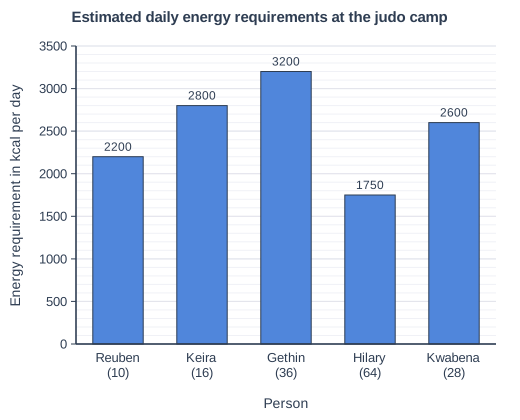
A judo club runs a two-day training camp in a sports hall. At lunchtime, volunteers serve wholewheat pasta with a chicken and tomato sauce, and a side salad. The bar chart shows the estimated daily energy requirement, on a camp day, of five people at the camp.
- Reuben (10) is a junior member who trains for two hours each day of the camp.
- Keira (16) is preparing for a national competition and trains for five hours each day.
- Gethin (36) is the head coach and is on the mat coaching and demonstrating all day.
- Hilary (64) is a volunteer who sits at the registration desk.
- Kwabena (28) is a club member who is recovering from a knee injury, so he is watching the sessions this weekend instead of training.
Explain how the portion sizes of the lunch should differ for these five people, and why.
Model answer
Each person's portion should match their energy requirement so that they stay in energy balance. Gethin needs the largest portion (3,200 kcal). As an adult man he is likely to have a large, muscular body and so a high BMR, and coaching on the mat all day gives him a high PAL. Keira needs the next largest portion (2,800 kcal) because training for five hours a day gives her a very high PAL and she is still growing. Her extra could be more pasta for starchy energy, with the chicken giving protein to repair her muscles. Kwabena still needs a fairly large portion (2,600 kcal) because, as a muscular young man, his BMR is high, but he is not training this weekend, so he should have less pasta than on a training day to avoid gaining weight. He still needs protein to help repair his knee. Reuben needs a child-sized portion (2,200 kcal) because his body is smaller, but it must give him enough energy for growth and training. Hilary needs the smallest portion (1,750 kcal) because her BMR has fallen with age and she sits at the desk all day, but it should still include chicken and salad for protein and vitamins. If everyone had the same portion, Hilary would gain weight while Gethin and Keira would lack energy.
Explanation
Top-level answers explain each portion using BMR (age, gender, body size and muscle), PAL and growth, and refer to the energy values in the chart, noticing that Kwabena still needs a fair amount of energy because his BMR is high even though his PAL has fallen. They also recognise that smaller portions must still be nutritious and that growing young people should not have their food restricted. Weak answers just rank the people by portion size without explaining why.