Level:
Correct: 0
Incorrect: 0
Marks: 0/0
Exam Practice
Course:
Topics:
AQA GCSE Food Preparation and Nutrition Smart practice A mixed round aimed at your weak spots
Unit 1
Food preparation skills
Unit 2
Food, nutrition and health
Unit 3
Food science
Unit 4
Food safety
Unit 5
Food choice
Unit 6
Food provenance
Avg
score:
–
Topics
done:
0/37

Macronutrients: protein

Practise 20 exam-style questions on Macronutrients: protein for AQA GCSE Food Preparation and Nutrition. Write your answer as you would in the exam and get it marked in seconds against the mark scheme, point by point, with the Study Helper on hand if you get stuck.

  • 20 questions
  • 1–12 marks each
  • Instant marking
  • No sign-up needed
20 questions, marked as you go

Sample questions with model answers

Here are 4 of the questions in this topic, each with a model answer, an explanation of why it earns the marks and the mark scheme an examiner would use.

Question 1

1 mark

Tofu is made by

Choose your answer.

  • curdling soya milk and pressing the curds
  • extruding soya flour and drying it
  • growing a fungus in fermentation tanks
  • washing the starch out of a wheat flour dough

Model answer

curdling soya milk and pressing the curds

Explanation

Tofu is made by adding a coagulant (such as calcium sulphate) to soya milk so that the soya protein forms curds, which are pressed into a block. The other options describe different protein alternatives: extruded and dried soya flour is textured vegetable protein (TVP), the fungus grown by fermentation is mycoprotein, and washing starch out of wheat dough makes seitan (wheat gluten).

Mark scheme
  1. 1 mark

    curdling soya milk and pressing the curds

    If more than one option is given, 0 marks.

Question 2

3 marks

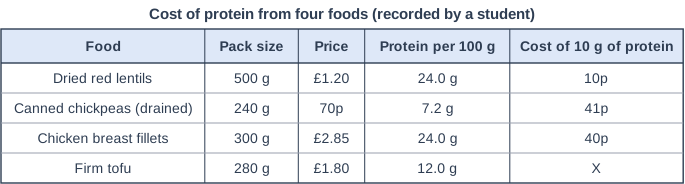
A student compared the cost of protein from four foods in a supermarket. The table shows the results.

Calculate the cost of 10 g of protein from the firm tofu (X in the table), rounded to the nearest penny.

Show your working.

Cost of protein from four foods (recorded by a student). Table with columns "Food", "Pack size", "Price", "Protein per 100 g", "Cost of 10 g of protein". Food: Dried red lentils; Pack size: 500 g; Price: £1.20; Protein per 100 g: 24.0 g; Cost of 10 g of protein: 10p | Food: Canned chickpeas (drained); Pack size: 240 g; Price: 70p; Protein per 100 g: 7.2 g; Cost of 10 g of protein: 41p | Food: Chicken breast fillets; Pack size: 300 g; Price: £2.85; Protein per 100 g: 24.0 g; Cost of 10 g of protein: 40p | Food: Firm tofu; Pack size: 280 g; Price: £1.80; Protein per 100 g: 12.0 g; Cost of 10 g of protein: X.

Model answer

Protein in the pack = 280 × 12.0 ÷ 100 = 33.6 g
Cost of 1 g of protein = 180p ÷ 33.6 = 5.36p
Cost of 10 g of protein = 5.36 × 10 = 53.6p
X = 54p

Explanation

Work out how much protein is in the whole pack first (33.6 g), then share the price between those grams and scale up to 10 g. The answer shows that tofu is the dearest of the four sources of protein, while dried lentils are by far the cheapest. Common errors are to use the price per 100 g of tofu instead of per 10 g of protein, or to leave out the unit.

Mark scheme
  1. 1 mark

    protein in the pack of tofu = 280 × 12.0 ÷ 100 = 33.6 g

    Award full marks for the correct answer with or without working. Credit any correct method, e.g. tofu costs 64.3p per 100 g (1 mark), and 83.3 g of tofu gives 10 g of protein, costing 83.3 × 0.643 = 54p.

  2. 1 mark

    cost of 10 g of protein = 180 ÷ 33.6 × 10 / £1.80 ÷ 3.36

    ecf: award this mark for 180 ÷ their protein × 10.

  3. 1 mark

    54p

    Accept £0.54 or 53.6p. Accept 53p or 54p from rounding in the working. Do not credit 54 without a unit. ecf from an incorrect protein value.

Question 3

4 marks

Paneer is a fresh cheese that is the main protein food in many vegetarian dishes, such as curries. To make paneer, whole milk is heated until it is almost boiling and lemon juice is stirred in. The curds that form are strained through muslin and then pressed into a block.

Explain how the lemon juice and the heat turn the milk into paneer, and why paneer is a useful protein food for vegetarians.

Model answer

The acid in the lemon juice, helped by the heat, denatures the milk protein (casein): the protein molecules unfold as the bonds holding their shape break. The denatured proteins then coagulate, clumping together into solid curds that separate from the liquid whey.
Paneer is made from milk, so its protein is high biological value and contains all the essential amino acids. This is useful for vegetarians, who do not get HBV protein from meat or fish.

Explanation

Full marks need both parts: how acid and heat denature the milk protein so that it coagulates into curds, and a reason linked to protein as a nutrient, such as paneer being an HBV protein for people who eat no meat or fish. A common mistake is to say the milk 'goes off', or to confuse coagulation with gelatinisation, which happens to starch. Paneer is not suitable for vegans, because it is made from milk.

Mark scheme
  1. 1 mark

    the acid in the lemon juice (helped by the heat) denatures the milk protein (casein)

    Award 1 mark per valid point or 2 marks for each point that is clearly explained. A maximum of two marks can be awarded for how the milk turns into paneer and two marks for why paneer is a useful protein food for vegetarians. max 4. Accept 'citric acid' for the acid. Do not credit 'the lemon juice makes the milk go off' or 'the milk curdles' without reference to the protein. Do not credit gelatinisation, which happens to starch.

  2. 1 mark

    the protein molecules unfold / their structure changes shape as the bonds holding them break

  3. 1 mark

    the denatured proteins coagulate / clump/join together to form solid curds

  4. 1 mark

    which separate from the liquid whey; straining and pressing remove the whey to give a firm block

  5. 1 mark

    heat also denatures the (whey) protein / speeds up denaturation and coagulation, so the curds form quickly

  6. 1 mark

    paneer is made from milk, so its protein is high biological value (HBV)

  7. 1 mark

    it contains all the essential amino acids, which vegetarians cannot get from meat or fish / so vegetarians get them without having to combine LBV plant proteins

  8. 1 mark

    most of the milk protein is collected in the curds and the watery whey is removed, so paneer is a concentrated source of protein / has much more protein per 100 g than milk

  9. 1 mark

    so a small portion adds a lot of protein to a vegetable or pulse dish, e.g. a spinach or pea curry

    Also credit: paneer is set with acid, not animal rennet, so it is suitable for vegetarians who avoid cheese made with animal rennet; the coagulated protein does not melt, so paneer keeps its shape when fried or added to a curry and can replace meat as the protein part of a dish; it also provides calcium. Do not credit 'paneer is healthy' or 'it is high in protein' without a reason. Do not credit 'suitable for vegans'. Any other relevant and correct response can be credited.

Question 4

6 marks

Jordan is 19 and weighs 75 kg. He trains at a gym five times a week and wants to build muscle. He eats meat or fish at every meal and also has three protein shakes a day. His protein intake is about 190 g a day.

The reference nutrient intake (RNI) for protein for adults is 0.75 g per kg of body weight per day.

Explain the possible effects on Jordan's health of eating this much protein, and the advice you would give him.

Model answer

Jordan's RNI is 0.75 × 75 = 56.25 g, so 190 g is more than three times what he needs and well over the UK advice not to eat more than twice the RNI. His body cannot store the extra protein. It is broken down in the liver and the nitrogen is removed by the kidneys as urea, which puts extra strain on both organs. The rest is used for energy, and if he eats more energy than he uses it is stored as fat, so he could gain body fat rather than muscle. Extra protein does not build extra muscle; training does.
Eating meat at every meal could also mean a lot of saturated fat, which raises LDL cholesterol and the risk of heart disease, and processed meat is high in salt and linked to bowel cancer. If the shakes replace starchy foods, fruit and vegetables, he will have less carbohydrate for energy when training, less fibre and fewer vitamins.
I would advise Jordan to stop most of the shakes, because his meals already give him more protein than his RNI. He should spread protein over his meals, with a snack such as yoghurt or eggs on toast after training. He should choose lean meat and fish and include beans and lentils, and base his meals on wholegrain starchy foods with plenty of fruit and vegetables, following the Eatwell Guide.

Explanation

Top-level answers use the data (56.25 g RNI against 190 g) and explain why too much protein matters: the strain on the liver and kidneys, excess energy stored as fat, and the saturated fat that comes with a lot of meat. They then give advice that is specific to Jordan's training. Weak answers just say 'too much protein is bad for you', or give advice without explaining the effects.

Mark scheme
  1. 6 marks

    Levels of response (6 marks). AO2.
    Level 3 (5-6 marks): Responses show very good knowledge and understanding of the functions of protein, its dietary reference values and the effects of eating too much protein. Detailed and factual explanations related to the possible effects of Jordan's high protein intake on his health and the advice he should be given.
    Level 2 (3-4 marks): Responses show good knowledge and understanding of the functions of protein, its dietary reference values and the effects of eating too much protein. Factual explanations, some of which relate to the possible effects of Jordan's high protein intake on his health and the advice he should be given.
    Level 1 (1-2 marks): Responses show limited knowledge and understanding of the functions of protein, its dietary reference values and the effects of eating too much protein. Limited explanation related to the possible effects of Jordan's high protein intake on his health and the advice he should be given.
    0 marks: nothing to reward.

    Indicative content (not a checklist; credit other valid points): Jordan's RNI is 0.75 × 75 = 56.25 g (about 56 g), so 190 g is more than three times his RNI and well above the UK advice not to eat more than twice the RNI (about 113 g). The body cannot store extra protein as protein: excess amino acids are broken down in the liver, and the nitrogen is turned into urea and removed by the kidneys, so the liver and kidneys have to work harder (strain on the liver and kidneys). The rest is used for energy or, if his energy intake is more than he uses, stored as body fat, so it could lead to weight gain rather than extra muscle. 190 g of protein provides 760 kcal; about 15% of food energy should come from protein. Muscle is built by training with enough protein and energy; protein above his needs does not build extra muscle. Meat at every meal: fatty red meat and processed meat are high in saturated fat, which raises LDL cholesterol and the risk of CHD; processed meat is high in salt (blood pressure); a high intake of red and processed meat is linked to bowel cancer (the NHS advises people who eat more than 90 g of red and processed meat a day to cut down to 70 g). The shakes may replace starchy carbohydrates, fruit and vegetables, so he may have too little carbohydrate for energy when training, too little fibre (constipation) and fewer vitamins and minerals; shakes are also expensive. Advice: follow the Eatwell Guide; his meals probably provide enough protein, so cut out most or all of the shakes; spread protein across his meals and have a protein-rich snack after training (e.g. milk, yoghurt, eggs on toast, beans); choose lean meat, remove visible fat, eat fish (including oily fish) and some plant proteins such as beans and lentils, which add fibre; base meals on wholegrain starchy carbohydrates for energy; eat plenty of fruit and vegetables; drink plenty of fluid when training.

Ready to try the rest? Every answer you write is marked against the mark scheme, so you can see exactly where the marks are.

Study Helper Hints first, answers after you try

Stuck on this one? Ask for a hint and I’ll point you in the right direction, without giving the answer away. Once you’ve checked your answer, I’ll show you how the marks are awarded.