Level:
Correct: 0
Incorrect: 0
Marks: 0/0
Exam Practice
Course:
Topics:
AQA GCSE Food Preparation and Nutrition Smart practice A mixed round aimed at your weak spots
Unit 1
Food preparation skills
Unit 2
Food, nutrition and health
Unit 3
Food science
Unit 4
Food safety
Unit 5
Food choice
Unit 6
Food provenance
Avg
score:
–
Topics
done:
0/37

Fruit and vegetables: enzymic browning and oxidation

Practise 18 exam-style questions on Fruit and vegetables: enzymic browning and oxidation for AQA GCSE Food Preparation and Nutrition. Write your answer as you would in the exam and get it marked in seconds against the mark scheme, point by point, with the Study Helper on hand if you get stuck.

  • 18 questions
  • 1–12 marks each
  • Instant marking
  • No sign-up needed
18 questions, marked as you go

Sample questions with model answers

Here are 4 of the questions in this topic, each with a model answer, an explanation of why it earns the marks and the mark scheme an examiner would use.

Question 1

1 mark

Which statement about the enzymic browning of cut fruit is correct?

Choose your answer.

  • It makes the fruit unsafe to eat
  • It only happens when the fruit is heated
  • It is caused by bacteria growing on the cut surface
  • It happens more quickly at room temperature than in a fridge

Model answer

It happens more quickly at room temperature than in a fridge

Explanation

Enzymes work faster when they are warmer, so cut fruit browns quickly in a warm kitchen; chilling slows the enzymes but does not stop them. Browning is caused by the fruit's own enzymes reacting with oxygen, not by bacteria, and browned fruit is still safe to eat. Heat actually stops enzymic browning, because it denatures the enzymes.

Mark scheme
  1. 1 mark

    It happens more quickly at room temperature than in a fridge

    If more than one option is given, 0 marks.

Question 2

3 marks

Gemma is preparing red peppers, broccoli and spring greens for a stir fry for her family. She wants to keep as much vitamin C in the vegetables as possible.

Give three ways Gemma can reduce the loss of vitamin C by oxidation while she prepares the vegetables.

Do not repeat your answers.

Model answer

1. Cut the vegetables just before she cooks them.
2. Cut them into fairly large pieces rather than shredding them finely.
3. Keep the cut vegetables covered in the fridge until she is ready to cook.

Explanation

Vitamin C is oxidised where cut surfaces meet the oxygen in air, so the loss grows with the area of cut surface, the time before cooking and the temperature. Good answers therefore cut less finely, cut later, and keep the cut vegetables covered and chilled. A common mistake is to give a cooking method, such as steaming, which does not answer a question about preparation.

Mark scheme
  1. 1 mark

    prepare / cut the vegetables just before cooking them (not hours in advance)

    Award 1 mark per valid point. max 3. Answers should not be repeated. The question is about preparation, so do not credit choices of cooking method (eg 'stir fry rather than boil', 'steam them') or 'do not overcook them'. Do not credit 'soak the vegetables in water': this keeps out air, but water-soluble vitamins dissolve into the water.

  2. 1 mark

    cut the vegetables into larger pieces / do not shred or chop them finely, so there is less cut surface (a smaller surface area) exposed to the air

  3. 1 mark

    keep the prepared vegetables covered (eg cling film, a lid, an airtight container or bag) so less air reaches them

  4. 1 mark

    keep the prepared vegetables in the fridge / cool until they are cooked

  5. 1 mark

    use a sharp knife, so fewer cells are crushed or bruised

  6. 1 mark

    use fresh vegetables soon after buying them and keep them whole until they are needed

    Any other relevant and correct response can be credited.

Question 3

4 marks

Leah investigated the browning of sliced pears. She cut pears into slices of the same thickness and divided them into three groups:
- untreated, left on a plate at 20 °C
- untreated, left on a plate in a fridge at 4 °C
- dipped in lemon juice, then left on a plate at 20 °C.

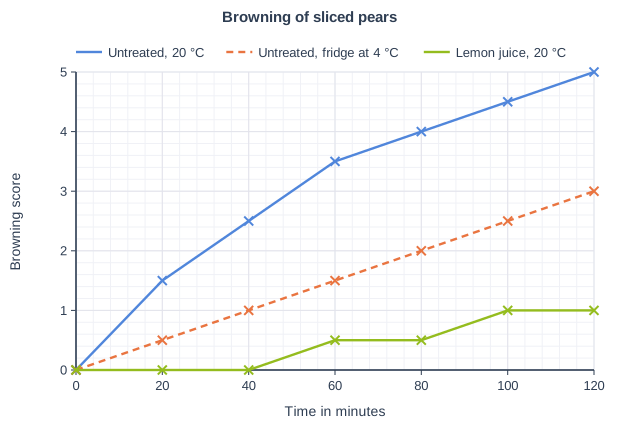
Every 20 minutes, she gave each group a browning score from 0 (no browning) to 5 (very brown). The graph shows her results.

Using the graph, compare the results for the three groups and explain the differences.

Browning of sliced pears. Line graph of browning score (y-axis, 0 to 5) against time in minutes (x-axis, 0 to 120). "Untreated, 20 °C" joins the points (0, 0), (20, 1.5), (40, 2.5), (60, 3.5), (80, 4), (100, 4.5), (120, 5). "Untreated, fridge at 4 °C" (dashed) joins the points (0, 0), (20, 0.5), (40, 1), (60, 1.5), (80, 2), (100, 2.5), (120, 3). "Lemon juice, 20 °C" joins the points (0, 0), (20, 0), (40, 0), (60, 0.5), (80, 0.5), (100, 1), (120, 1).

Model answer

The untreated slices at 20 °C browned fastest, reaching a score of 3.5 after 60 minutes and 5 (very brown) after 120 minutes. Cutting released enzymes that reacted quickly with oxygen at room temperature. The slices in the fridge browned more slowly, reaching only 1.5 after 60 minutes and 3 after 120 minutes, because the low temperature slowed the enzymes down. It did not destroy them, so the browning still increased steadily. The lemon juice slices browned least: there was no browning for 40 minutes and the score was only 1 after 120 minutes, because the acid lowered the pH so the enzymes could not work properly.

Explanation

Top answers quote readings from the graph for each group and link each difference to the science: temperature controls how fast the enzymes work, and acid stops them working properly. Describing the lines without explaining them earns at most 2 marks. A common mistake is to say the fridge stopped the browning, but the fridge line keeps rising.

Mark scheme
  1. 1 mark

    the untreated slices at 20 °C browned fastest / most: a score of 3.5 at 60 minutes and 5 (very brown) at 120 minutes

    Award 1 mark per valid point or 2 marks for each point that is clearly explained. max 4. Max 2 for describing the results without explaining them. Readings within 0.5 of the plotted values can be credited (untreated at 20 °C: 0, 1.5, 2.5, 3.5, 4, 4.5, 5; fridge: 0, 0.5, 1, 1.5, 2, 2.5, 3; lemon juice: 0, 0, 0, 0.5, 0.5, 1, 1, at 0, 20, 40, 60, 80, 100 and 120 minutes). Do not credit 'the fridge stopped the browning' or 'the cold killed the enzymes'.

  2. 1 mark

    because at room temperature the enzymes released from the cut cells work quickly, reacting with oxygen at the cut surfaces

  3. 1 mark

    the slices in the fridge browned more slowly: only 1.5 at 60 minutes and 3 at 120 minutes

  4. 1 mark

    because the low temperature slows the enzymes down but does not destroy (denature) them, so the browning still increased steadily

  5. 1 mark

    the slices dipped in lemon juice browned least: no browning for the first 40 minutes and a score of only 1 at 120 minutes

  6. 1 mark

    because the acid lowers the pH so the enzymes cannot work properly / the vitamin C in lemon juice acts as an antioxidant

  7. 1 mark

    all three groups browned more over time, because the cut surfaces were exposed to oxygen for longer

    Any other relevant and correct response can be credited.

Question 4

6 marks

A juice bar at a railway station sells pear, banana and orange smoothies. Each smoothie is made by blending a peeled pear and a banana with 150 ml of freshly squeezed orange juice.

To save time in the morning rush, staff make all the smoothies at 6 am. They pour them into clear plastic bottles, filling each bottle about three-quarters full, and put them on an open chiller shelf until they are sold, up to 4 pm.

By the afternoon, the smoothies have changed from pale yellow to a dull beige-brown, and tests show that they contain less vitamin C than freshly made smoothies.

Explain why the smoothies change colour and lose vitamin C, and how the juice bar could reduce these changes.

Model answer

Blending breaks open almost every cell in the pear and banana, releasing enzymes, and it whisks air into the smoothie. The enzymes react with oxygen to form brown pigments; this enzymic browning turns the smoothie from pale yellow to beige-brown. The acid in the orange juice lowers the pH and slows the enzymes at first, but over up to ten hours it is not enough to stop them.

Vitamin C, mostly from the orange juice, is oxidised by oxygen in the air bubbles and in the air at the top of each bottle, which is only three-quarters full. Blended fruit has a huge surface area, so oxidation is fast. The open chiller shelf slows the reactions but does not stop them, and it may be warmer than a fridge as customers take bottles out. Light through the clear bottles also speeds up the loss of vitamin C.

The juice bar could blend smoothies in small batches through the day, or to order, so that they are drunk soon after blending. Bottles should be filled to the top and sealed straight away, so little air is left in them, and opaque bottles would keep out light. Keeping them at 0-5 °C and adding a little lemon juice would also slow both changes.

Explanation

Top-level answers explain both changes with the science (enzymes released by blending reacting with oxygen, and vitamin C being oxidised) and link them to details in the question: the air whisked in, the part-filled clear bottles, the long time and the chiller shelf. Suggested changes must follow from these causes. Answers that only list ways to prevent browning, or that describe the changes without explaining them, stay in Level 1 or 2.

Mark scheme
  1. 6 marks

    Levels of response (6 marks). AO2.
    Level 3 (5-6 marks): Responses show very good knowledge and understanding of enzymic browning and the oxidation of vitamin C. Detailed and factual explanations related to why the smoothies change and how the juice bar could reduce this.
    Level 2 (3-4 marks): Responses show good knowledge and understanding of enzymic browning and the oxidation of vitamin C. Factual explanations, some of which relate to why the smoothies change and how the juice bar could reduce this.
    Level 1 (1-2 marks): Responses show limited knowledge and understanding of enzymic browning and the oxidation of vitamin C. Limited explanation related to why the smoothies change and how the juice bar could reduce this.
    0 marks: nothing to reward.

    Indicative content (not a checklist; credit other valid points): Colour: blending breaks open almost every cell in the pear and banana, releasing enzymes; blending also whisks air (oxygen) into the smoothie; the enzymes react with oxygen to form brown pigments (enzymic browning, an oxidation reaction), turning the smoothie beige-brown; pears and bananas brown readily; the orange juice is acidic and contains vitamin C, which lowers the pH and slows browning at first, but over up to 10 hours it is not enough to stop it; the air left at the top of each three-quarters-full bottle supplies more oxygen; chilling slows the enzymes but does not stop them, and an open chiller shelf may be warmer than a fridge (eg when customers take bottles). Vitamin C: vitamin C (mainly from the orange juice) is oxidised by oxygen in the air bubbles and in the air at the top of the bottle; blended fruit has a very large surface area, so oxidation is fast; enzymes released by blending can speed up the loss; the longer the smoothies stand (up to 10 hours), the more is lost; warmth speeds up the loss; light through the clear bottles speeds up the loss of vitamin C. Reducing the changes: blend to order or in small batches through the day, so the smoothies are drunk soon after blending; squeeze the orange juice just before blending; fill bottles to the top and seal them straight away to leave little air; use opaque bottles or keep them out of strong light; keep them in a fridge at 0-5 °C; add a little lemon or lime juice (more acid) or vitamin C (ascorbic acid); blend for no longer than needed; give the smoothies a short sell-by time; evaluate the trade-off with staff time in the morning rush (eg prepare fruit ready but blend later). Food safety points earn credit only when linked to the colour or vitamin C changes (eg keeping the smoothies at 0-5 °C also slows the enzymes). Do not credit 'the smoothies have gone off' or 'bacteria turn them brown'.

Ready to try the rest? Every answer you write is marked against the mark scheme, so you can see exactly where the marks are.

Study Helper Hints first, answers after you try

Stuck on this one? Ask for a hint and I’ll point you in the right direction, without giving the answer away. Once you’ve checked your answer, I’ll show you how the marks are awarded.