Level:
Correct: 0
Incorrect: 0
Marks: 0/0
Exam Practice
Course:
Topics:
AQA GCSE Food Preparation and Nutrition Smart practice A mixed round aimed at your weak spots
Unit 1
Food preparation skills
Unit 2
Food, nutrition and health
Unit 3
Food science
Unit 4
Food safety
Unit 5
Food choice
Unit 6
Food provenance
Avg
score:
–
Topics
done:
0/37

Food and the environment

Practise 20 exam-style questions on Food and the environment for AQA GCSE Food Preparation and Nutrition. Write your answer as you would in the exam and get it marked in seconds against the mark scheme, point by point, with the Study Helper on hand if you get stuck.

  • 20 questions
  • 1–12 marks each
  • Instant marking
  • No sign-up needed
20 questions, marked as you go

Sample questions with model answers

Here are 4 of the questions in this topic, each with a model answer, an explanation of why it earns the marks and the mark scheme an examiner would use.

Question 1

1 mark

Food waste sent to landfill is buried and rots without oxygen. As it rots, it releases a powerful greenhouse gas.

Which gas is this?

Choose your answer.

  • Methane
  • Carbon monoxide
  • Hydrogen
  • Nitrogen

Model answer

Methane

Explanation

Without oxygen, microorganisms break down buried food waste and produce methane, a greenhouse gas that traps far more heat than carbon dioxide. This is why food waste is better sent for composting or anaerobic digestion, where the gas can be captured and used as fuel. Carbon monoxide is a common wrong answer, often confused with carbon dioxide.

Mark scheme
  1. 1 mark

    Methane

    If more than one option is given, 0 marks.

Question 2

3 marks

The Brennan family make a beef chilli once a week, using 500 g of beef mince. They plan to use 500 g of beans and lentils instead of the beef.

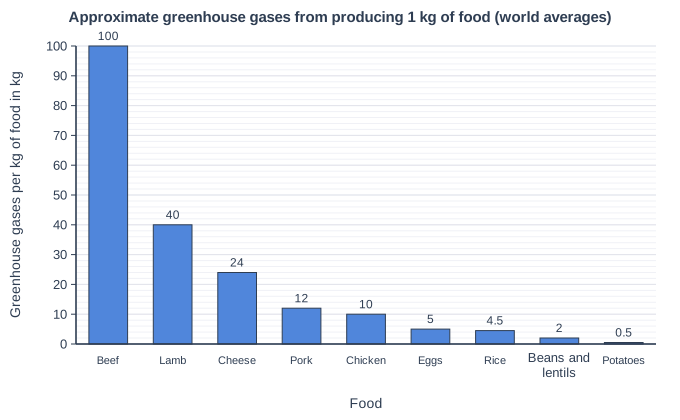
The bar chart shows approximate world average greenhouse gas emissions for producing 1 kg of different foods.

Use the bar chart to calculate how much less greenhouse gas would be released each week by producing beans and lentils for the chilli instead of beef.

Give one reason why producing beef releases much more greenhouse gas than producing beans and lentils.

Approximate greenhouse gases from producing 1 kg of food (world averages). Bar chart of greenhouse gases per kg of food in kg for each food: Beef 100, Lamb 40, Cheese 24, Pork 12, Chicken 10, Eggs 5, Rice 4.5, Beans and lentils 2, Potatoes 0.5.

Model answer

Beef: 0.5 kg × 100 = 50 kg
Beans and lentils: 0.5 kg × 2 = 1 kg
Reduction = 50 - 1 = 49 kg each week

Cattle release methane, a powerful greenhouse gas, as they digest their food.

Explanation

500 g is 0.5 kg, so each value from the chart is halved before the difference is found; forgetting this gives the common wrong answer of 98 kg. The chart shows beef releases about 50 times more greenhouse gas per kg than beans and lentils, mainly because cattle produce methane and need large areas of land and feed. Reasons about transport or cooking do not explain these figures, which are for producing the food.

Mark scheme
  1. 1 mark

    method: beef 0.5 × 100 = 50 kg and beans and lentils 0.5 × 2 = 1 kg / (100 - 2) × 0.5

    Award 1 mark for the method and 1 mark for the correct answer, and 1 mark for a valid reason. Award full marks for the calculation with or without working. 98 kg (the difference for 1 kg, not 500 g) scores the method mark only.

  2. 1 mark

    49 kg less greenhouse gas each week

    Accept 49 kg of carbon dioxide (equivalent).

  3. 1 mark

    cattle release methane (a powerful greenhouse gas) as they digest their food / a lot of land is needed for grazing and growing cattle feed, and forests may be cleared, releasing carbon dioxide / growing feed for cattle uses fertiliser and fuel / cattle eat much more plant food than the meat they produce

    Accept 'cattle manure releases greenhouse gases'. Do not credit 'beef is transported further' or 'beef needs cooking for longer', as the chart shows producing the food. Any other relevant and correct response can be credited.

Question 3

4 marks

A supermarket wants to buy 1 tonne of fresh asparagus in March, when it is not in season in the UK. It could buy it from one of two growers:
- Route A: grown in Peru, flown about 10,000 km to the UK, then taken 100 km by lorry to the supermarket's depot
- Route B: grown in Spain, taken about 1,800 km by lorry to the depot.

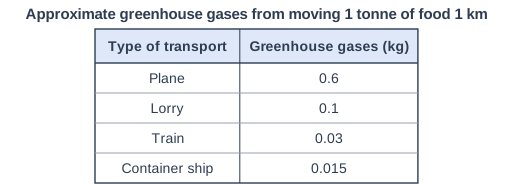
The table shows approximate greenhouse gas emissions for moving 1 tonne of food 1 km by different types of transport.

Use: emissions = distance (km) × emissions for 1 tonne per km.

Calculate the greenhouse gas emissions from transporting 1 tonne of asparagus by Route A and by Route B, and how many times greater the emissions from Route A are than those from Route B.

Suggest why asparagus from Peru is sent to the UK by plane rather than by ship.

Approximate greenhouse gases from moving 1 tonne of food 1 km. Table with columns "Type of transport", "Greenhouse gases (kg)". Type of transport: Plane; Greenhouse gases (kg): 0.6 | Type of transport: Lorry; Greenhouse gases (kg): 0.1 | Type of transport: Train; Greenhouse gases (kg): 0.03 | Type of transport: Container ship; Greenhouse gases (kg): 0.015.

Model answer

Route A: (10,000 × 0.6) + (100 × 0.1) = 6,000 + 10 = 6,010 kg
Route B: 1,800 × 0.1 = 180 kg
6,010 ÷ 180 = 33.4, so Route A releases about 33 times more greenhouse gas than Route B.

Asparagus spoils quickly. A ship from Peru would take weeks, so the asparagus would not arrive fresh, but a plane gets it to the UK in less than a day.

Explanation

Multiply each distance by the figure for that type of transport and add both parts of Route A: the flight alone gives 6,000 kg, because a plane releases six times more than a lorry and 40 times more than a ship for each tonne per km. Common mistakes are leaving out the lorry part of Route A and dividing the wrong way round. Perishable foods are flown because sea journeys are too slow, which is why air-freighted produce has such a large carbon footprint.

Mark scheme
  1. 1 mark

    Route A: (10,000 × 0.6) + (100 × 0.1) = 6,000 + 10 = 6,010 kg

    Award 1 mark for each correct value (3 marks) and 1 mark for a valid suggestion. Award full marks for the calculation with or without working. 6,000 kg (lorry journey left out) does not score this mark.

  2. 1 mark

    Route B: 1,800 × 0.1 = 180 kg

  3. 1 mark

    6,010 ÷ 180 = about 33 times greater

    Accept 33 to 33.4. ecf: allow the student's Route A value divided by the student's Route B value, correctly worked out (e.g. 6,000 ÷ 180 = 33.3).

  4. 1 mark

    asparagus is perishable / has a short shelf life / spoils quickly, and a sea journey would take weeks, so it would not arrive fresh, while a plane takes less than a day

    Accept 'a plane is much faster, so the asparagus keeps its quality'. Do not credit 'it is cheaper' (air freight costs more) or 'ships cannot reach the UK'. Any other relevant and correct response can be credited.

Question 4

6 marks

A factory makes chilled sandwiches, such as cheese salad and egg mayonnaise, for supermarkets and railway station shops. The sandwiches are made on production lines, packed, labelled with a use-by date and sent out in refrigerated lorries every night. The manager has found that a lot of food is thrown away in the factory before any sandwiches leave it.

Explain three reasons why food is wasted in the sandwich factory, and how each could be reduced.
Do not repeat your answers.

Model answer

1. The end slices of every loaf, and the crusts cut off some sandwiches, are not used. The factory could turn them into breadcrumbs or croutons to sell, use longer loaves so there are fewer end slices, or send them to be made into animal feed instead of throwing them away.
2. More sandwiches may be made than the shops need, for example when an order is cut at short notice or sales fall in wet weather. This could be reduced by using sales records and weather forecasts to plan production, and by giving surplus sandwiches that are still within their use-by date to a food redistribution charity.
3. Sandwiches are rejected in quality checks if they are squashed, under-filled or have the wrong label or date mark, so whole batches can be thrown away. Training staff and checking the first packs and labels at the start of each run would find mistakes before many sandwiches are made.

Explanation

Each reason earns its second mark only when it is paired with a linked way to reduce that waste, as in the model answer. Strong answers use the factory context, such as bread crusts and end slices, orders cut at short notice or labelling errors found in quality checks. A common mistake is to give reasons for waste in homes or shops, such as customers buying too much, which do not answer a question about food production.

Mark scheme
  1. 1 mark

    offcuts: the crusts and the end slices of loaves, and trimmings such as tomato and cucumber ends or outer lettuce leaves, are cut off and not used

    Award 1 mark per valid point or 2 marks for each point that is clearly explained: 1 mark for the reason and 1 mark for a linked way to reduce it. A maximum of two marks can be awarded for each reason. Answers should not be repeated. max 6.

  2. 1 mark

    use them in other products, e.g. breadcrumbs, croutons, stuffing or soup / use longer loaves so there are fewer end slices / send bread offcuts for animal feed / send unavoidable trimmings for anaerobic digestion or composting instead of landfill

  3. 1 mark

    over-production: more sandwiches are made than the shops order / orders are cut at short notice / sales are hard to predict (e.g. they fall in wet or cold weather or in school holidays)

  4. 1 mark

    use sales records and weather forecasts to plan production / agree orders with the shops earlier / make sandwiches to order / give surplus sandwiches that are still within their use-by date to a food redistribution charity

  5. 1 mark

    faulty sandwiches are rejected in quality checks and cannot be sold, e.g. under-filled or squashed sandwiches, split or badly sealed packs, wrong or missing labels, date marks or allergen information

  6. 1 mark

    train staff / maintain and adjust the machines / check the first packs and labels at the start of each run, so that mistakes are found before a whole batch is made

  7. 1 mark

    chilled ingredients (e.g. cheese, salad, boiled eggs) go past their use-by date or spoil before they are used, because too much is ordered or stock is not rotated

  8. 1 mark

    order smaller amounts more often / use stock rotation (first in, first out) / keep chilled ingredients at 0-5 °C so they last until they are used

  9. 1 mark

    fillings or ingredients are dropped, spilled or left in the machines at the end of a production run / a fridge or chiller breaks down, so chilled food must be thrown away

  10. 1 mark

    plan longer runs with fewer changes of filling / clean and maintain equipment / fit temperature alarms and check chillers regularly

    Do not credit reasons for waste in homes or shops, such as customers buying too much. Do not credit 'the food goes off' without a cause, or 'throw less away' without a method. Any other relevant and correct response can be credited.

Ready to try the rest? Every answer you write is marked against the mark scheme, so you can see exactly where the marks are.

Study Helper Hints first, answers after you try

Stuck on this one? Ask for a hint and I’ll point you in the right direction, without giving the answer away. Once you’ve checked your answer, I’ll show you how the marks are awarded.