Level:
Correct: 0
Incorrect: 0
Marks: 0/0
Exam Practice
Course:
Topics:
AQA GCSE Food Preparation and Nutrition Smart practice A mixed round aimed at your weak spots
Unit 1
Food preparation skills
Unit 2
Food, nutrition and health
Unit 3
Food science
Unit 4
Food safety
Unit 5
Food choice
Unit 6
Food provenance
Avg
score:
–
Topics
done:
0/37

Informed choices: life stages and dietary groups

Practise 20 exam-style questions on Informed choices: life stages and dietary groups for AQA GCSE Food Preparation and Nutrition. Write your answer as you would in the exam and get it marked in seconds against the mark scheme, point by point, with the Study Helper on hand if you get stuck.

  • 20 questions
  • 1–12 marks each
  • Instant marking
  • No sign-up needed
20 questions, marked as you go

Sample questions with model answers

Here are 4 of the questions in this topic, each with a model answer, an explanation of why it earns the marks and the mark scheme an examiner would use.

Question 1

1 mark

From what age can skimmed milk be given to children as their main drink?

Choose your answer.

  • 1 year
  • 2 years
  • 5 years
  • 11 years

Model answer

5 years

Explanation

Skimmed and 1% milk have had most of their fat removed, so they do not provide enough energy (or fat-soluble vitamin A) for young children, who are growing quickly. NHS advice is that they should not be a child's main drink before the age of 5. A common confusion is with 1 year, which is the age from which whole cow's milk can first be given as a main drink, or 2 years, the age from which semi-skimmed milk can be.

Mark scheme
  1. 1 mark

    5 years

    If more than one option is given, 0 marks.

Question 2

3 marks

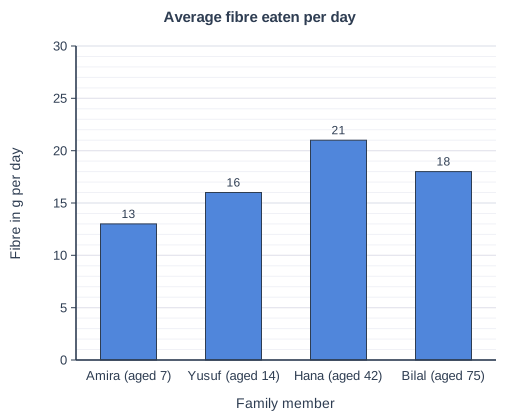
The Rahman family recorded the average amount of fibre each person ate per day for one week. The bar chart shows their results.

The recommended daily fibre intakes are 20 g for children aged 5-11, 25 g for 11-16 year olds and 30 g for adults.

Using the bar chart:
- identify the family member whose fibre intake is furthest below their recommended intake
- calculate the percentage of his recommended daily fibre intake that Yusuf eats. Show your working.

Percentage = fibre eaten ÷ recommended intake × 100

Average fibre eaten per day. Bar chart of fibre in g per day for each family member: Amira (aged 7) 13, Yusuf (aged 14) 16, Hana (aged 42) 21, Bilal (aged 75) 18.

Model answer

Bilal is furthest below: he eats 18 g, which is 12 g below the adult recommendation of 30 g.
Yusuf: 16 ÷ 25 × 100 = 64%

Explanation

Each person must be compared with the guideline for their own age: Amira is 7 g short, Yusuf 9 g, Hana 9 g and Bilal 12 g. For Yusuf, divide his intake by the 25 g guideline for 11-16 year olds and multiply by 100 to get 64%. A common mistake is to pick Amira because her bar is shortest, or to use the 30 g adult value for Yusuf.

Mark scheme
  1. 1 mark

    Bilal (aged 75)

    Award 1 mark for identifying the family member. Accept 'the 75-year-old' or 'the grandfather'. Bilal eats 18 g, 12 g below the adult recommendation of 30 g (60% of it). The other shortfalls are Amira 7 g, Yusuf 9 g and Hana 9 g. Do not credit Amira, whose bar is the shortest but who is only 7 g below the 20 g recommendation for her age.

  2. 1 mark

    Method: 16 ÷ 25 × 100

    Award full marks for the calculation with or without working. Accept 16/25 = 0.64.

  3. 1 mark

    64%

    Accept 64 without the % sign. Do not credit 53% (16 ÷ 30, using the adult value) or 80% (16 ÷ 20, using the 5-11 value).

Question 3

4 marks

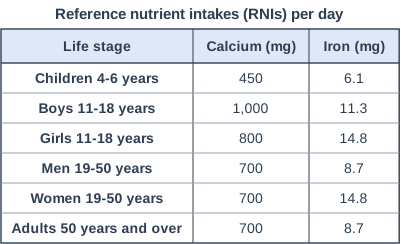
The table shows the reference nutrient intakes (RNIs) for calcium and iron at different life stages.

Using the table, explain why:
- boys aged 11-18 have the highest RNI for calcium
- the RNI for iron for women falls after the age of 50.

Reference nutrient intakes (RNIs) per day. Table with columns "Life stage", "Calcium (mg)", "Iron (mg)". Life stage: Children 4-6 years; Calcium (mg): 450; Iron (mg): 6.1 | Life stage: Boys 11-18 years; Calcium (mg): 1,000; Iron (mg): 11.3 | Life stage: Girls 11-18 years; Calcium (mg): 800; Iron (mg): 14.8 | Life stage: Men 19-50 years; Calcium (mg): 700; Iron (mg): 8.7 | Life stage: Women 19-50 years; Calcium (mg): 700; Iron (mg): 14.8 | Life stage: Adults 50 years and over; Calcium (mg): 700; Iron (mg): 8.7.

Model answer

Boys aged 11-18 are going through a growth spurt and their bones are growing quickly in length and density. They need 1,000 mg of calcium a day, compared with 700 mg for men, to build strong bones and reach peak bone mass.
Women aged 19-50 lose iron every month in the blood lost during their periods. After about 50, periods stop at the menopause, so less iron needs replacing and the RNI falls from 14.8 mg to 8.7 mg, the same as for men.

Explanation

Each part needs a reason (the teenage growth spurt; periods stopping at the menopause) and a clear link to the nutrient (calcium for building bone mass; iron to replace blood losses). Quoting values from the table, such as 1,000 mg against 700 mg, strengthens the explanation. A common mistake is to say older women need less iron because they eat less or are less active.

Mark scheme
  1. 1 mark

    Boys aged 11-18 are going through a growth spurt / their bones are growing rapidly in length and density

    Award 1 mark per valid point or 2 marks for each point that is clearly explained. A maximum of two marks can be awarded for each part (calcium for boys; iron for women over 50). Credit use of data from the table as part of a development, e.g. 1,000 mg compared with 700 mg for men or 800 mg for girls.

  2. 1 mark

    so they need more calcium (1,000 mg) to build strong bones and reach peak bone mass/bone density / boys build a larger skeleton than girls, who need 800 mg

  3. 1 mark

    Women aged 19-50 lose iron every month in the blood lost during menstruation/periods

  4. 1 mark

    After about 50, periods stop (the menopause), so less iron needs replacing and the RNI falls from 14.8 mg to 8.7 mg, the same as men

    Also credit: iron is needed to make haemoglobin in red blood cells, so blood lost in periods must be replaced; reaching peak bone mass reduces the risk of osteoporosis in later life. Do not credit 'boys are more active' on its own for calcium, or 'older women eat less/are less active' for iron. Any other relevant and correct response can be credited.

Question 4

6 marks

Ingredients for strawberry trifle:
- 6 trifle sponges
- 300 g strawberries
- 1 packet strawberry jelly
- 500 ml custard, made with custard powder, sugar and whole milk
- 300 ml double cream, whipped
- 25 g milk chocolate, grated, to decorate

Chloe is lactose intolerant.

Explain how three of the ingredients could be changed so that the trifle is suitable for Chloe.

Do not repeat your answers.

Model answer

The whole milk in the custard could be replaced with lactose-free milk. The lactose in it has already been broken down by the enzyme lactase, so Chloe can digest it, and the cornflour in the custard powder still thickens it when it is heated, so the custard is as thick as usual and still provides calcium.
The double cream could be replaced with an oat-based whipping cream, because cream is made from milk and contains lactose, while the oat cream can still be whipped to trap air and give a light, creamy topping.
The grated milk chocolate could be replaced with dairy-free dark chocolate, because milk chocolate contains milk solids, which contain lactose. The dark chocolate still gives the trifle a chocolate flavour and an attractive decoration.

Explanation

Each ingredient can earn 2 marks: 1 for a suitable replacement and 1 for explaining why it is needed or how the replacement still does the same job in the trifle. The strawberries, jelly, custard powder and sugar contain no lactose, so changing them earns no credit. A common mistake is to suggest semi-skimmed or skimmed milk, which still contain lactose.

Mark scheme
  1. 1 mark

    Replace the whole milk in the custard with lactose-free milk / a calcium-fortified plant drink (e.g. soya or oat) / use a ready-made dairy-free custard

    Award 1 mark per valid point or 2 marks for each point that is clearly explained. A maximum of two marks can be awarded for each ingredient. max 6. Answers should not be repeated. Do not credit changing the strawberries, jelly, custard powder or sugar: they do not contain lactose. Do not credit semi-skimmed or skimmed milk, which still contain lactose. Do not credit 'use dairy-free ingredients' unless the ingredient and its replacement are named.
  2. 1 mark

    because milk contains lactose; in lactose-free milk the lactose has been broken down (by the enzyme lactase) so Chloe can digest it / plant drinks are not made from milk so contain no lactose; the cornflour in the custard powder still thickens the custard when it is heated (gelatinisation), and fortified drinks still provide calcium

  3. 1 mark

    Replace the double cream with lactose-free double (whipping) cream / a plant-based cream alternative that can be whipped (e.g. an oat- or soya-based whipping cream, or chilled coconut cream)

    Do not credit single cream or ordinary creme fraiche or yoghurt, which are made from milk and contain lactose.

  4. 1 mark

    because cream is made from milk and contains lactose; the alternative can still be whipped to trap air, giving a light, thick, creamy topping

  5. 1 mark

    Replace the milk chocolate with dark chocolate / dairy-free (milk-free) chocolate / decorate the trifle with something else, e.g. sliced strawberries or toasted flaked almonds

    Accept 'dark chocolate', as most dark chocolate contains no milk solids; 'check the label' can be part of the explanation.

  6. 1 mark

    because milk chocolate contains milk solids (milk powder), which contain lactose; dark or dairy-free chocolate still gives a chocolate flavour and an attractive decoration

  7. 1 mark

    Check the label of the trifle sponges / use sponges made without milk ingredients (e.g. milk powder, whey or butter), as some contain them

    Credit a development for the sponges, e.g. 'milk powder and whey contain lactose'. Any other relevant and correct response can be credited.

Ready to try the rest? Every answer you write is marked against the mark scheme, so you can see exactly where the marks are.

Study Helper Hints first, answers after you try

Stuck on this one? Ask for a hint and I’ll point you in the right direction, without giving the answer away. Once you’ve checked your answer, I’ll show you how the marks are awarded.