
Level:
Correct: 0
Incorrect: 0
Marks: 0/0
Exam Practice
Course:
Topics:
AQA GCSE Food Preparation and Nutrition Smart practice A mixed round aimed at your weak spots
Unit 1
Food preparation skills
Unit 2
Food, nutrition and health
Unit 3
Food science
Unit 4
Food safety
Unit 5
Food choice
Unit 6
Food provenance
Avg
score:
–
Topics
done:
0/37

Technological developments in health and food production

Practise 20 exam-style questions on Technological developments in health and food production for AQA GCSE Food Preparation and Nutrition. Write your answer as you would in the exam and get it marked in seconds against the mark scheme, point by point, with the Study Helper on hand if you get stuck.

  • 20 questions
  • 1–12 marks each
  • Instant marking
  • No sign-up needed
20 questions, marked as you go

Sample questions with model answers

Here are 4 of the questions in this topic, each with a model answer, an explanation of why it earns the marks and the mark scheme an examiner would use.

Question 1

1 mark

Food labels often list additives by their E numbers, for example E300.

What does an E number show about an additive?

Choose your answer.

  • It comes from a natural source
  • It is an artificial chemical
  • It improves the nutritional value of the food
  • It has passed safety tests and is approved for use

Model answer

It has passed safety tests and is approved for use

Explanation

An E number shows that an additive has been safety tested and approved for use in food in the UK and the EU. E numbers are given to additives from natural sources as well as to artificial ones: E300, for example, is vitamin C (ascorbic acid), used as an antioxidant. A common mistake is to think that every E number is an artificial chemical.

Mark scheme
  1. 1 mark

    It has passed safety tests and is approved for use

    If more than one option is given, 0 marks.
Question 2

4 marks

Additives are used in many processed foods.

State the function of each of these types of additive:
- preservative
- emulsifier
- stabiliser
- colouring.

Model answer

A preservative slows the growth of microorganisms, so the food stays safe for longer. An emulsifier helps oil and water to mix and stops them separating. A stabiliser keeps the mixture stable, giving a smooth, even texture during storage. A colouring adds or restores colour so the food looks appealing.

Explanation

Each type of additive has a different job: preservatives extend shelf life, emulsifiers mix oil and water, stabilisers keep a mixture or emulsion from separating and keep its texture, and colourings improve or restore appearance. Answers must be precise: 'keeps food fresh' is too vague for a preservative. A common mistake is to say colourings improve flavour.

Mark scheme
  1. 1 mark

    preservative: slows or prevents the growth of microorganisms (bacteria, moulds, yeasts) / stops food spoiling, so it stays safe and keeps for longer / extends shelf life

    Award 1 mark per valid point. Each function must be matched to the correct additive. Accept 'makes food last longer'. Accept 'stops fats going rancid' (antioxidant preservatives). Do not credit 'keeps food fresh' on its own, or 'kills all bacteria'.

  2. 1 mark

    emulsifier: helps oil/fat and water to mix / holds oil and water together so they do not separate

    Accept 'helps ingredients that would normally separate to mix'. Do not credit 'mixes the ingredients' with no idea of oil and water (or ingredients that would separate).

  3. 1 mark

    stabiliser: keeps an emulsion or mixture stable so it does not separate during storage / thickens / keeps a smooth, even texture

    Accept 'stops ice crystals forming in ice cream' or 'keeps the texture the same'. 'Stops the mixture separating' can be credited for both the emulsifier and the stabiliser.

  4. 1 mark

    colouring: adds colour / restores colour lost during processing / makes food look more attractive or appealing / gives the colour consumers expect / keeps the colour the same in every batch

    Do not credit 'improves the flavour' or 'makes it healthier'.

Question 3

4 marks

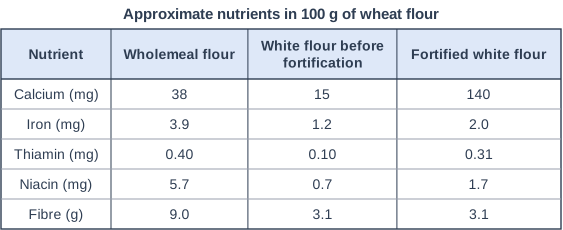
The table shows approximate values for some nutrients in 100 g of three types of wheat flour.

Calculate the iron in 100 g of fortified white flour as a percentage of the iron in 100 g of wholemeal flour. Give your answer to the nearest whole number.

Use the table to give two ways in which fortified white flour is less nutritious than wholemeal flour, even after fortification.

Approximate nutrients in 100 g of wheat flour. Table with columns "Nutrient", "Wholemeal flour", "White flour before fortification", "Fortified white flour". Nutrient: Calcium (mg); Wholemeal flour: 38; White flour before fortification: 15; Fortified white flour: 140 | Nutrient: Iron (mg); Wholemeal flour: 3.9; White flour before fortification: 1.2; Fortified white flour: 2.0 | Nutrient: Thiamin (mg); Wholemeal flour: 0.40; White flour before fortification: 0.10; Fortified white flour: 0.31 | Nutrient: Niacin (mg); Wholemeal flour: 5.7; White flour before fortification: 0.7; Fortified white flour: 1.7 | Nutrient: Fibre (g); Wholemeal flour: 9.0; White flour before fortification: 3.1; Fortified white flour: 3.1.

Model answer

2.0 ÷ 3.9 × 100 = 51.3, so 51%.

Fortified white flour has much less fibre than wholemeal flour (3.1 g compared with 9.0 g per 100 g), because fibre is not added back. It also has much less niacin (1.7 mg compared with 5.7 mg), so fortification only partly replaces the nutrients lost in milling.

Explanation

Divide the fortified white flour value by the wholemeal value and multiply by 100: even after fortification, white flour has only about half the iron of wholemeal flour. Fortification replaces only some nutrients, and only partly, and adds no fibre. A common mistake is to say white flour has less calcium, but it has more, because calcium is added by law.

Mark scheme
  1. 1 mark

    2.0 ÷ 3.9 × 100

    Award 1 mark per valid point. Award full marks for the calculation with or without working.

  2. 1 mark

    51%

    Accept 51.3% or 51.28%. Do not credit 195% (3.9 ÷ 2.0 × 100) or 49% (the percentage difference).

  3. 1 mark

    one valid way using the table, e.g. it has much less fibre (3.1 g compared with 9.0 g), because fibre is not added back / less iron (2.0 mg compared with 3.9 mg) / less niacin (1.7 mg compared with 5.7 mg) / less thiamin (0.31 mg compared with 0.40 mg)

    Figures from the table are not required for the mark, but the nutrient must be one that is lower in fortified white flour. Do not credit calcium: fortified white flour has more calcium than wholemeal flour (140 mg compared with 38 mg).

  4. 1 mark

    a second, different way, e.g. less fibre / less iron / less niacin / less thiamin than wholemeal flour

    Answers should not be repeated. The two ways must be different nutrients shown in the table. Do not credit nutrients that are not in the table (e.g. magnesium or zinc), as the question asks students to use the table.

Question 4

6 marks

Michael is 55. His doctor has told him that his blood cholesterol is raised. He has replaced the butter on his toast with a spread containing plant stanols. He says, 'Now that I use this spread, I don't need to worry about the rest of my diet.'

Explain how the spread could help Michael, and why it may not reduce his risk of coronary heart disease as much as he hopes.

Model answer

Plant stanols have a structure similar to cholesterol, so they reduce the amount of cholesterol Michael absorbs from his gut. If he eats 1.5-3 g a day, his LDL cholesterol could fall by about 7-12% within a few weeks. Raised LDL cholesterol leads to fatty deposits in the coronary arteries, so lowering it reduces his risk of coronary heart disease. Swapping butter, which is high in saturated fat, for this spread also helps.

However, the spread only works if he eats the stated amount every day, usually two or three servings with meals; spread on toast once a day may not give him enough stanols, and the effect stops if he stops using it. Michael is also wrong that the rest of his diet does not matter. If he still eats fatty meat, cheese and pastries, the extra saturated fat will keep raising his LDL cholesterol. He should also eat more fibre, such as oats and beans, at least 5 A Day and less salt, and be active and keep a healthy weight. The spread is still high in fat and energy, so using lots of it could lead to weight gain. There is also little long-term evidence that the spreads prevent heart attacks, so they should be one small part of a healthy lifestyle.

Explanation

Level 3 answers explain how stanols work (less cholesterol absorbed from the gut, so lower LDL) and then explain the limits for Michael: the daily amount needed, the effect stopping when he stops, and why the rest of his diet still matters. Challenging his comment directly, with specific foods and reasons, is what makes an answer detailed and related to the context. A common pitfall is to say the spread 'removes cholesterol from the arteries' or to give general healthy eating advice without linking it to cholesterol.

Mark scheme
  1. 6 marks

    Levels of response (6 marks). AO2.
    Level 3 (5-6 marks): Responses show very good knowledge and understanding of how cholesterol-lowering spreads work and how effective they are. Detailed and factual explanations related to Michael's use of the spread and the rest of his diet.
    Level 2 (3-4 marks): Responses show good knowledge and understanding of how cholesterol-lowering spreads work and how effective they are. Factual explanations, some of which relate to Michael's use of the spread and the rest of his diet.
    Level 1 (1-2 marks): Responses show limited knowledge and understanding of how cholesterol-lowering spreads work and how effective they are. Limited explanation related to Michael's use of the spread and the rest of his diet.
    0 marks: nothing to reward.

    Indicative content (not a checklist; credit other valid points): How it could help: plant stanols are similar in structure to cholesterol, so they reduce the amount of cholesterol absorbed from the gut; eaten every day in the stated amount (1.5-3 g, usually 2-3 servings with meals), they can lower LDL cholesterol by about 7-12% within 2-3 weeks; high LDL cholesterol leads to fatty deposits in the coronary arteries, narrowing them, so lowering it can reduce the risk of coronary heart disease (CHD); replacing butter, which is high in saturated fat, with a spread lower in saturated fat also helps to lower LDL cholesterol. Why it may not help as much as he hopes: the spread only works if eaten every day in the stated amount; spread on toast once a day may give less than 1.5 g of stanols; the effect wears off within weeks if he stops; more than 3 g a day gives no extra benefit; there is little long-term evidence that the spreads reduce heart attacks or strokes; Michael is wrong that the rest of his diet does not matter: he still needs to eat less saturated fat (fatty meat, cheese, pastries, cakes), more fibre (oats, beans and lentils help lower cholesterol), at least 5 A Day, oily fish once a week, and less salt to keep his blood pressure down; the spread may give him a false sense of security, so he eats more fatty foods; it is still mostly fat and high in energy, so using a lot could lead to weight gain; plant stanols can reduce the absorption of beta-carotene, so he needs plenty of fruit and vegetables; other risk factors, such as smoking, inactivity, being overweight, age and family history, are not changed by the spread; if he is prescribed cholesterol-lowering medication he should use the spread only with his doctor's agreement; the spreads cost more than ordinary spreads, so he may not keep buying them.

Ready to try the rest? Every answer you write is marked against the mark scheme, so you can see exactly where the marks are.

Study Helper Hints first, answers after you try

Stuck on this one? Ask for a hint and I’ll point you in the right direction, without giving the answer away. Once you’ve checked your answer, I’ll show you how the marks are awarded.