
Level:
Correct: 0
Incorrect: 0
Marks: 0/0
Exam Practice
Course:
Topics:
AQA GCSE Food Preparation and Nutrition Smart practice A mixed round aimed at your weak spots
Unit 1
Food preparation skills
Unit 2
Food, nutrition and health
Unit 3
Food science
Unit 4
Food safety
Unit 5
Food choice
Unit 6
Food provenance
Avg
score:
–
Topics
done:
0/37

General practical, knife and fruit and vegetable skills

Practise 20 exam-style questions on General practical, knife and fruit and vegetable skills for AQA GCSE Food Preparation and Nutrition. Write your answer as you would in the exam and get it marked in seconds against the mark scheme, point by point, with the Study Helper on hand if you get stuck.

  • 20 questions
  • 1–12 marks each
  • Instant marking
  • No sign-up needed
20 questions, marked as you go

Sample questions with model answers

Here are 4 of the questions in this topic, each with a model answer, an explanation of why it earns the marks and the mark scheme an examiner would use.

Question 1

1 mark

Carrots for a stir fry are cut into very thin strips about the size of matchsticks, so that they cook quickly and evenly.

What is this cut called?

Choose your answer.

  • Batons
  • Dice
  • Wedges
  • Julienne

Model answer

Julienne

Explanation

Julienne strips are very thin, about 2-3 mm thick and 3-5 cm long, so they cook in a few minutes in a stir fry. Batons are a similar shape but much thicker, about 0.5-1 cm across, and dice are small cubes. Students often confuse julienne with batons.

Mark scheme
  1. 1 mark

    Julienne

    If more than one option is given, 0 marks.
Question 2

3 marks

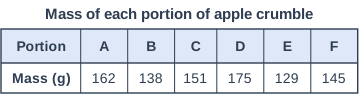
Tia works in a school cafe. She made an apple crumble in one large dish and served six portions with a serving spoon. Each portion should weigh 150 g. She weighed each portion, and the table shows the results.

Calculate the difference in mass between the largest and the smallest portion.

Identify the portions that were more than 10 g away from the 150 g target.

Suggest one way Tia could make the portions more even.

Mass of each portion of apple crumble. Table with columns "Portion", "A", "B", "C", "D", "E", "F". Portion: Mass (g); A: 162; B: 138; C: 151; D: 175; E: 129; F: 145.

Model answer

The difference is 175 - 129 = 46 g. Portions A, B, D and E were more than 10 g away from the target. Tia could bake the crumble in six individual dishes, weighing the same amount of fruit and topping into each one.

Explanation

The largest portion is D (175 g) and the smallest is E (129 g), a difference of 46 g; only C (151 g) and F (145 g) were within 10 g of the target. Even portions are fair to customers, keep costs under control and make every plate look the same. The suggestion must say how to make the portions even, so 'be more careful' gains no credit.

Mark scheme
  1. 1 mark

    46 g (175 - 129)

    Award 1 mark per valid point: 1 mark for the difference, 1 mark for the portions and 1 mark for one suggestion (only one suggestion can be credited). max 3. Award full marks for the calculation with or without working. Accept 46 without the unit.

  2. 1 mark

    A, B, D and E

    All four letters are needed, and no others; do not credit if C or F is included.

  3. 1 mark

    weigh each portion on digital scales as it is served

  4. 1 mark

    mark or score the top of the crumble into six equal sections, using a knife, ruler or template, before serving / bake it in a rectangular tin and cut it into equal squares

  5. 1 mark

    bake the crumble in six individual dishes, weighing the same amount of fruit and topping into each

  6. 1 mark

    use a portion scoop or the same-sized serving spoon, level each time

    Do not credit 'be more careful' or 'serve the same amount' unless the student says how. Any other relevant and correct response can be credited.

Question 3

4 marks

A baker brushes bread rolls with beaten egg before they go into the oven. She brushes cinnamon buns with a sugar syrup as soon as they come out of the oven.

Explain why each glaze is used and why it is put on at that time.

Model answer

The beaten egg gives the rolls a shiny, golden-brown crust. It has to go on before baking because the egg needs the heat of the oven to set and brown; brushed on afterwards it would stay raw. The sugar syrup gives the buns a sticky, shiny finish and extra sweetness. It goes on as soon as they come out of the oven so the warm syrup spreads easily and sets to a shine as the buns cool. If it went on before baking, the sugar would burn in the oven.

Explanation

Glazes change both appearance and flavour, and timing matters: an egg glaze needs the oven's heat to set and brown, while a sugar glaze would burn if baked, so it goes on the hot buns afterwards. Each glaze can score two marks, one for its effect and one for why it is applied at that time. 'Makes it look nice' is too vague to credit.

Mark scheme
  1. 1 mark

    Egg: the egg glaze gives the rolls a shiny/glossy, golden-brown crust

    Award 1 mark per valid point or 2 marks for each point that is clearly explained. A maximum of two marks can be awarded for each glaze. max 4.

  2. 1 mark

    Egg: it is put on before baking because the egg needs the heat of the oven to set and brown (brushed on after baking it would stay raw and wet)

  3. 1 mark

    Egg: the egg glaze helps seeds or other toppings stick to the rolls, adding texture/crunch and decoration

  4. 1 mark

    Sugar syrup: gives the buns a sticky, shiny finish and extra sweetness/flavour

  5. 1 mark

    Sugar syrup: it is brushed on while the buns are hot so it spreads easily, soaks in slightly and sets to a shine as they cool

  6. 1 mark

    Sugar syrup: it is not put on before baking because the sugar would burn/caramelise too much and go dark and bitter in the oven

  7. 1 mark

    Sugar syrup: it helps keep the buns moist / stops the surface drying out

    Also credit: egg brushed on after baking would be raw and unsafe to eat (risk of salmonella). Do not credit 'it makes it look nice' unless the effect is described (shiny, golden brown, sticky). Any other relevant and correct response can be credited.

Question 4

6 marks

A hotel serves a fresh fruit platter at breakfast. The platter contains mango, orange and apple.

Explain how each fruit should be prepared so that the platter looks attractive and is safe to eat.

Do not repeat your answers.

Model answer

The mango should be cut down either side of the flat stone to remove the two cheeks. The flesh can then be scored in a criss-cross without cutting the skin and pushed inside out, so neat cubes can be sliced off. The orange should have its top and base cut off, then the peel and white pith cut away following the curve. Each segment is then cut out from between the membranes, so the pieces are neat with no bitter pith. The apple should be washed and dried, quartered and cored, then cut into even slices. The slices should be dipped in lemon juice, or cut just before serving, to stop them turning brown.

Explanation

Each fruit needs its own skill: removing the stone and scooping for the mango, segmenting for the orange and controlling enzymic browning for the apple. Two marks per fruit come from a clear step plus its reason or result. A common mistake is to repeat a general point, such as 'wash it', for every fruit, which is credited only once.

Mark scheme
  1. 1 mark

    Mango: cut down either side of the large, flat stone to remove the two cheeks

    Award 1 mark per valid point or 2 marks for each point that is clearly explained. A maximum of two marks can be awarded for each fruit. max 6. Answers should not be repeated. Washing and drying the fruit, using a clean board and knife, and covering and chilling the platter can each be credited once, under any one fruit.

  2. 1 mark

    Mango: score the flesh in a criss-cross without cutting the skin and push it inside out, or scoop or slice the flesh away from the skin, giving neat, even cubes or slices

  3. 1 mark

    Orange: cut off the top and base, then cut away the peel and white pith, following the curve of the fruit

  4. 1 mark

    Orange: cut between the membranes to release each segment, so the segments are neat and free of bitter pith and tough membrane

  5. 1 mark

    Apple: quarter it, remove the core and seeds, and cut it into even slices or wedges (skin left on for colour)

  6. 1 mark

    Apple: dip or toss the slices in lemon, orange or pineapple juice / cut them just before serving

  7. 1 mark

    to prevent enzymic browning, so the slices stay pale and attractive

  8. 1 mark

    wash and dry the fruit before cutting, because a knife can carry soil and bacteria from the skin into the flesh

  9. 1 mark

    use a clean (green) chopping board and a sharp knife, to avoid cross-contamination and give clean, neat cuts

  10. 1 mark

    cover the platter and keep it in the fridge (below 5 °C) until it is served, to slow spoilage and browning and keep the fruit fresh

    Do not credit 'cut it up' or 'make it look nice' without a method. Any other relevant and correct response can be credited.

Ready to try the rest? Every answer you write is marked against the mark scheme, so you can see exactly where the marks are.

Study Helper Hints first, answers after you try

Stuck on this one? Ask for a hint and I’ll point you in the right direction, without giving the answer away. Once you’ve checked your answer, I’ll show you how the marks are awarded.