Level:
Correct: 0
Incorrect: 0
Marks: 0/0
Exam Practice
Course:
Topics:
AQA GCSE Food Preparation and Nutrition Smart practice A mixed round aimed at your weak spots
Unit 1
Food preparation skills
Unit 2
Food, nutrition and health
Unit 3
Food science
Unit 4
Food safety
Unit 5
Food choice
Unit 6
Food provenance
Avg
score:
–
Topics
done:
0/37

Sustainability of food

Practise 18 exam-style questions on Sustainability of food for AQA GCSE Food Preparation and Nutrition. Write your answer as you would in the exam and get it marked in seconds against the mark scheme, point by point, with the Study Helper on hand if you get stuck.

  • 18 questions
  • 1–8 marks each
  • Instant marking
  • No sign-up needed
18 questions, marked as you go

Sample questions with model answers

Here are 4 of the questions in this topic, each with a model answer, an explanation of why it earns the marks and the mark scheme an examiner would use.

Question 1

1 mark

About what fraction of all the food produced for people around the world is lost or wasted?

Choose your answer.

  • One third
  • One half
  • Two thirds
  • Three quarters

Model answer

One third

Explanation

The United Nations estimates that about 13% of the world's food is lost between harvest and the shops, and that about 19% of the food that reaches shops, restaurants and homes is then wasted, so roughly a third of all food produced is never eaten. In lower-income countries most of it is lost on farms, in storage and in transport, while in higher-income countries more is wasted by shops and households. A common mistake is to overestimate the figure: it is large, but it is not half.

Mark scheme
  1. 1 mark

    One third

    If more than one option is given, 0 marks.

Question 2

3 marks

Give three reasons why there may not be enough land to grow food for the world's population in the future.

Model answer

1. As the population grows, farmland is built on for new homes, roads and towns.
2. Soil can be damaged by erosion and overuse, so it loses its fertility and crops grow poorly.
3. Large areas of land are used to grow animal feed and crops for biofuels instead of food for people.

Explanation

Each mark needs a different reason why land for growing food is being lost or used for something else, such as building, soil damage, drought, rising sea levels or growing animal feed and biofuels. Simply saying 'the population is growing' does not explain why there is less land. A common mistake is to give two versions of the same idea, such as building houses and building roads.

Mark scheme
  1. 1 mark

    farmland is built on for new homes, roads, towns and factories as populations grow / cities spread (urbanisation)

    Award 1 mark per valid point. Max 3. Answers should not be repeated: building homes and building roads are one point.

  2. 1 mark

    soil is damaged or loses its fertility through erosion / overuse / overgrazing, so crops grow poorly

    Accept soil degradation or soil being blown or washed away.

  3. 1 mark

    climate change makes land too dry (drought / desertification) or too hot to grow crops

  4. 1 mark

    flooding / rising sea levels cover farmland or make the soil too salty

  5. 1 mark

    land is used to grow non-food crops (e.g. biofuels, cotton, flowers) or animal feed / large areas are used to rear livestock

    Also credit: forests and wildlife habitats need to be protected, so more land cannot simply be cleared for farming; pollution of land (e.g. by chemicals or waste) makes it unsuitable for growing food. Do not credit 'the population is growing' or 'there is not enough space' on its own: the answer must say why the land is lost or unavailable. Any other relevant and correct response can be credited.

Question 3

4 marks

In some lower-income countries, much of the best farmland is used to grow crops such as coffee, cocoa, tea or green beans for export to richer countries such as the UK.

Explain how growing crops for export can affect the food security of local communities.

Model answer

When the best land and water are used for export crops such as coffee, less land is left to grow staple foods such as maize and beans, so families have to buy food, often at higher prices. On the other hand, selling export crops earns farmers money, which they can use to buy a wider range of food and pay for schooling and healthcare. However, world prices for coffee and cocoa rise and fall, so in years when prices fall, families may not earn enough to buy the food they need.

Explanation

Good answers recognise that export crops can both help and harm food security: they bring income, but they take land away from local food and leave families exposed to changes in world prices or the failure of one crop. Each 2-mark point needs a clear 'so' linking the cause to the community's food. A common mistake is to say only that export crops are 'unfair' without explaining the effect on the food local people can get.

Mark scheme
  1. 1 mark

    land and water used for export crops cannot be used to grow staple foods for local people

    Award 1 mark per valid point or 2 marks for each point that is clearly explained. Max 4. Credit both positive and negative effects.

  2. 1 mark

    so less food is grown locally and families must buy food, often at higher prices / food has to be imported

  3. 1 mark

    farmers and workers earn money from selling export crops

  4. 1 mark

    so they can buy a wider range of food / pay for schooling and healthcare, which can improve food security

  5. 1 mark

    world prices for crops such as coffee and cocoa rise and fall

  6. 1 mark

    so when prices fall, families earn too little to buy enough food

    Accept that schemes such as Fairtrade's minimum price protect farmers when prices fall.

  7. 1 mark

    relying on one crop is risky

  8. 1 mark

    so if it fails through drought or disease, families lose their income and have no food crops to fall back on

    Also credit: workers on large plantations may be paid low wages, so they cannot afford enough nutritious food; export crops bring money and jobs into the area, which can improve roads, storage and local markets; growing the same crop year after year, or heavy use of water and chemicals, can damage the soil and water supplies needed for food in future. Do not credit 'it is unfair' or 'the UK gets the food' without explaining the effect on the local community's food. Any other relevant and correct response can be credited.

Question 4

6 marks

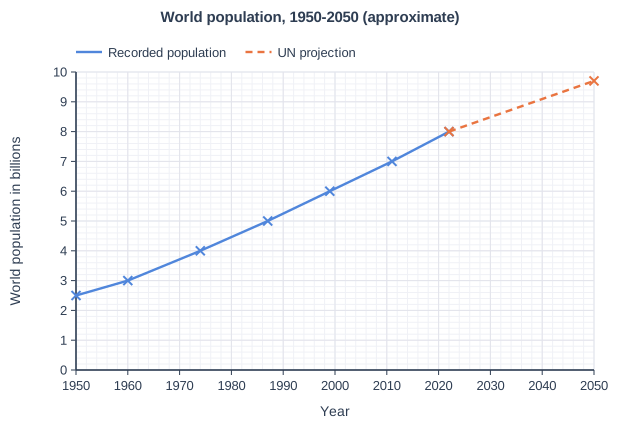
The graph shows how the world's population has grown since 1950, with a United Nations projection to 2050.

Explain the challenges of providing the world's growing population with a sustainable and secure supply of safe, nutritious and affordable food.

World population, 1950-2050 (approximate). Line graph of world population in billions (y-axis, 0 to 10) against year (x-axis, 1950 to 2050). "Recorded population" joins the points (1950, 2.5), (1960, 3), (1974, 4), (1987, 5), (1999, 6), (2011, 7), (2022, 8). "UN projection" (dashed) joins the points (2022, 8), (2050, 9.7).

Model answer

The graph shows that the world's population has more than tripled since 1950, from about 2.5 billion to 8 billion in 2022, and it is projected to reach about 9.7 billion by 2050. This means much more food will be needed, which is difficult for several reasons.

There is not enough spare land. Farmland is being built on as cities grow, and soil is damaged by erosion and overuse. Clearing forests for more farmland is not sustainable because it destroys wildlife habitats and releases greenhouse gases.

Climate change makes supplies less secure. Droughts, floods and heatwaves cause crops to fail, and farming already uses most of the world's fresh water.

As people become richer, many eat more meat and dairy foods, which need far more land, water and animal feed than plant foods. Meanwhile, about a third of all food is lost or wasted.

Food must also be affordable. If demand grows faster than supply, prices rise and low-income families cannot buy enough food. Cheap staple foods may fill people up but lack protein, vitamins and minerals, so diets may not be nutritious. Finally, food must be safe: longer supply chains and poor storage or refrigeration increase the risk of food spoiling or being contaminated.

Explanation

Top-level answers use the graph to show the scale of the challenge and then explain several different challenges, linking each one to whether the food supply is sustainable, secure, safe, nutritious and affordable. Common pitfalls are describing the graph without explaining any challenges, or listing problems such as 'climate change' and 'waste' without saying how they make it harder to feed more people.

Mark scheme
  1. 6 marks

    Levels of response (6 marks). AO2.
    Level 3 (5-6 marks): Responses show very good knowledge and understanding of the challenges of feeding a growing world population. Detailed and factual explanations related to providing a sustainable, secure, safe, nutritious and affordable food supply.
    Level 2 (3-4 marks): Responses show good knowledge and understanding of the challenges of feeding a growing world population. Factual explanations, some of which relate to providing a sustainable, secure, safe, nutritious and affordable food supply.
    Level 1 (1-2 marks): Responses show limited knowledge and understanding of the challenges of feeding a growing world population. Limited explanation related to providing a sustainable, secure, safe, nutritious and affordable food supply.
    0 marks: nothing to reward.

    Indicative content (not a checklist; credit other valid points): the population grew from about 2.5 billion in 1950 to 8 billion in 2022 (more than three times) and is projected to reach about 9.7 billion by 2050, so much more food will be needed; insufficient land: farmland is lost to building as cities grow, and soil is damaged by erosion and overuse; clearing forests for more farmland is not sustainable because it destroys habitats and releases greenhouse gases; water: farming uses most of the world's fresh water, and shortages limit how much can be grown; climate change and global warming bring droughts, floods and heatwaves that cause crop failures, making supplies less secure; overfishing threatens fish stocks if demand keeps rising; as incomes rise, more people eat meat and dairy foods, which need much more land, water and feed than plant foods; intensive farming can raise yields but may damage soil, water and wildlife through fertilisers and pesticides; about a third of food is lost or wasted, while many people go hungry; affordability: when demand grows faster than supply, prices rise and low-income families cannot afford enough food; nutrition: cheap staple foods may fill people up but lack protein, vitamins and minerals, so deficiencies continue; safety: longer supply chains and poor storage or refrigeration in some regions increase the risk of food spoiling or being contaminated; conflict, poverty and poor transport stop food reaching people; possible responses that show understanding of the challenge: reducing waste, drought-tolerant or GM crops, eating more plant proteins, sustainable fishing, Fairtrade and fair prices for farmers. Answers that only describe the graph, or only list problems without explaining them, should not reach Level 3.

Ready to try the rest? Every answer you write is marked against the mark scheme, so you can see exactly where the marks are.

Study Helper Hints first, answers after you try

Stuck on this one? Ask for a hint and I’ll point you in the right direction, without giving the answer away. Once you’ve checked your answer, I’ll show you how the marks are awarded.