
Level:
Correct: 0
Incorrect: 0
Marks: 0/0
Exam Practice
Course:
Topics:
AQA GCSE Food Preparation and Nutrition Smart practice A mixed round aimed at your weak spots
Unit 1
Food preparation skills
Unit 2
Food, nutrition and health
Unit 3
Food science
Unit 4
Food safety
Unit 5
Food choice
Unit 6
Food provenance
Avg
score:
–
Topics
done:
0/37

The signs of food spoilage

Practise 18 exam-style questions on The signs of food spoilage for AQA GCSE Food Preparation and Nutrition. Write your answer as you would in the exam and get it marked in seconds against the mark scheme, point by point, with the Study Helper on hand if you get stuck.

  • 18 questions
  • 1–12 marks each
  • Instant marking
  • No sign-up needed
18 questions, marked as you go

Sample questions with model answers

Here are 4 of the questions in this topic, each with a model answer, an explanation of why it earns the marks and the mark scheme an examiner would use.

Question 1

1 mark

Food can be spoiled by microorganisms or by enzymes.

Which of these signs of spoilage is not caused by a microorganism?

Choose your answer.

  • Fuzzy blue spots on a bread roll
  • Froth and an alcoholic smell on old apple juice
  • Black, speckled skins on over-ripe bananas
  • A slimy film on cooked ham

Model answer

Black, speckled skins on over-ripe bananas

Explanation

Bananas over-ripen because of their own enzymes, which keep working after the fruit is picked; enzymes are proteins, not living microorganisms. The other three are caused by microorganisms: moulds make fuzzy spots, yeasts make froth and alcohol, and bacteria make a slimy film. A common mistake is to think that all spoilage is caused by 'germs'.

Mark scheme
  1. 1 mark

    Black, speckled skins on over-ripe bananas

    If more than one option is given, 0 marks.
Question 2

3 marks

Hannah opened a jar of tomato pasta sauce, used half of it and put the jar in the fridge. Ten days later she takes the jar out to use the rest of the sauce.

Give two signs that would show that mould is growing on the sauce.

State what Hannah should do with the sauce if she finds mould on it.

Model answer

Fuzzy, furry growth on the surface of the sauce. Spots of white, green or black on the sauce or under the lid. Hannah should throw the whole jar of sauce away and not scrape off the mould and use the rest.

Explanation

Mould is recognised by fuzzy growth, coloured spots and a musty smell. The Food Standards Agency advises that food containing mould should not be eaten, because removing the mould gives no guarantee that all the toxins it may have made are removed, and in soft, moist food the mould threads spread beyond what you can see. A common mistake is to scrape the mould off and use the rest of the sauce.

Mark scheme
  1. 1 mark

    fuzzy / furry / fluffy growth (on the surface of the sauce, or on the rim of the jar or inside the lid)

    Award 1 mark per valid point. Award a maximum of 2 marks for signs and 1 mark for what Hannah should do. Do not credit 'it looks mouldy' or 'it has gone off' without a description of a sign. Do not credit an alcoholic smell or bubbles as a sign of mould: these are signs of yeast action.

  2. 1 mark

    spots or patches of colour on the surface (e.g. white, grey, green, blue or black) / a discoloured surface

    Credit only once for colours, however many are named.

  3. 1 mark

    a musty / mouldy / stale or unpleasant smell

    Also credit: a film or skin of growth on the surface; spots that grow larger or spread.

  4. 1 mark

    throw the whole jar of sauce away / do not eat any of it (do not scrape off the mould and use the rest)

    The Food Standards Agency advises that food containing mould should not be eaten, as removing the mould gives no guarantee that all unseen toxins are removed; in a soft, moist food such as a sauce, mould threads also spread beyond what is visible. Do not credit 'scrape off the mould and use the rest', 'boil the sauce to kill the mould' or 'put it back in the fridge'. max 3. Any other relevant and correct response can be credited.

Question 3

4 marks

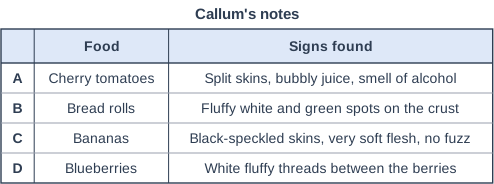
A student, Callum, checked some foods at home and recorded the signs of spoilage he found. The table shows his notes.

For each food A to D, identify the cause of the spoilage. Choose from: enzymic action, mould growth, yeast action. You may use a cause more than once.

Callum's notes. Table with columns (row headings), "Food", "Signs found". A; Food: Cherry tomatoes; Signs found: Split skins, bubbly juice, smell of alcohol | B; Food: Bread rolls; Signs found: Fluffy white and green spots on the crust | C; Food: Bananas; Signs found: Black-speckled skins, very soft flesh, no fuzz | D; Food: Blueberries; Signs found: White fluffy threads between the berries.

Model answer

A: yeast action. B: mould growth. C: enzymic action. D: mould growth.

Explanation

Fuzzy or fluffy growth and coloured spots are signs of mould (B and D); bubbly juice and an alcoholic smell are signs of yeasts fermenting the sugars in fruit (A); and over-ripening with speckled skins and soft flesh, but no growth, is caused by the fruit's own enzymes (C). A common mistake is to think a cause can only be used once, or to blame bacteria for all spoilage.

Mark scheme
  1. 1 mark

    A (cherry tomatoes): yeast action

    Award 1 mark per valid point. Each answer must be matched to the correct food. Accept 'yeasts' / 'fermentation by yeasts' for yeast action, 'mould' for mould growth, and 'enzymes' / 'over-ripening' for enzymic action. Do not credit 'bacteria' for any food.

  2. 1 mark

    B (bread rolls): mould growth

  3. 1 mark

    C (bananas): enzymic action

  4. 1 mark

    D (blueberries): mould growth

Question 4

6 marks

Bethan runs a cheese stall at a weekly farmers' market. She sells hard cheeses such as Cheddar, soft cheeses such as Brie, and blue cheeses. She cuts wedges to order from large cheeses. The cut cheeses are kept in a chilled display cabinet during the market and taken back to her cold store afterwards.

Explain how Bethan can recognise unwanted mould growth on her cheeses, and how she can reduce the risk of it.

Model answer

Bethan must first know which moulds belong in her cheeses. The blue veins inside a blue cheese and the soft white rind on Brie are made by moulds added on purpose, so they are not spoilage. Unwanted mould shows as fuzzy or furry spots, often green, grey or black, on the cut faces of hard cheeses such as Cheddar, or as coloured spots that are different from the white rind of the Brie. It may also give a musty smell or a slimy surface.

To reduce the risk, Bethan should keep all her cheeses chilled at 0-5 °C in the cabinet and the cold store, because chilling slows down mould growth. She should wrap each cut face tightly as soon as a wedge is cut, so that mould spores in the air cannot land on it. Blue cheeses should be wrapped separately and cut with their own knife, so that their mould spores do not spread to the other cheeses, and knives and boards should be cleaned between cheeses. She should check every cheese at each market, use the oldest stock first, and never sell cheese with unwanted mould. A soft cheese such as Brie with unwanted mould must be thrown away whole, because the mould threads spread through it, and the Food Standards Agency warns that cutting mould off gives no guarantee that all its toxins are removed.

Explanation

Top-level answers cover both parts of the question and apply them to Bethan's stall: they separate the moulds added on purpose from unwanted mould, describe clear signs, and explain why each storage or handling step slows mould growth or stops spores spreading. Weaker answers list general hygiene rules without explaining them, or say that any mould on cheese is spoilage, which is wrong for blue and mould-ripened cheeses. Recommending simply cutting the mould off a soft or blue cheese and selling the rest goes against FSA advice.

Mark scheme
  1. 6 marks

    Levels of response (6 marks). AO2.
    Level 3 (5-6 marks): Responses show very good knowledge and understanding of the signs of unwanted mould growth on cheese and how to prevent it. Detailed and factual explanations related to how Bethan should check, handle and store the cheeses she sells.
    Level 2 (3-4 marks): Responses show good knowledge and understanding of the signs of unwanted mould growth on cheese and how to prevent it. Factual explanations, some of which relate to how Bethan should check, handle and store the cheeses she sells.
    Level 1 (1-2 marks): Responses show limited knowledge and understanding of the signs of unwanted mould growth on cheese and how to prevent it. Limited explanation related to how Bethan should check, handle and store the cheeses she sells.
    0 marks: nothing to reward.

    Indicative content (not a checklist; credit other valid points): Recognising unwanted mould: some moulds are added on purpose and are not spoilage, e.g. the blue veins inside blue cheese and the soft white rind on Brie; unwanted mould shows as fuzzy, furry or powdery spots or patches; it is often green, grey, blue, black, or pink or orange, in a colour different from the cheese's own mould; on hard cheeses such as Cheddar it appears on cut faces and on the rind; on Brie it shows as coloured spots on the white rind; on blue cheese it appears as fuzzy growth on the surface or cut face rather than in the veins; a musty, unpleasant smell; a slimy, wet or discoloured surface; dried, cracked cut faces often go mouldy first. Reducing the risk: keep all cheeses chilled at 0-5 °C in the display cabinet and the cold store, as chilling slows mould growth; keep the cheeses cold while travelling (e.g. in cool boxes) so their temperature does not rise; wrap cut faces tightly straight after cutting (e.g. cheese paper, wax paper or cling film), so spores in the air cannot land on them and the cheese does not dry out; wrap blue cheeses separately and use a separate knife or wire for them, so their mould spores do not spread to other cheeses; clean knives, wires and boards between cheeses; wash hands; cut wedges to order so cut surfaces are not left exposed; check every cheese at each market and in the cold store; use the oldest stock first; buy in amounts she is likely to sell; avoid condensation (e.g. moving cheese in and out of the cold), as moisture encourages mould; keep the cabinet and cold store clean. Never sell soft or blue cheese with unwanted mould: mould threads spread through soft cheese, and FSA guidance for businesses is that soft cheese with visible mould is thrown away whole; on a large block of hard cheese such as Cheddar, the same FSA guidance allows the mould to be cut away hygienically with 1-2 cm of unaffected cheese, so credit this where the answer recognises the risk; the FSA's advice to consumers is that food containing mould should not be eaten, as cutting off the mould gives no guarantee that all toxins are removed. Do not credit simply scraping mould off soft cheese and selling it.

Ready to try the rest? Every answer you write is marked against the mark scheme, so you can see exactly where the marks are.

Study Helper Hints first, answers after you try

Stuck on this one? Ask for a hint and I’ll point you in the right direction, without giving the answer away. Once you’ve checked your answer, I’ll show you how the marks are awarded.