
Level:
Correct: 0
Incorrect: 0
Marks: 0/0
Exam Practice
Course:
Topics:
AQA GCSE Food Preparation and Nutrition Smart practice A mixed round aimed at your weak spots
Unit 1
Food preparation skills
Unit 2
Food, nutrition and health
Unit 3
Food science
Unit 4
Food safety
Unit 5
Food choice
Unit 6
Food provenance
Avg
score:
–
Topics
done:
0/37

British and international cuisines

Practise 18 exam-style questions on British and international cuisines for AQA GCSE Food Preparation and Nutrition. Write your answer as you would in the exam and get it marked in seconds against the mark scheme, point by point, with the Study Helper on hand if you get stuck.

  • 18 questions
  • 1–12 marks each
  • Instant marking
  • No sign-up needed
18 questions, marked as you go

Sample questions with model answers

Here are 4 of the questions in this topic, each with a model answer, an explanation of why it earns the marks and the mark scheme an examiner would use.

Question 1

1 mark

In some Indian and Pakistani cooking, naan bread and marinated chicken are cooked in a deep, round clay oven heated by charcoal or wood. The naan dough is pressed onto the very hot inside wall of the oven, where it cooks in a few minutes.

What is this oven called?

Choose your answer.

  • Tawa
  • Tagine
  • Tandoor
  • Wok

Model answer

Tandoor

Explanation

A tandoor is a clay oven that reaches very high temperatures, so naan bakes quickly on its wall and tandoori chicken cooks on long skewers lowered inside it. A tawa is a flat or slightly curved metal griddle used on the hob for chapatis and parathas, a tagine is a North African earthenware cooking pot with a cone-shaped lid, and a wok is a round-bottomed pan used for stir frying. A common mistake is to confuse the tandoor with the tawa, because both are used to cook Indian breads.

Mark scheme
  1. 1 mark

    Tandoor

    If more than one option is given, 0 marks.
Question 2

4 marks

Many traditional British dishes and food products are linked to a particular part of the UK.

Name one traditional dish or food product from each of the following:
- Scotland
- Wales
- Northern Ireland
- a county, city or region of England. Name the place as well as the dish.

Model answer

Scotland: Scotch broth
Wales: bara brith
Northern Ireland: soda farls
England: Derbyshire - Bakewell pudding

Explanation

Regional dishes grew from the ingredients, work and traditions of each area, such as oats in Scotland and potatoes in Northern Ireland. Each answer must be correctly linked to its part of the UK, and the English dish needs its place. A common mistake is to give a dish eaten all over the UK, such as fish and chips, or to assume that a dish with a place in its name comes from there, such as the Scotch egg.

Mark scheme
  1. 1 mark

    Scotland: haggis (with neeps and tatties) / Scotch broth / cullen skink / cock-a-leekie soup / cranachan / shortbread / porridge / oatcakes / Arbroath smokies / stovies / clootie dumpling / tablet / Dundee cake / Scotch pie / Forfar bridie / Selkirk bannock / Scotch pancakes (drop scones)

    Award 1 mark per valid point. One mark for each part of the UK; the dish must be correctly linked to that part. Do not credit Scotch eggs for Scotland: they are not generally thought to come from Scotland. Do not credit dishes with no particular regional link, such as fish and chips or roast beef, for any part.

  2. 1 mark

    Wales: Welsh cakes / bara brith / cawl / Welsh rarebit / laverbread / Glamorgan sausages / Caerphilly cheese / Anglesey eggs

  3. 1 mark

    Northern Ireland: Ulster fry / soda bread or soda farls / potato bread (potato farls, fadge or tattie bread) / champ / Irish stew / boxty / yellowman / dulse / Armagh Bramley apple dishes such as apple tart

  4. 1 mark

    England, with the place named: Cornwall - Cornish pasty / saffron buns / stargazy pie; Devon - cream tea / Devonshire splits; Yorkshire - Yorkshire pudding / parkin / Yorkshire curd tart / Wensleydale cheese; Lancashire - Lancashire hotpot / Eccles cakes / Morecambe Bay potted shrimps / black pudding (Bury); Liverpool - scouse; North East - stottie cake / pease pudding / pan haggerty; Cumbria - Cumberland sausage / Grasmere gingerbread / Kendal mint cake; Derbyshire - Bakewell pudding or tart; Leicestershire - Melton Mowbray pork pie / Stilton / Red Leicester; Birmingham - balti; Black Country - faggots and peas; Staffordshire - oatcakes; London - pie and mash / jellied eels / Chelsea buns; Bath - Bath buns; Somerset - Cheddar cheese

    Accept any other correctly linked county, city or region of England; for example, Eccles cakes may be linked with Lancashire, Salford or Greater Manchester. Do not credit a dish without a correctly named place in England. Any other relevant and correct response can be credited.

Question 3

4 marks

Name one international cuisine you have studied.

For this cuisine, name two pieces of traditional equipment and explain how each one is used.

Model answer

Cuisine: Chinese

1. A wok is a large, round-bottomed pan. It is used for stir frying: small, even pieces of meat and vegetables are cooked very quickly in a little oil over a high heat and kept moving all the time.

2. A bamboo steamer is a round basket with a lid. Baskets are stacked over a wok of boiling water so that dumplings, buns or fish cook gently in the steam.

Explanation

Each piece of equipment earns one mark, and a second mark comes from explaining how it is used in that cuisine, such as stir frying in a wok or steaming dumplings in a bamboo basket. Everyday equipment such as a saucepan does not show what is distinctive about a cuisine. A common mistake is to name equipment from a different cuisine, such as a tagine for Indian cooking.

Mark scheme
  1. 1 mark

    A first piece of equipment that is traditional in the named cuisine

    Award 1 mark per valid point or 2 marks for each point that is clearly explained. A maximum of two marks can be awarded for each piece of equipment. No mark for naming the cuisine, but the equipment must be traditional in that cuisine. Do not credit equipment found in most kitchens (e.g. saucepan, knife, frying pan, oven) unless a use distinctive to the cuisine is given. The list below is not exhaustive: credit equipment that is traditional in any international cuisine studied. Examples - Chinese: wok (stir frying small pieces quickly over a high heat; also deep frying and steaming); bamboo steamer (stacked over boiling water to steam dumplings, buns and fish); cleaver (chopping meat and vegetables, crushing garlic with the flat blade); chopsticks. Indian: tawa (flat or slightly curved griddle for chapatis, rotis and parathas); tandoor (clay oven for naan and tandoori dishes); karahi or kadai (deep, round pan for frying and curries); pestle and mortar or spice grinder (grinding whole spices); masala dabba (round tin of spices); belan and chakla (rolling pin and round board for chapatis). Italian: pasta machine (rolling and cutting fresh pasta); wood-fired oven (baking pizza very quickly at a very high temperature); mezzaluna (curved blade for chopping herbs); ravioli cutter or stamp. Mexican: comal (flat griddle for tortillas and toasting chillies); tortilla press (flattening balls of masa dough); molcajete (stone pestle and mortar for salsas and guacamole). Japanese: rice cooker; makisu (bamboo mat for rolling sushi); tamagoyaki pan (rectangular pan for rolled omelette); donabe (clay pot). Moroccan: tagine (earthenware pot with a cone-shaped lid for slow-cooked stews); couscoussier (steams couscous over a stew). Spanish: paella pan (wide, shallow pan so the rice cooks in a thin layer); cazuela (earthenware dish); plancha (flat griddle). Thai: wok; granite or clay pestle and mortar (pounding curry pastes and salads); bamboo basket (steaming sticky rice). Caribbean: Dutch pot (heavy pot for stews and rice and peas); jerk drum or barbecue (grilling jerk chicken). French: bain-marie; mandoline; crepe pan; ramekins.

  2. 1 mark

    A correct explanation of how it is used, e.g. the wok is used to stir fry small, even pieces of food quickly over a high heat, tossing them all the time

  3. 1 mark

    A second, different piece of equipment that is traditional in the named cuisine

  4. 1 mark

    A correct explanation of how it is used, e.g. the bamboo steamer is stacked over a wok of boiling water so that dumplings or buns cook in the steam

    Any other relevant and correct response can be credited.

Question 4

6 marks

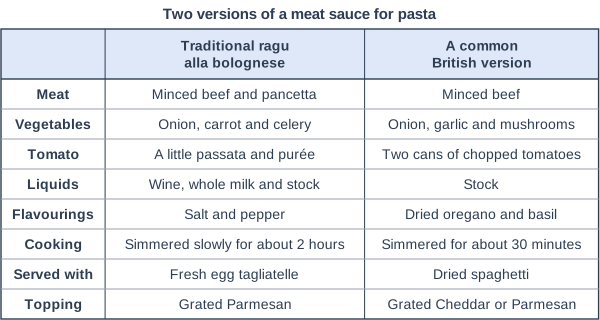
The table compares a traditional ragu alla bolognese from the city of Bologna in northern Italy with a version of spaghetti bolognese commonly made in the UK.

Explain how the British version differs from the traditional Italian recipe and suggest reasons for these changes.

Two versions of a meat sauce for pasta. Table with columns (row headings), "Traditional ragu alla bolognese", "A common British version". Meat; Traditional ragu alla bolognese: Minced beef and pancetta; A common British version: Minced beef | Vegetables; Traditional ragu alla bolognese: Onion, carrot and celery; A common British version: Onion, garlic and mushrooms | Tomato; Traditional ragu alla bolognese: A little passata and purée; A common British version: Two cans of chopped tomatoes | Liquids; Traditional ragu alla bolognese: Wine, whole milk and stock; A common British version: Stock | Flavourings; Traditional ragu alla bolognese: Salt and pepper; A common British version: Dried oregano and basil | Cooking; Traditional ragu alla bolognese: Simmered slowly for about 2 hours; A common British version: Simmered for about 30 minutes | Served with; Traditional ragu alla bolognese: Fresh egg tagliatelle; A common British version: Dried spaghetti | Topping; Traditional ragu alla bolognese: Grated Parmesan; A common British version: Grated Cheddar or Parmesan.

Model answer

The British version uses only minced beef, while the traditional ragu also uses pancetta. The ragu gets its flavour from a base of onion, carrot and celery, with wine and whole milk, and only a little passata and tomato puree, so it is a thick, meaty sauce. The British version adds garlic, mushrooms, dried oregano and basil and two cans of chopped tomatoes, so it is redder, more tomato-flavoured and more liquid. The ragu is simmered slowly for about 2 hours, which makes the meat very tender, but the British version is cooked for only about 30 minutes. It is also served with dried spaghetti rather than fresh egg tagliatelle, and sometimes with Cheddar instead of Parmesan.

There are several likely reasons for these changes. Many British families want a quick weekday meal, so a 30-minute sauce suits busy lifestyles better than 2 hours of simmering. When the dish first became popular in the UK, Italian ingredients such as pancetta, Parmesan and fresh egg pasta were harder to find and more expensive, while canned tomatoes, dried herbs, dried spaghetti and Cheddar were cheap and easy to buy, and dried pasta keeps for a long time. Adding mushrooms and extra tomatoes makes the meat go further, which saves money, and suits British tastes for a garlicky, herby sauce. The adapted recipe is now a modern variation in its own right.

Explanation

Top-level answers use the table to explain several specific differences (meat, tomato, liquids, flavourings, cooking time, pasta and cheese) and say what effect each has on the sauce, then give convincing reasons such as time, cost, availability and British tastes. The best answers link each reason to a particular change. Common pitfalls are copying the table without explaining, or giving vague reasons such as 'British people prefer it'.

Mark scheme
  1. 6 marks

    Levels of response (6 marks). AO2.
    Level 3 (5-6 marks): Responses show very good knowledge and understanding of how the British spaghetti bolognese differs from the traditional ragu alla bolognese. Detailed and factual explanations related to the reasons for the changes, such as time, cost, availability and British tastes.
    Level 2 (3-4 marks): Responses show good knowledge and understanding of how the British spaghetti bolognese differs from the traditional ragu alla bolognese. Factual explanations, some of which relate to the reasons for the changes, such as time, cost, availability and British tastes.
    Level 1 (1-2 marks): Responses show limited knowledge and understanding of how the British spaghetti bolognese differs from the traditional ragu alla bolognese. Limited explanation related to the reasons for the changes, such as time, cost, availability and British tastes.
    0 marks: nothing to reward.

    Indicative content (not a checklist; credit other valid points): Differences: only beef and no pancetta, so less pork flavour; garlic, mushrooms and dried herbs are added, whereas the ragu has no garlic or herbs and gets its flavour from the onion, carrot and celery base, the pancetta, wine and long cooking; much more tomato, so the British sauce is redder, more acidic and more liquid, whereas the ragu is a thick, meaty sauce with only a little tomato; no wine or milk (milk gives the ragu a mellow flavour and tender meat); simmered for about 30 minutes instead of about 2 hours, so less flavour develops and the meat is less tender; served with dried spaghetti rather than fresh egg tagliatelle, whose wide ribbons hold the thick sauce; Cheddar may be used instead of Parmesan. Reasons: time - busy families want a quick weekday meal, so a 30-minute sauce suits modern lifestyles; availability and cost - in the past pancetta, Parmesan and fresh egg pasta were hard to find or expensive in the UK, while canned tomatoes, dried herbs, dried spaghetti and Cheddar were cheap and easy to buy; dried pasta keeps for a long time in the cupboard; British tastes - many people like a garlicky, herby, tomato-rich sauce, and Cheddar is a familiar cheese; extra vegetables such as mushrooms and tomatoes make the meat go further and count towards 5 A Day; wine may be left out for cost, for children or for religious reasons; the recipe has been adapted over many years through cookbooks, television and jars of ready-made sauce, so the British version has become a modern variation in its own right. Do not credit 'it is healthier' or 'it tastes better' unless explained.

Ready to try the rest? Every answer you write is marked against the mark scheme, so you can see exactly where the marks are.

Study Helper Hints first, answers after you try

Stuck on this one? Ask for a hint and I’ll point you in the right direction, without giving the answer away. Once you’ve checked your answer, I’ll show you how the marks are awarded.