Level:
Correct: 0
Incorrect: 0
Marks: 0/0
Practice
Course:
Topics:
Year 3 Maths Smart practice A mixed round aimed at your weak spots
Unit 1
Place value
Unit 2
Addition and subtraction
Unit 3
Multiplication and division
Unit 4
Fractions
Unit 5
Measurement
Unit 6
Geometry
Unit 7
Statistics
Statistics
Pictograms
Quick practice5 skills
Bar charts
Quick practice6 skills
Tables
Quick practice5 skills
Avg
score:
–
Topics
done:
0/36

Telling the time

Practise 24 questions on Telling the time for Year 3 Maths. Tap your answer and find out straight away if you are right, with the Study Helper on hand if you get stuck.

  • 24 questions
  • 1–4 marks each
  • Instant marking
  • No sign-up needed
20 questions, marked as you go

Sample questions with model answers

Here are 4 of the questions in this topic, each with a model answer, an explanation of why it earns the marks and the mark scheme.

Question 1

1 mark

The picture shows an old clock. It has Roman numerals.

What time does it show?

A round clock face with the Roman numerals I to XII and a small mark for every minute. The short hour hand is between the IX and the X. The long minute hand points to the V.

Model answer

IX means 9, and the hour hand has just gone past it.
V means 5, so the minute hand is on the 5.
That is 25 minutes past.
It is 25 minutes past 9.

Explanation

Read Roman numerals just like ordinary numbers: IX is 9 and V is 5. The minute hand on V means 5 lots of 5 minutes, which is 25 minutes past. A common mistake is to say 5 minutes past, by reading the number on the clock face as the minutes.

Mark scheme
  1. 1 mark

    25 minutes past 9

    Accept twenty-five past nine, 25 past 9, 9:25, 9.25, 09:25, 21:25, nine twenty-five, 35 minutes to 10, or any of these with am or pm. Do not accept 5 past 9 (V read as 5 minutes) or 25 past 10.

Question 2

2 marks

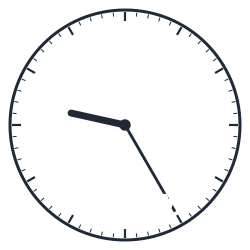
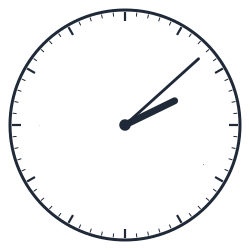
Reece is at the park. He looks at the clock in the picture.

What time does it show?

A round clock face with the numbers 1 to 12 and a small mark for every minute. The short hour hand is between the 2 and the 3. The long minute hand points to the third small mark after the 1.

Model answer

The hour hand is just past the 2, so the hour is 2.
The minute hand is 3 small marks past the 1.
The 1 is 5 minutes.
\(5 + 3 = 8\)
It is 8 minutes past 2.

Explanation

Count in fives up to the number just before the minute hand, then count the small marks in ones. The hand has gone past the 1, which is 5 minutes, and then 3 small marks more, which makes 8. A common mistake is to round to the nearest five and say 10 past 2.

Mark scheme
  1. 1 mark

    The hour read correctly: the time is after 2 o'clock and before 3 o'clock (for example 2:..., '... past 2' or '... to 3'); or the correct answer 2:08 with no working

    In the 'to' form the hour named is the next hour, so '... minutes to 3' shows the hour read correctly. Do not accept 3:08 for this mark.

  2. 1 mark

    The minutes read correctly: 8 minutes past (or 52 minutes to)

    This mark does not need the hour to be right: for example 3:08 scores this mark only, and 2:10 scores the first mark only. Do not accept 7, 9 or 10 minutes past. The full answer is 2:08. Any correct way of writing it scores both marks: 2:08, 2.08, 02:08, 14:08, 8 minutes past 2, eight minutes past two, 8 past 2, two oh eight, 52 minutes to 3, or any of these with am or pm. A correct answer with no working scores full marks.

Question 3

2 marks

Here are three times from one day.

Put them in order. Start with the earliest.

Model answer

am times come before noon.
pm times come after noon.
The order is 9:40 am, noon, 2:15 pm.

Explanation

The day starts at midnight. Morning times, am, come first. Then comes noon, and pm times come after that. A common mistake is to put 2:15 pm first, because 2 is a small number. Check whether it is am or pm before you compare.

Mark scheme
  1. 1 mark

    9:40 am is first; or the correct order with no working

  2. 1 mark

    9:40 am, noon, 2:15 pm

    Accept 12:00 or 12 noon for noon. Do not accept noon first or 2:15 pm first. A correct answer with no working scores full marks.

Question 4

4 marks

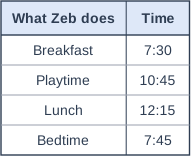
The table shows some times in Zeb's day.

Is each time am or pm?

Table with columns "What Zeb does", "Time". What Zeb does: Breakfast; Time: 7:30 | What Zeb does: Playtime; Time: 10:45 | What Zeb does: Lunch; Time: 12:15 | What Zeb does: Bedtime; Time: 7:45.

Model answer

Breakfast is in the morning: 7:30 am.
Playtime is in the morning at school: 10:45 am.
Lunch is just after noon: 12:15 pm.
Bedtime is in the evening: 7:45 pm.

Explanation

Times before noon are am, and times from noon onwards are pm. Think about when each thing happens in the day. Lunch at 12:15 is just after noon, so it is pm. A common mistake is to think that 12:15 is am, because 12 looks like the start of the clock.

Mark scheme
  1. 1 mark

    Breakfast: am

  2. 1 mark

    Playtime: am

    Playtime at 10:45 is in the morning, at school. Do not accept pm.

  3. 1 mark

    Lunch: pm

    12:15 is just after noon, so it is pm. Do not accept am.

  4. 1 mark

    Bedtime: pm

    Accept a list in the table's order: am, am, pm, pm. Accept a.m., p.m., AM and PM. Each time earns its own mark, and no working is needed.

Ready to try the rest? Tap your answers and see straight away how you did.

Topic notes

Telling the time

The big idea

A clock tells us the time. An analogue clock has hands that turn. A digital clock shows the time in numbers.

Reading an analogue clock

The short hand is the hour hand. The long hand is the minute hand. It takes 5 minutes for the long hand to move from one number to the next. Each small step between the numbers is 1 minute. When the long hand points to the 12, it is an o'clock time, like 4 o'clock.

  1. Long hand: count in fives from the 12 to the last number it has passed. Then count on in ones.
  2. Short hand: the hour is the last number it has passed.
A clock with the numbers 1 to 12 and small dots for the minutes between them. The long hand points 3 dots past the 4. The short hand is a little before halfway from the 8 to the 9. The time is 8:23.
The long hand has passed the 4, so count 5, 10, 15, 20. It is 3 small steps more: 21, 22, 23. The short hand has passed the 8. The time is 23 minutes past 8.

The short hand on its own gives a rough time, called an estimate. On the 7 is about 7 o'clock. Halfway from the 7 to the 8 is about half past 7.

Past and to

Past means after an o'clock. To means before the next o'clock.

  • Long hand on the right side of the clock: say past. On the 3, say quarter past.
  • Long hand on the 6: say half past.
  • Long hand on the left side: say to, and name the next hour. Count on from the long hand to the 12 to find the minutes. On the 9, say quarter to.

Digital times

A digital clock shows the hour first. Then come two dots. After the dots come the minutes past the hour. So 3:25 means 25 past 3.

DigitalIn words
11:055 past 11
6:30half past 6
9:5010 to 10

Dad's bus comes at 20 past 11. Where do the hands point on the clock at that time?

Long hand: 4 lots of 5 make 20, so it points to the 4.

Short hand: the hour is 11, so it is a little way past the 11, about a third of the way to the 12.

A sign on a café door says "Back at 1:40". Where is the long hand when the café opens? How do we say this time in words?

The minutes are 40. 8 lots of 5 make 40, so the long hand points to the 8.

From 40 minutes to the next o'clock is \(60 - 40 = 20\) minutes.

The next o'clock is 2. So we say 20 to 2.

Roman numerals

Some clocks use Roman numerals. Read them just like ordinary numbers.

Roman numeralIIIIIIIVVVIVIIVIIIIXXXIXII
Number123456789101112
A clock with Roman numerals from I to XII and small dots for the minutes between them. The long hand points 3 dots past VIII. The short hand is between II and III, close to III. The time is 2:43.
This clock has Roman numerals. It shows 17 minutes to 3.

A tower clock has Roman numerals. It is 17 minutes to 3. Where does each hand point?

17 minutes to 3 is the same as \(60 - 17 = 43\) minutes past 2.

Long hand: VIII is 8, and 8 lots of 5 make 40. So 43 is 3 small steps past VIII.

Short hand: it is nearly 3, but not yet. So it is between II and III, close to III.

am and pm

The hours go round twice each day. So we use am and pm to say which time we mean.

  • Midnight is 12 o'clock in the middle of the night. The day starts here.
  • am times go from midnight until noon. This includes the morning.
  • Noon (or midday) is 12 o'clock in the middle of the day.
  • pm times go from noon until midnight. This includes the afternoon and the evening.

So 25 past 3 in the afternoon is 3:25 pm.

Stretch: 24-hour times

Some clocks keep counting after noon. They show 13:00 for 1 pm, 14:00 for 2 pm, and so on.

Remember

  • The hour is the last number the short hand has passed.
  • Count in fives for the long hand.
  • For "to" times, name the next o'clock.

Common mistakes

  • Reading the hour from the nearest number. At 3:55 the short hand is nearly at 4, but the hour is still 3.
  • Reading the number as the minutes. A long hand on the 4 means 20 minutes, not 4 minutes.
  • Naming the wrong hour with "to". 8:50 is 10 to 9, not 10 to 8.
  • Writing a "to" time in the order you say it. 20 to 6 is 5:40, not 6:20.
  • Mixing up am and pm. Morning times are am.

Top tip

Look at the long hand first and work out the minutes. Then ask which number the short hand has just passed.

Study Helper Hints first, answers after you try

Stuck on this one? Ask for a hint and I’ll point you in the right direction, without giving the answer away. Once you’ve checked your answer, I’ll show you how the marks are awarded.