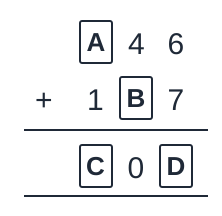
The big idea
Column addition is a way to add bigger numbers on paper. You write one number under the other. Then you add one column at a time, starting on the right.
Start with partitioning
To partition a number means to split it into hundreds, tens and ones. You can add the parts, then put them together. To add \(324 + 153\):
- Hundreds: \(300 + 100 = 400\)
- Tens: \(20 + 50 = 70\)
- Ones: \(4 + 3 = 7\)
\(400 + 70 + 7 = 477\). Column addition does the same thing, but it is shorter to write.
Setting out the columns
Each digit is one of the signs 0 to 9. It goes in a column: hundreds (H), tens (T) or ones (O).
- Write the numbers one under the other, with ones under ones and tens under tens.
- Draw a line. The answer goes under it.
- Add the ones first. Then add the tens, then the hundreds.
A library has 324 books. It buys 153 new books. How many books does it have now?
The library gets more books, so add.
\[ \begin{array}{cccc} & \text{H} & \text{T} & \text{O} \\ & 3 & 2 & 4 \\ + & 1 & 5 & 3 \\ \hline & 4 & 7 & 7 \end{array} \]
Ones: \(4 + 3 = 7\). Tens: \(2 + 5 = 7\). Hundreds: \(3 + 1 = 4\).
The library has 477 books.
Carrying
Sometimes a column makes 10 or more. Only one digit can go in each column. So write the ones digit in the answer. The ten moves into the next column on the left, as a 1.
This is called carrying. Some people say exchanging, because 10 ones are swapped for 1 ten. Write the carried 1 small, under the answer line. Add it in with the next column.
A 2-digit number has no hundreds. Line up the ones, and leave the hundreds place empty.
A pet shop has 236 fish. Then 48 more fish arrive. How many fish does it have now?
\[ \begin{array}{cccc} & 2 & 3 & 6 \\ + & & 4 & 8 \\ \hline & 2 & 8 & 4 \\ & & {\scriptsize 1} & \end{array} \]
Ones: \(6 + 8 = 14\). Write 4 and carry 1 into the tens.
Tens: \(3 + 4 = 7\), and the carried 1 makes 8.
Hundreds: the 2 comes straight down.
The shop has 284 fish.
The tens can make 10 or more as well. Then you carry 1 into the hundreds, because 10 tens make 1 hundred. Some additions need two carries.
Class 3 collects 278 bottle tops. Class 4 collects 165. How many do they collect altogether?
\[ \begin{array}{cccc} & 2 & 7 & 8 \\ + & 1 & 6 & 5 \\ \hline & 4 & 4 & 3 \\ & {\scriptsize 1} & {\scriptsize 1} & \end{array} \]
Ones: \(8 + 5 = 13\). Write 3 and carry 1.
Tens: \(7 + 6 = 13\), and the carried 1 makes 14. Write 4 and carry 1.
Hundreds: \(2 + 1 = 3\), and the carried 1 makes 4.
They collect 443 bottle tops.
Missing digits
Start with the ones and move left, as usual. In \(1\square 6 + 238 = 384\), the ones make \(6 + 8 = 14\). Write 4 and carry 1. In the tens, the 3 and the carried 1 make 4. The answer has 8 tens, and \(4 + 4 = 8\). So the missing digit is 4. Check: \(146 + 238 = 384\).
When your head is quicker
You do not always need columns. Look at the numbers first. \(300 + 400\) has only hundreds, so do it in your head: 3 hundreds and 4 hundreds make 7 hundreds, which is 700.
Stretch: totals over 999
Sometimes the hundreds make 10 or more. 10 hundreds make 1 thousand, so the 1 goes in a new column on the left.
\[ \begin{array}{ccccc} & \text{Th} & \text{H} & \text{T} & \text{O} \\ & & 6 & 5 & 0 \\ + & & 4 & 7 & 5 \\ \hline & 1 & 1 & 2 & 5 \\ & {\scriptsize 1} & {\scriptsize 1} & & \end{array} \]
Ones: \(0 + 5 = 5\). Tens: \(5 + 7 = 12\). Write 2 and carry 1. Hundreds: \(6 + 4 + 1 = 11\). Write 1 and carry 1 into the thousands. The answer is 1,125.
Common mistakes
- Forgetting a carried 1. \(236 + 48\) is 284, not 274.
- Lining up from the left. Putting the 4 of 48 under the 2 of 236 adds 480, not 48.
- Writing the 1 and carrying the 3. When a column makes 13, write the 3 and carry the 1.
- Starting on the left. Always start with the ones.
Top tip
Line up the ones under the ones. Write each carried 1 small, so you do not forget it.