Level:
Correct: 0
Incorrect: 0
Marks: 0/0
Practice
Course:
Topics:
Year 3 Maths Smart practice A mixed round aimed at your weak spots
Unit 1
Place value
Unit 2
Addition and subtraction
Unit 3
Multiplication and division
Unit 4
Fractions
Unit 5
Measurement
Measurement
Length
Quick practice5 skills
Perimeter
Quick practice5 skills
Mass
Quick practice5 skills
Capacity and volume
Quick practice5 skills
Money
Quick practice5 skills
Telling the time
Quick practice6 skills
Units of time and durations
Quick practice6 skills
Unit 6
Geometry
Unit 7
Statistics
Statistics
Pictograms
Quick practice5 skills
Bar charts
Quick practice6 skills
Tables
Quick practice5 skills
Avg
score:
–
Topics
done:
0/36

10 or 100 more or less

Practise 17 questions on 10 or 100 more or less for Year 3 Maths. Tap your answer and find out straight away if you are right, with the Study Helper on hand if you get stuck.

  • 17 questions
  • 1–4 marks each
  • Instant marking
  • No sign-up needed
17 questions, marked as you go

Sample questions with model answers

Here are 4 of the questions in this topic, each with a model answer, an explanation of why it earns the marks and the mark scheme.

Question 1

1 mark

What number is 1 less than 300?

Model answer

\(300 - 1 = 299\)

Explanation

300 has no tens or ones, so you go back across the hundred. The number just before 300 is 299. A common mistake is to write 209 by forgetting that the tens digit becomes 9 as well.

Mark scheme
  1. 1 mark

    299

    Do not accept 301, 200 or 209.

Question 2

2 marks

What number is 10 more than 562?

What number is 10 less than 562?

Model answer

\(562 + 10 = 572\)
\(562 - 10 = 552\)

Explanation

Only the tens digit changes. It goes up by 1 for 10 more and down by 1 for 10 less. So the tens digit 6 becomes 7, or 5. A common mistake is to change the hundreds digit instead.

Mark scheme
  1. 1 mark

    10 more: 572

    Do not accept 662 (100 more) or 563 (1 more).

  2. 1 mark

    10 less: 552

    Do not accept 462 (100 less) or 561 (1 less). If the answers are not labelled, take them in the order the questions are asked.

Question 3

3 marks

Priya adds 100 to 347.

What is the new number?

Which digit changes?

Why do the other two digits stay the same?

Model answer

\(347 + 100 = 447\)
The hundreds digit changes from 3 to 4.
100 is 1 hundred, 0 tens and 0 ones, so the tens and ones do not change.

Explanation

100 is 1 hundred, 0 tens and 0 ones. So the hundreds go up by 1, but nothing is added to the tens or the ones. A common mistake is to think the tens digit must change too, as it does when adding 10.

Mark scheme
  1. 1 mark

    447

    Do not accept 357 or 348.

  2. 1 mark

    The hundreds digit

    Accept 'the 3', 'the first digit', or 'the 3 changes to a 4'. Do not accept the tens digit.

  3. 1 mark

    A correct reason, for example: adding 100 is adding 1 hundred, with no tens or ones added; or 100 has 0 tens and 0 ones

    'Because you only add 100' alone is not enough: the pupil must link it to no tens or ones being added, or to only the hundreds going up.

Question 4

4 marks

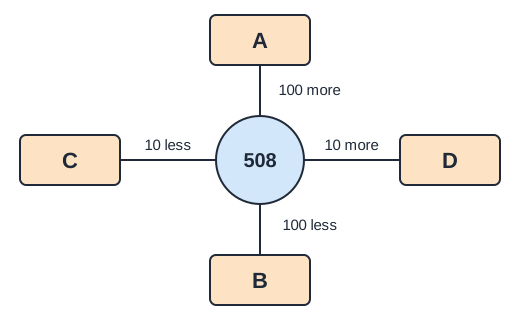
The picture shows a number web. The number in the middle is 508.

What numbers are A, B, C and D?

A number web with 508 in the middle. A line goes up to box A, labelled 100 more. A line goes down to box B, labelled 100 less. A line goes left to box C, labelled 10 less. A line goes right to box D, labelled 10 more.

Model answer

A: \(508 + 100 = 608\)
B: \(508 - 100 = 408\)
C: \(508 - 10 = 498\)
D: \(508 + 10 = 518\)

Explanation

100 more and 100 less change only the hundreds digit. 10 more changes only the tens digit. 10 less is the tricky one: 508 has no tens, so you go back over 500 to 498. A common mistake is to write 408 for C.

Mark scheme
  1. 1 mark

    A = 608

    Do not accept 408 or 518.

  2. 1 mark

    B = 408

    Do not accept 608 or 498.

  3. 1 mark

    C = 498

    Do not accept 408 (100 less) or 518 (10 more).

  4. 1 mark

    D = 518

    Do not accept 608 or 509. If the answers are not labelled, take them in the order A, B, C, D. Correct answers with no working score full marks.

Ready to try the rest? Tap your answers and see straight away how you did.

Topic notes

10 or 100 more or less

The big idea

Adding or taking away 1, 10 or 100 is quick. You change just one digit, a sign from 0 to 9. Only a few numbers need more care. Those are the ones where a digit is 9 or 0.

Which digit changes?

Each amount belongs to one place in the number. So only that place changes.

ChangeDigit that changesStarting at 482
1 moreones digit goes up by 1483
1 lessones digit goes down by 1481
10 moretens digit goes up by 1492
10 lesstens digit goes down by 1472
100 morehundreds digit goes up by 1582
100 lesshundreds digit goes down by 1382

Why does only one digit change? Look at 10. It is just 1 ten, with no hundreds and no ones. So adding 10 adds nothing to the hundreds or the ones.

A toy train has gone 463 cm. It goes 100 cm more. Then it goes 10 cm more. How far has it gone now?

100 more changes the hundreds digit. The 4 becomes 5, so 463 becomes 563.

10 more changes the tens digit. The 6 becomes 7, so 563 becomes 573.

The toy train has gone 573 cm.

Crossing a hundred

Take care when the tens digit is 9 or 0.

10 more when the tens digit is 9. Ten tens make a hundred. So the tens digit goes to 0, and the hundreds digit goes up by 1.

\[195 + 10 = 205\]

10 less when the tens digit is 0. There are no tens to take. So you go back over the hundred. The tens digit goes to 9, and the hundreds digit goes down by 1.

\[403 - 10 = 393\]

To see why, take 3 from 403 to reach 400. Then take the other 7 to reach 393.

The same thing happens with 1 more and 1 less. 1 more than 499 is 500. 1 less than 600 is 599.

Ravi makes 701 with counters: 7 counters worth 100 and 1 counter worth 1. He must take away 10, but he has no counters worth 10. What can he do?

He can swap 1 counter worth 100 for 10 counters worth 10. They are worth the same, so he still has 701. Now it is 6 hundreds, 10 tens and 1 one.

He takes away 1 counter worth 10. That leaves 6 hundreds, 9 tens and 1 one.

So 10 less than 701 is 691.

Missing numbers

To find a missing number, do the opposite step.

  • \(\square + 10 = 505\). The opposite of adding 10 is taking away 10. \(505 - 10 = 495\), so the missing number is 495.
  • \(\square - 100 = 271\). The opposite of taking away 100 is adding 100. \(271 + 100 = 371\), so the missing number is 371.

Then check: put your number back in. \(495 + 10 = 505\).

Number machines

A number machine does something to each number that goes in. Follow the steps in order. To find what went in, start at the end. Work back, doing the opposite of each step.

A robot moves along a number line. First it goes 10 more. Then it goes 100 less. It ends at 600. Where did it start?

Start at the end and work back. Do the opposite of each step.

The last step was 100 less, so add 100: \(600 + 100 = 700\).

The first step was 10 more, so take away 10: \(700 - 10 = 690\).

The robot started at 690.

Check by going forwards: 10 more than 690 is 700, and 100 less than 700 is 600.

Four boxes joined by arrows: start at 690, then 10 more, then 100 less, then end at 600.
The robot's moves, written like a number machine.

Common mistakes

  • Changing the wrong digit. 10 more than 482 is 492, not 483.
  • Mixing up 10 and 100. 10 less than 403 is 393, not 303.
  • Forgetting to change the hundreds. 10 more than 195 is 205, not 105.
  • Working forwards when you know the end number. Start at the end and work back.

Top tip

Before you start, look at the tens digit. If it is 9 or 0, slow down: you may cross a hundred.

Study Helper Hints first, answers after you try

Stuck on this one? Ask for a hint and I’ll point you in the right direction, without giving the answer away. Once you’ve checked your answer, I’ll show you how the marks are awarded.