Level:
Correct: 0
Incorrect: 0
Marks: 0/0
Practice
Course:
Topics:
Year 3 Maths Smart practice A mixed round aimed at your weak spots
Unit 1
Place value
Unit 2
Addition and subtraction
Unit 3
Multiplication and division
Unit 4
Fractions
Unit 5
Measurement
Measurement
Length
Quick practice5 skills
Perimeter
Quick practice5 skills
Mass
Quick practice5 skills
Capacity and volume
Quick practice5 skills
Money
Quick practice5 skills
Telling the time
Quick practice6 skills
Units of time and durations
Quick practice6 skills
Unit 6
Geometry
Unit 7
Statistics
Statistics
Pictograms
Quick practice5 skills
Bar charts
Quick practice6 skills
Tables
Quick practice5 skills
Avg
score:
–
Topics
done:
0/36

Numbers up to 1,000

Practise 26 questions on Numbers up to 1,000 for Year 3 Maths. Tap your answer and find out straight away if you are right, with the Study Helper on hand if you get stuck.

  • 26 questions
  • 1–4 marks each
  • Instant marking
  • No sign-up needed
20 questions, marked as you go

Sample questions with model answers

Here are 4 of the questions in this topic, each with a model answer, an explanation of why it earns the marks and the mark scheme.

Question 1

1 mark

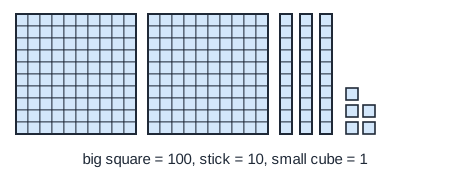
The picture shows base 10 blocks.

What number do the blocks show?

Base 10 blocks: 2 big squares, 3 sticks and 5 small cubes. A key says a big square is 100, a stick is 10 and a small cube is 1.

Model answer

2 hundreds, 3 tens and 5 ones
\(200 + 30 + 5 = 235\)

Explanation

Count each kind of block. Two big squares make 200, three sticks make 30 and five small cubes make 5. Together they make 235. A common mistake is to count the blocks and say 10.

Mark scheme
  1. 1 mark

    235

    Accept two hundred and thirty-five. Do not accept 2,305, 253 or 10.

Question 2

1 mark

Mia has ten counters. Each counter is worth 100.

What number do they make?

Model answer

Ten hundreds make one thousand.
\(100 \times 10 = 1{,}000\)
1,000

Explanation

Count in hundreds: 100, 200, 300 and so on. The tenth count is 1,000, so ten hundreds make one thousand. A common mistake is to say 100, but that is only one counter.

Mark scheme
  1. 1 mark

    1,000

    Accept 1000 or one thousand. Do not accept 100, 110 or 10,000.

Question 3

2 marks

Ella splits 365 into two parts in two different ways.

\(365 = 300 + \square\)

\(365 = 340 + \square\)

What are the two missing numbers?

Model answer

\(365 - 300 = 65\)
\(365 - 340 = 25\)
The missing numbers are 65 and 25.

Explanation

After 300, there are 6 tens and 5 ones left, which is 65. After 340, there are only 2 tens and 5 ones left, which is 25. Both ways make the same whole. A common mistake is to write 65 both times.

Mark scheme
  1. 1 mark

    First missing number: 65

    Do not accept 60 or 5 on its own.

  2. 1 mark

    Second missing number: 25

    Do not accept 65. If the answers are not labelled, take them in the order of the two lines. Correct answers with no working score full marks.

Question 4

4 marks

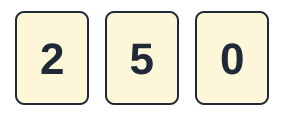
The picture shows three digit cards. Use each card once to make a 3-digit number. A 3-digit number cannot start with 0.

Which numbers can you make? Choose them all.

Which of your numbers has a 5 in the tens place?

What is the smallest of your numbers in words?

Three digit cards in a row showing 2, 5 and 0.

Model answer

Starting with 2: 205 and 250
Starting with 5: 502 and 520
The number with a 5 in the tens place is 250.
The smallest is 205: two hundred and five.

Explanation

Work in order so you do not miss one. Put the 2 first and swap the other two cards, then do the same with the 5. The 0 cannot go first, so there are four numbers. A common mistake is to write 025, which is not a 3-digit number.

Mark scheme
  1. 1 mark

    The list 205, 250, 502 and 520 with one or two mistakes; or the full correct list

    There are exactly four numbers, in any order. Wrong numbers include 025, 052 and any number that does not use each card once. Each right number left out and each wrong number written is one mistake. One or two mistakes score 1 mark for the list (points 1 and 2 together), for example 205, 250 and 502, or all four plus 025. Three or more mistakes score 0 for the list.

  2. 1 mark

    All four numbers 205, 250, 502 and 520, and no wrong numbers

    The full correct list scores both points 1 and 2.

  3. 1 mark

    250

    Do not accept 205, 502 or 520.

  4. 1 mark

    two hundred and five

    Accept it without 'and' and small spelling slips. Do not accept twenty-five. Follow through: if 205 is missing from the pupil's list, accept the smallest 3-digit number in their list written correctly in words. Correct answers with no working score full marks.

Ready to try the rest? Tap your answers and see straight away how you did.

Topic notes

Numbers up to 1,000

The big idea

Numbers are written with digits. The digits are 0, 1, 2, 3, 4, 5, 6, 7, 8 and 9. What a digit is worth depends on where it sits in the number. This is called place value.

Hundreds, tens and ones

A 3-digit number has three places: hundreds (H), tens (T) and ones (O). A place-value chart is a table with one column for each place. Here is 352:

HTO
352

The value of a digit is what it is worth.

  • The 3 is in the hundreds place. Its value is 300.
  • The 5 is in the tens place. Its value is 50.
  • The 2 is in the ones place. Its value is 2.

Ten ones make 1 ten. Ten tens make 1 hundred. Ten hundreds make 1,000 (one thousand).

You can show a number with things you can count.

  • Place-value counters have 100, 10 or 1 on them. For 352, use 3 counters worth 100, 5 counters worth 10 and 2 counters worth 1.
  • Base 10 blocks come in three sizes. A big square is 100, a stick is 10 and a small cube is 1.

Reading and writing numbers

Say the hundreds first, then "and", then the last two digits together. Writing a number with digits is called writing it in figures.

In figuresIn words
352three hundred and fifty-two
419four hundred and nineteen
760seven hundred and sixty
805eight hundred and five

Look at 805. It has no tens, but you still write a 0 in the tens place. This 0 is a place holder. It keeps the 8 in the hundreds place. Without it, 805 would turn into 85.

A locker at the pool has 905 on it. Tom reads it out as "nine hundred and fifty". What should he say?

Put the digits in their places: 9 hundreds, 0 tens and 5 ones.

The 0 tells you there are no tens, so there is no "fifty". The 5 is only worth 5.

Tom should say nine hundred and five.

Partitioning

To partition a number means to split it into parts. The usual way uses the value of each digit:

\[352 = 300 + 50 + 2\]

A part-whole model shows this. The whole is the full number. The parts make the whole when you add them.

A part-whole model. The whole is 352 and the parts are 300, 50 and 2.
The whole, 352, is at the top. The parts are underneath.

You can split a number in other ways too. The whole stays the same: \(352 = 320 + 32\).

You can also swap 1 ten for 10 ones, because they are worth the same. Then 352 is 3 hundreds, 4 tens and 12 ones: \(352 = 300 + 40 + 12\).

A car park has 263 cars. 230 are on the top floor. The rest are on the bottom floor. How many are on the bottom floor?

Partition both numbers. 263 is 200, 60 and 3. 230 is 200 and 30.

The 200 is in both numbers, so no hundreds are left.

The tens left are \(60 - 30 = 30\). The 3 ones are still there.

So 33 cars are on the bottom floor. Check: \(230 + 33 = 263\).

Digit cards

A digit card shows one digit. Move the cards around, and you make different numbers. The cards 5, 1 and 7 can make 517 or 751. A 3-digit number cannot start with 0.

Three friends hold the digit cards 6, 8 and 1. They stand in a line to make a number. The 8 must be worth 80. The 6 must be worth 600. What number do they make?

A digit worth 600 goes in the hundreds place, so the 6 goes first.

A digit worth 80 goes in the tens place, so the 8 goes in the middle.

The 1 is left. It goes in the ones place.

They make 681: six hundred and eighty-one.

Common mistakes

  • Giving the digit, not its value. In 352 the 5 is worth 50, not 5.
  • Leaving out a place holder. Eight hundred and five is 805, not 85.
  • Writing the parts side by side. 500, 30 and 4 make 534. The answer has 3 digits, not 6.
  • Mixing up "teen" and "ty" words. 419 is four hundred and nineteen, not four hundred and ninety.
  • Starting with 0. 025 is not a 3-digit number.

Top tip

Put the number in a place-value chart. Each digit then has its own column, and you can see what it is worth.

Study Helper Hints first, answers after you try

Stuck on this one? Ask for a hint and I’ll point you in the right direction, without giving the answer away. Once you’ve checked your answer, I’ll show you how the marks are awarded.