Level:
Correct: 0
Incorrect: 0
Marks: 0/0
Practice
Course:
Topics:
Year 3 Maths Smart practice A mixed round aimed at your weak spots
Unit 1
Place value
Unit 2
Addition and subtraction
Unit 3
Multiplication and division
Unit 4
Fractions
Unit 5
Measurement
Unit 6
Geometry
Unit 7
Statistics
Statistics
Pictograms
Quick practice5 skills
Bar charts
Quick practice6 skills
Tables
Quick practice5 skills
Avg
score:
–
Topics
done:
0/36

Perimeter

Practise 19 questions on Perimeter for Year 3 Maths. Tap your answer and find out straight away if you are right, with the Study Helper on hand if you get stuck.

  • 19 questions
  • 1–4 marks each
  • Instant marking
  • No sign-up needed
19 questions, marked as you go

Sample questions with model answers

Here are 4 of the questions in this topic, each with a model answer, an explanation of why it earns the marks and the mark scheme.

Question 1

1 mark

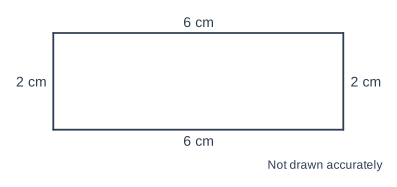
The diagram shows a rectangle with its sides labelled.

What is the perimeter of the rectangle?

Geometry diagram, marked "Not drawn accurately". A rectangle (its vertices are not labelled). The unlabelled side going to the right is labelled 6 cm. The unlabelled side going upwards is labelled 2 cm. The unlabelled side going to the left is labelled 6 cm. The unlabelled side going downwards is labelled 2 cm.

Model answer

\(6 + 2 + 6 + 2 = 16\)
The perimeter is 16 cm.

Explanation

Add all four sides of the rectangle. You could add the two long sides to get 12, then the two short sides to get 16. A common mistake is to add only two of the sides.

Mark scheme
  1. 1 mark

    16 cm

    Accept 16 with or without the unit. Do not accept 8 (two sides only) or 12 (6 times 2).

Question 2

2 marks

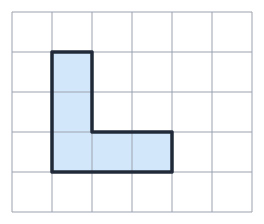
The picture shows an L-shape on squared paper. Each square has sides of 1 cm.

What is the perimeter of the L-shape?

Squared paper with a shaded L-shape drawn on the grid lines. Its bottom side is 3 squares long and its left side is 3 squares tall. The upright part is 1 square wide and the part along the bottom is 1 square tall.

Model answer

Going round the edge:
\(1 + 2 + 2 + 1 + 3 + 3 = 12\)
The perimeter is 12 cm.

Explanation

Start at a corner and follow the outline all the way round, counting each square edge. Keep a finger on your starting corner so that you know when to stop. A common mistake is to miss the short sides in the bend of the L.

Mark scheme
  1. 1 mark

    Adds the sides going round the shape, e.g. \(1 + 2 + 2 + 1 + 3 + 3\), with no more than one mistake; or the correct answer 12 cm with no working

  2. 1 mark

    12 cm

    Accept 12 with or without the unit. Do not accept 5 (the squares inside) or 10 (missing the short sides). A correct answer with no working scores full marks.

Question 3

2 marks

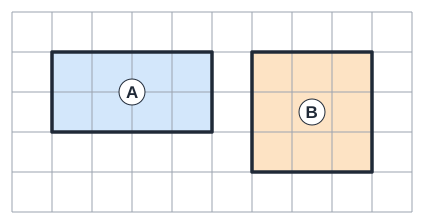
The picture shows two shapes, A and B, on squared paper. Each square has sides of 1 cm.

Mina says, "A and B have the same perimeter."

Is Mina right? How do you know?

Squared paper with two shaded shapes drawn on the grid lines. Shape A is a rectangle 4 squares long and 2 squares wide. Shape B is a square with sides 3 squares long.

Model answer

Yes.
A: \(4 + 2 + 4 + 2 = 12\), so its perimeter is 12 cm.
B: \(3 + 3 + 3 + 3 = 12\), so its perimeter is 12 cm.

Explanation

Count round the edge of each shape. Shape A and shape B both come to 12 cm, so Mina is right. They look different, but the distance round them is the same. A common mistake is to count the squares inside instead of the edges.

Mark scheme
  1. 1 mark

    Says Yes, with a reason that is relevant but not complete, e.g. finds one perimeter correctly (12 cm), or "I counted round both shapes"

    Yes alone scores 0. "They look the same size" scores 0.

  2. 1 mark

    A complete reason: the perimeter of A is 12 cm and the perimeter of B is 12 cm

    Accept the working written as sums, e.g. \(4 + 2 + 4 + 2 = 12\) and \(3 + 3 + 3 + 3 = 12\). A complete correct reason on its own scores both marks.

Question 4

4 marks

Tia has 4 straws. They are 3 cm, 4 cm, 5 cm and 6 cm long.

She makes a triangle from 3 of the straws.

Find the perimeter of every different triangle she can make.

Model answer

Each time, one straw is left out.
Leave out 6 cm: \(3 + 4 + 5 = 12\)
Leave out 5 cm: \(3 + 4 + 6 = 13\)
Leave out 4 cm: \(3 + 5 + 6 = 14\)
Leave out 3 cm: \(4 + 5 + 6 = 15\)
The perimeters are 12 cm, 13 cm, 14 cm and 15 cm.

Explanation

A triangle has 3 sides, so Tia uses 3 straws and leaves 1 out. There are 4 straws she could leave out, so there are 4 triangles. Add the 3 sides of each one to find its perimeter. A common mistake is to add all 4 straws, but a triangle has only 3 sides.

Mark scheme
  1. 1 mark

    12 cm

    There are 4 triangles, so 4 perimeters in all, each worth 1 mark, in any order. No working is needed: each correct perimeter scores its mark. 12 cm uses the 3 cm, 4 cm and 5 cm straws. Accept each perimeter with or without the unit, or written as a sum such as \(3 + 4 + 5 = 12\).

  2. 1 mark

    13 cm

    From 3 cm, 4 cm and 6 cm.

  3. 1 mark

    14 cm

    From 3 cm, 5 cm and 6 cm.

  4. 1 mark

    15 cm

    From 4 cm, 5 cm and 6 cm. Max 3 marks if the list also has a wrong perimeter, such as 18 cm (all four straws). Ignore a perimeter written twice.

Ready to try the rest? Tap your answers and see straight away how you did.

Topic notes

Perimeter

The big idea

The perimeter of a shape is the distance all the way round its edge. Imagine walking round the edge until you are back where you started. The distance you walk is the perimeter.

Perimeter on squared paper

Some shapes are drawn on squared paper. Often each square has sides of 1 cm. To find the perimeter, count the edges of the squares along the outside of the shape.

Put your finger on one corner. Count round until you are back at that corner.

Squared paper with a rectangle drawn on the grid lines. It is 5 squares long and 2 squares wide.
Each square has sides of 1 cm. Count 5 along the top, 2 down, 5 along the bottom and 2 up. That makes 14, so the perimeter is 14 cm.

Do not count the squares inside the shape. Perimeter is only the edge.

Shapes with labelled sides

When the sides have numbers on them, add all the sides. Check that you have used every one.

  • A rectangle has 4 sides: 2 long sides and 2 short sides. Sides that are opposite each other are equal.
  • A square has 4 equal sides. A square with sides of 6 cm has a perimeter of \(6 + 6 + 6 + 6 = 24\) cm. You can also work out \(4 \times 6\).
  • A triangle has 3 sides. A triangle with sides of 4 cm, 7 cm and 8 cm has a perimeter of \(4 + 7 + 8 = 19\) cm.

A small football pitch is a rectangle. It is 50 m long and 30 m wide. Jo runs round the edge two times. How far does she run?

One time round is the perimeter. Add all 4 sides.

Long sides: \(50 + 50 = 100\)

Short sides: \(30 + 30 = 60\)

Perimeter: \(100 + 60 = 160\), so one time round is 160 m.

Two times round: \(160 + 160 = 320\)

Jo runs 320 m.

A road sign is a triangle. All of its sides are 30 cm long. Will a 1 m strip of tape go all the way round the sign?

The perimeter is \(30 + 30 + 30 = 90\), which is 90 cm.

Write the tape in centimetres too. 1 m is 100 cm.

90 cm is less than 100 cm, so yes, it will go round.

L-shapes

An L-shape looks like the letter L. It has 6 sides, so there are 6 lengths to add. Do not stop at 4 sides, as if it were a rectangle.

An L-shape with 6 labelled sides. Going round from the bottom they are 8 cm, 2 cm, 5 cm, 3 cm, 3 cm and 5 cm.
This L-shape has 6 sides. Every side has its length written beside it.

Mia bakes a biscuit like the L-shape in the picture. She puts icing all the way round its edge. How long is the line of icing?

Start at the bottom and go round. Cross off each side as you use it.

\(8 + 2 + 5 = 15\)

\(15 + 3 + 3 = 21\)

\(21 + 5 = 26\)

The line of icing is 26 cm long.

Stretch: finding a missing side

Sometimes you know the perimeter, but not one of the sides. Add the sides you know. Then count on to the perimeter.

All the sides of a square are equal, so you can share the perimeter between the 4 sides.

A field has 4 sides, all of different lengths. Three of them are 40 m, 25 m and 30 m long. The perimeter is 130 m. How long is the fourth side?

Add the sides you know: \(40 + 25 + 30 = 95\).

Count on from 95 to 130. It is 5 to reach 100, then 30 more to reach 130.

\(5 + 30 = 35\), so the fourth side is 35 m long.

Check your answer: \(95 + 35 = 130\)

Remember

  • Perimeter is the distance all the way round a shape.
  • A rectangle and a square have 4 sides. A triangle has 3. An L-shape has 6.
  • Give your answer in a unit, such as cm or m.

Common mistakes

  • Counting the squares inside. Count the edges round the outside.
  • Adding only two sides of a rectangle. A rectangle 9 cm long and 4 cm wide has a perimeter of 26 cm, not 13 cm.
  • Answering with the number of sides. A square has 4 sides, but its perimeter is the distance round it.
  • Missing the short sides in the bend of an L-shape.
  • Adding two perimeters when shapes are joined. The sides that touch are now inside, so they do not count.

Top tip

Cross off each side as you add it. Then you will not miss one or use one twice.

Study Helper Hints first, answers after you try

Stuck on this one? Ask for a hint and I’ll point you in the right direction, without giving the answer away. Once you’ve checked your answer, I’ll show you how the marks are awarded.