Level:
Correct: 0
Incorrect: 0
Marks: 0/0
Practice
Course:
Topics:
Year 3 Maths Smart practice A mixed round aimed at your weak spots
Unit 1
Place value
Unit 2
Addition and subtraction
Unit 3
Multiplication and division
Unit 4
Fractions
Unit 5
Measurement
Measurement
Length
Quick practice5 skills
Perimeter
Quick practice5 skills
Mass
Quick practice5 skills
Capacity and volume
Quick practice5 skills
Money
Quick practice5 skills
Telling the time
Quick practice6 skills
Units of time and durations
Quick practice6 skills
Unit 6
Geometry
Unit 7
Statistics
Statistics
Pictograms
Quick practice5 skills
Bar charts
Quick practice6 skills
Tables
Quick practice5 skills
Avg
score:
–
Topics
done:
0/36

2-D shapes

Practise 20 questions on 2-D shapes for Year 3 Maths. Tap your answer and find out straight away if you are right, with the Study Helper on hand if you get stuck.

  • 20 questions
  • 1–4 marks each
  • Instant marking
  • No sign-up needed
20 questions, marked as you go

Sample questions with model answers

Here are 4 of the questions in this topic, each with a model answer, an explanation of why it earns the marks and the mark scheme.

Question 1

1 mark

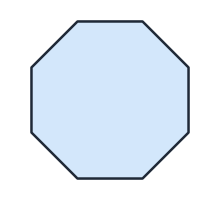
The picture shows a shape.

What is the name of this shape?

One flat shape with straight sides that are all the same length. It sits on one of its sides.

Model answer

It has 8 straight sides, so it is an octagon.

Explanation

Count the sides, starting at one corner so you do not count any side twice. There are 8 sides, and a shape with 8 sides is an octagon. A common mistake is to call it a hexagon without counting.

Mark scheme
  1. 1 mark

    octagon

    Accept regular octagon. Do not accept hexagon or pentagon. Small spelling slips are fine.

Question 2

2 marks

Sally has a triangle and a hexagon.

How many sides do the two shapes have altogether?

Model answer

A triangle has 3 sides. A hexagon has 6 sides.
\(3 + 6 = 9\)
9 sides

Explanation

First find how many sides each shape has, then add them. A triangle has 3 and a hexagon has 6, so together they have 9. A common mistake is to use 5 sides for the hexagon, which is the number for a pentagon.

Mark scheme
  1. 1 mark

    uses 3 sides for the triangle and 6 sides for the hexagon; or the correct answer 9 with no working

    Accept \(3 + 6\) written down.

  2. 1 mark

    9

    Accept nine or 9 sides. A correct answer with no working scores full marks.

Question 3

2 marks

Jay says, "A semicircle is a polygon."

Is Jay right? How do you know?

Model answer

No. A semicircle has a curved edge. A polygon has only straight sides.

Explanation

All the sides of a polygon must be straight. A semicircle has one straight side and one curved edge, so it cannot be a polygon. A common mistake is to think one straight side is enough.

Mark scheme
  1. 1 mark

    No, with a relevant but incomplete reason, such as 'it is not a polygon because of its shape'

    Yes or No alone scores 0.

  2. 1 mark

    a complete reason: a semicircle has a curved edge, and a polygon has only straight sides

    A complete correct reason on its own scores both marks. Accept 'it has a curved side' on its own, because that is the key idea.

Question 4

4 marks

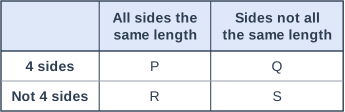
Chen sorts shapes using the table in the picture.

Which box does each shape go in?

Table with columns (row headings), "All sides the same length", "Sides not all the same length". 4 sides; All sides the same length: P; Sides not all the same length: Q | Not 4 sides; All sides the same length: R; Sides not all the same length: S.

Model answer

Square: P
Long rectangle: Q
Regular hexagon: R
Pentagon with sides of different lengths: S

Explanation

Ask two questions about each shape: does it have 4 sides, and are its sides all the same length? A square has 4 equal sides, but a long rectangle has 2 long sides and 2 short sides. A common mistake is to read only one heading in the table.

Mark scheme
  1. 1 mark

    square: P

    Each shape earns one mark on its own.

  2. 1 mark

    long rectangle: Q

  3. 1 mark

    regular hexagon: R

  4. 1 mark

    pentagon with sides of different lengths: S

    Accept the four answers in order, such as 'P, Q, R, S'.

Ready to try the rest? Tap your answers and see straight away how you did.

Topic notes

2-D shapes

The big idea

A 2-D shape is a flat shape. You can draw it on a page. We name 2-D shapes by their sides and corners. A corner is where two sides meet. Another word for a corner is a vertex. For more than one vertex, we say vertices.

Names of shapes

ShapeSidesVertices
triangle33
square4, all the same length4
rectangle4, in 2 matching pairs4
pentagon55
hexagon66
octagon88
circle1 curved edge0
semicircle1 straight side and 1 curved edge2

A semicircle is half of a circle.

Six flat shapes with their names: a triangle, a square, a rectangle, a pentagon, a hexagon and an octagon.
Count the sides of each shape.

A shape with only straight sides has the same number of vertices as sides.

Guess my shape. It has only straight sides. It has 2 more vertices than a rectangle. What is it?

A rectangle has 4 vertices.

\(4 + 2 = 6\), so my shape has 6 vertices.

It has only straight sides, so it has 6 sides too.

A shape with 6 sides is a hexagon.

Polygons

A polygon is a closed shape with only straight sides. Closed means the sides join up, with no gaps. Triangles, squares, pentagons and octagons are all polygons.

A circle is not a polygon, because its edge is curved. A semicircle is not a polygon either. One straight side is not enough: every side must be straight.

To sort shapes, ask one question about each shape in turn. Does it have a curved edge? Does it have more than 4 sides?

Sam looks round the kitchen. He sees a round plate, half a round pizza, a square tile and a 6-sided tile. Which of these are polygons?

ThingShapeAll edges straight?Polygon?
round platecirclenono
half a pizzasemicirclenono
square tilesquareyesyes
6-sided tilehexagonyesyes

The square tile and the 6-sided tile are polygons.

Regular and irregular shapes

A regular shape has all its sides the same length and all its corners the same size. A square is regular. A shape that is not regular is irregular. A long rectangle is irregular, because 2 of its sides are longer than the others.

The name comes from the number of sides. Any shape with 6 straight sides is a hexagon, even if it looks uneven.

We can use lengths to describe a shape: "This rectangle has 2 sides of 6 cm and 2 sides of 3 cm."

Bea is making a flower bed with 6 straight sides. She wants a regular shape. She has made 5 sides, each 2 m long. How long must the last side be?

In a regular shape, all the sides are the same length. So the last side must be 2 m long too.

If Bea made the last side 3 m long, it would still be a hexagon. But it would be an irregular hexagon.

Lines of symmetry

A line of symmetry cuts a shape into two halves that match exactly. Imagine folding the shape along the line. The two halves fit on top of each other.

We look for lines that go straight up and down. These are called vertical lines.

A triangle with its point at the top and a semicircle. A vertical dashed line goes down the middle of each one, and they are labelled the halves match. A rectangle with a vertical dashed line nearer one end, labelled the halves do not match.
Each dashed line is a fold line. The line on the rectangle is not in the middle, so it is not a line of symmetry.

Max draws a square 4 cm wide. He adds a vertical line, 1 cm from the left side. Is it a line of symmetry? Where should the line go?

The left part is 1 cm wide. The right part is \(4 - 1 = 3\) cm wide.

The two parts do not match, so it is not a line of symmetry.

The line must go down the middle. Half of 4 cm is 2 cm, so it should be 2 cm from the left side.

Common mistakes

  • Mixing up a pentagon and a hexagon. A pentagon has 5 sides and a hexagon has 6.
  • Counting the first corner again at the end. Put a finger on it when you start.
  • Thinking only neat shapes have these names. A shape with 5 straight sides is a pentagon, even if its sides are all different.
  • Saying a semicircle is a polygon. All the sides of a polygon must be straight.
  • Thinking any fold is a line of symmetry. It must make two halves that match exactly.

Top tip

To draw a polygon, make a dot for each vertex. Then join the dots with a ruler. To remember the names, think of an octopus with its 8 legs for an octagon.

Study Helper Hints first, answers after you try

Stuck on this one? Ask for a hint and I’ll point you in the right direction, without giving the answer away. Once you’ve checked your answer, I’ll show you how the marks are awarded.