Level:
Correct: 0
Incorrect: 0
Marks: 0/0
Practice
Course:
Topics:
Year 3 Maths Smart practice A mixed round aimed at your weak spots
Unit 1
Place value
Unit 2
Addition and subtraction
Unit 3
Multiplication and division
Unit 4
Fractions
Unit 5
Measurement
Measurement
Length
Quick practice5 skills
Perimeter
Quick practice5 skills
Mass
Quick practice5 skills
Capacity and volume
Quick practice5 skills
Money
Quick practice5 skills
Telling the time
Quick practice6 skills
Units of time and durations
Quick practice6 skills
Unit 6
Geometry
Unit 7
Statistics
Statistics
Pictograms
Quick practice5 skills
Bar charts
Quick practice6 skills
Tables
Quick practice5 skills
Avg
score:
–
Topics
done:
0/36

Right angles and turns

Practise 20 questions on Right angles and turns for Year 3 Maths. Tap your answer and find out straight away if you are right, with the Study Helper on hand if you get stuck.

  • 20 questions
  • 1–4 marks each
  • Instant marking
  • No sign-up needed
20 questions, marked as you go

Sample questions with model answers

Here are 4 of the questions in this topic, each with a model answer, an explanation of why it earns the marks and the mark scheme.

Question 1

1 mark

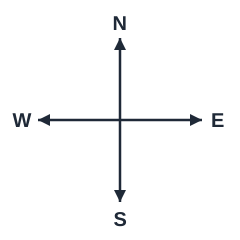
The picture shows the compass points.

A toy robot is facing west. It makes a quarter turn clockwise.

Which way is it facing now?

Two crossing lines with arrowheads showing the compass points: N at the top, E on the right, S at the bottom and W on the left.

Model answer

North

Explanation

Clockwise is the way the hands of a clock turn. A quarter turn clockwise moves from W to the next point round, which is N. A common mistake is to turn the other way and say south.

Mark scheme
  1. 1 mark

    north

    Accept N. Do not accept south (anticlockwise), east or west.

Question 2

2 marks

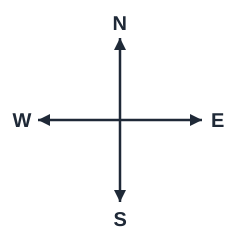
The picture shows the compass points.

Zoe is facing east. She makes a quarter turn clockwise. Then she makes another quarter turn clockwise.

Which way is she facing now?

Two crossing lines with arrowheads showing the compass points: N at the top, E on the right, S at the bottom and W on the left.

Model answer

First quarter turn: east to south.
Second quarter turn: south to west.
She is facing west.

Explanation

Take one turn at a time. Clockwise, the order is N, E, S, W. From E, the next point is S, and the next is W. A common mistake is to go the wrong way round and end up at N.

Mark scheme
  1. 1 mark

    south after the first turn; or the correct answer west with no working

    Accept S.

  2. 1 mark

    west

    Accept W. Do not accept north (going anticlockwise). A correct answer with no working scores full marks.

Question 3

2 marks

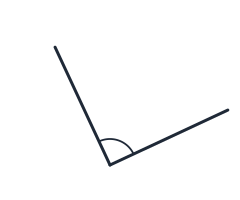
The picture shows an angle. It is drawn accurately.

Priya says, "This angle is bigger than a right angle because its arms are so long."

Is Priya right? How do you know?

An angle marked with a small arc. One arm goes up steeply to the left. The other arm goes up gently to the right.

Model answer

No. The length of the arms does not matter. Only the gap between them does, and this gap is a right angle.

Explanation

The size of an angle is the amount of turn between its two arms. Making the arms longer does not change that turn, and turning the angle does not change it either. A common mistake is to think a right angle must have one arm flat along the bottom.

Mark scheme
  1. 1 mark

    No, with a relevant but incomplete reason, such as 'long arms do not make it bigger'

    No alone scores 0.

  2. 1 mark

    a complete reason: this angle is exactly a right angle / the length of the arms does not change the size of an angle, only the gap between them does

    A complete correct reason on its own scores both marks.

Question 4

4 marks

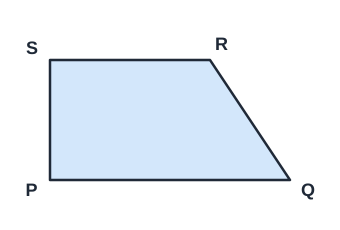
The picture shows the shape of a flower bed. Its corners are P, Q, R and S. It is drawn accurately.

Which two corners are right angles?

Which corner is acute?

Which corner is obtuse?

A flat flower bed shape with four straight sides and corners P, Q, R and S. P is at the bottom left, Q at the bottom right, R at the top right and S at the top left. The top side is shorter than the bottom side, and the right side slopes.

Model answer

P and S are right angles.
Q is acute.
R is obtuse.

Explanation

Check each corner against a square corner. P and S match. The sloping side makes the corner at Q narrower and the corner at R wider. A common mistake is to swap acute and obtuse: acute is the small, sharp one.

Mark scheme
  1. 1 mark

    P

    P and S are the right angles. The letters can be in either order.

  2. 1 mark

    S

    If a pupil gives a wrong extra letter here, take off one of these two marks.

  3. 1 mark

    Q (acute)

    Do not accept R.

  4. 1 mark

    R (obtuse)

    Do not accept Q.

Ready to try the rest? Tap your answers and see straight away how you did.

Topic notes

Right angles and turns

The big idea

An angle tells you how much something has turned. You can see an angle where two straight lines meet at a point. These two lines are called the arms of the angle. The more one arm is turned away from the other, the bigger the angle.

Turns

A right angle is a quarter of a whole turn. It is a square corner, like the corner of a book. A small square in a corner shows a right angle.

TurnRight anglesA clock hand going from 12 to
quarter turn13
half turn26
three-quarter turn39
whole turn412 again

Clockwise means the way the hands of a clock go round. Anticlockwise means the other way. A half turn ends in the same place, whichever way you go. So does a whole turn.

A music box has a handle. Theo winds the handle 2 whole turns. How many right angles is that?

One whole turn is 4 right angles.

Two whole turns are \(4 + 4 = 8\).

The handle turns through 8 right angles.

Turning between compass points

The four compass points are north (N), east (E), south (S) and west (W). Going clockwise, the order is N, E, S, W, then back to N. Each step along this order is a quarter turn.

Two crossing lines showing the compass points, with N at the top, E on the right, S at the bottom and W on the left. The right angle between N and E is labelled quarter turn.
Turning from N to E is a quarter turn clockwise. It is 1 right angle.

A boat is sailing south. The captain wants to sail east. Which turns will do this?

Start at S and try each way round.

  • Anticlockwise, the next point after S is E. That is 1 step, so it is a quarter turn anticlockwise.
  • Clockwise, the boat goes from S to W, then to N, then to E. That is 3 steps, so it is a three-quarter turn clockwise.

Check your answer: 1 right angle and 3 right angles make 4 right angles. That is a whole turn, so both ways end up facing east.

Right angles all around us

You can find right angles in tables, envelopes, screens and floor tiles. A square and a rectangle each have 4 right angles. A circle has no corners at all, so it has no right angles.

Make a right-angle checker to find them. Fold a sheet of paper in half, then fold it in half again. The folded corner is a right angle. Hold it against a corner and see if the corner fits exactly.

Greater or less than a right angle

We can compare any angle with a right angle.

  • An acute angle is less than a right angle. Think of a small, sharp corner.
  • An obtuse angle is greater than a right angle, but less than a half turn.
Four angles with their names: an acute angle, a right angle, the same right angle turned round, and an obtuse angle. The right angles have a small square in the corner.
A right angle is still a right angle when it is turned round.

Look at a clock at 1 o'clock, at 3 o'clock and at 5 o'clock. What kind of angle do the hands make each time?

At each time, the long hand points to the 12. So look at where the short hand points.

  • 3 o'clock: from 12 to 3 is a quarter turn. This is a right angle.
  • 1 o'clock: from 12 to 1 is less than a quarter turn. This is an acute angle.
  • 5 o'clock: from 12 to 5 is more than a quarter turn, but less than a half turn. This is an obtuse angle.

Common mistakes

  • Mixing up a half turn and a whole turn. A half turn leaves you facing the opposite way. A whole turn brings you back to where you started.
  • Thinking long arms make a big angle. Only the turn between the arms matters.
  • Thinking a right angle only counts when one arm lies flat. A right angle can point any way. Turning an angle does not change its size.
  • Going the wrong way round. Clockwise goes N, E, S, W. Anticlockwise goes N, W, S, E.
  • Mixing up acute and obtuse. To remember, say "an acute angle is a cute, small angle".

Top tip

To remember the compass points in clockwise order, say "Naughty Elephants Squirt Water". For a long turn, move one point at a time and say each one out loud.

Study Helper Hints first, answers after you try

Stuck on this one? Ask for a hint and I’ll point you in the right direction, without giving the answer away. Once you’ve checked your answer, I’ll show you how the marks are awarded.