Level:
Correct: 0
Incorrect: 0
Marks: 0/0
Practice
Course:
Topics:
Year 3 Maths Smart practice A mixed round aimed at your weak spots
Unit 1
Place value
Unit 2
Addition and subtraction
Unit 3
Multiplication and division
Unit 4
Fractions
Unit 5
Measurement
Measurement
Length
Quick practice5 skills
Perimeter
Quick practice5 skills
Mass
Quick practice5 skills
Capacity and volume
Quick practice5 skills
Money
Quick practice5 skills
Telling the time
Quick practice6 skills
Units of time and durations
Quick practice6 skills
Unit 6
Geometry
Unit 7
Statistics
Statistics
Pictograms
Quick practice5 skills
Bar charts
Quick practice6 skills
Tables
Quick practice5 skills
Avg
score:
–
Topics
done:
0/36

Fractions on a number line

Practise 17 questions on Fractions on a number line for Year 3 Maths. Tap your answer and find out straight away if you are right, with the Study Helper on hand if you get stuck.

  • 17 questions
  • 1–4 marks each
  • Instant marking
  • No sign-up needed
17 questions, marked as you go

Sample questions with model answers

Here are 4 of the questions in this topic, each with a model answer, an explanation of why it earns the marks and the mark scheme.

Question 1

1 mark

The number line goes from 0 to 1. It is split into thirds.

Which arrow points to \(\dfrac{2}{3}\)?

A horizontal scale from 0 to 1, with a long mark at each end, split into 3 small divisions by short marks. Every long mark is numbered (0 and 1). An arrow labelled A points to a mark on the scale. An arrow labelled B points to a mark on the scale.

Model answer

Count the jumps from 0: \(\dfrac{1}{3}\), \(\dfrac{2}{3}\).

Arrow B is 2 jumps from 0.

B

Explanation

There are 3 equal gaps between 0 and 1, so each gap is one third. So \(\dfrac{2}{3}\) is 2 gaps along from 0. A common mistake is to choose arrow A, thinking it is 2 gaps from the 1.

Mark scheme
  1. 1 mark

    B

    Only B. Arrow A points to 1/3.

Question 2

2 marks

The number line goes from 0 to 1. It is split into fifths.

What fraction does arrow A point to?

What fraction does arrow B point to?

A horizontal scale from 0 to 1, with a long mark at each end, split into 5 small divisions by short marks. Every long mark is numbered (0 and 1). An arrow labelled A points to a mark on the scale. An arrow labelled B points to a mark on the scale.

Model answer

A is 1 gap from 0: \(\dfrac{1}{5}\)

B is 4 gaps from 0: \(\dfrac{4}{5}\)

Explanation

There are 5 equal gaps from 0 to 1, so each gap is one fifth. Count the gaps from 0 up to each arrow. A common mistake is to count from the 1 by accident, which gives the fractions the wrong way round.

Mark scheme
  1. 1 mark

    A: \(\dfrac{1}{5}\)

    Accept 1/5 or one fifth. Accept 0.2 if a pupil writes it.

  2. 1 mark

    B: \(\dfrac{4}{5}\)

    Accept 4/5 or four fifths. Accept 0.8 if a pupil writes it.

Question 3

2 marks

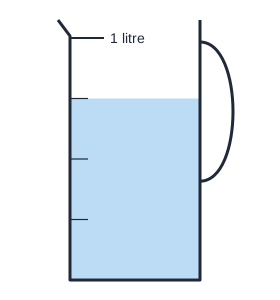
The picture shows a jug that holds 1 litre. The marks split 1 litre into 4 equal parts.

What fraction of a litre is in the jug?

How much more water would fill the jug to 1 litre?

A measuring jug with water in it. The top mark says 1 litre. Three more marks below it split the jug into equal parts.

Model answer

The water is at the third mark, so there is \(\dfrac{3}{4}\) of a litre.

\(1 - \dfrac{3}{4} = \dfrac{1}{4}\), so \(\dfrac{1}{4}\) of a litre more.

Explanation

The marks split the litre into quarters, so each gap is one quarter of a litre. The water reaches the third mark. One more quarter fills it to 1 litre. A common mistake is to say \(\dfrac{1}{3}\), because there are 3 quarters already.

Mark scheme
  1. 1 mark

    \(\dfrac{3}{4}\) of a litre

    Accept 3/4 or three quarters. Accept 750 ml.

  2. 1 mark

    \(\dfrac{1}{4}\) of a litre

    Accept 1/4 or one quarter. Accept 250 ml. Follow through: 1 take away their first answer.

Question 4

4 marks

Kwame counts on in fifths from \(\dfrac{3}{5}\).

\(\dfrac{3}{5}\)   \(\dfrac{4}{5}\)   1   ?   ?   ?

What are the next three numbers Kwame says?

How many jumps of \(\dfrac{1}{5}\) are there from \(\dfrac{3}{5}\) to 2?

Model answer

1 and \(\dfrac{1}{5}\), 1 and \(\dfrac{2}{5}\), 1 and \(\dfrac{3}{5}\)

From \(\dfrac{3}{5}\) to 1 is 2 jumps.

From 1 to 2 is 5 jumps.

\(2 + 5 = 7\) jumps

Explanation

After 1 you keep the whole and add fifths. To count the jumps, use the 1 as a stepping stone: 2 jumps to reach 1, then 5 more to reach 2. A common mistake is to forget that 5 fifths are needed to go from 1 to 2.

Mark scheme
  1. 1 mark

    1 and \(\dfrac{1}{5}\)

    Accept 1 1/5 or 6/5.

  2. 1 mark

    1 and \(\dfrac{2}{5}\)

    Accept 1 2/5 or 7/5.

  3. 1 mark

    1 and \(\dfrac{3}{5}\)

    Accept 1 3/5 or 8/5.

  4. 1 mark

    7 jumps

    Accept 7.

Ready to try the rest? Tap your answers and see straight away how you did.

Topic notes

Fractions on a number line

The big idea

A fraction is a number, just like 2 or 7. So it has its own place on a number line. A number line can show the fractions between 0 and 1. It can also carry on past 1. To read a fraction, count the gaps between the lines.

Reading a number line

Remember the two numbers in a fraction. The denominator is at the bottom. The numerator is at the top.

  1. Count the equal gaps between 0 and 1. This number is the denominator.
  2. Count the gaps from 0 up to the arrow. This number is the numerator.

Count the gaps, not the lines. A line from 0 to 1 with 6 gaps has 7 lines. Each gap is \(\dfrac{1}{6}\).

A race goes from the start at 0 to the finish at 1. The track is split into 8 equal parts. Mo stops after 5 parts. What fraction of the race has Mo run? How much further is it to the finish?

A number line from 0 at the start to 1 at the finish, with 8 equal gaps. An arrow shows Mo at 5 eighths.
A race track split into 8 equal parts. Mo is 5 gaps from the start.

There are 8 equal gaps from 0 to 1, so each gap is one eighth.

Mo is 5 gaps from the start. Mo has run \(\dfrac{5}{8}\) of the race.

Count on from Mo to the finish: 3 more gaps. The finish is \(\dfrac{3}{8}\) further on.

Check your answer: \(\dfrac{5}{8}\) and \(\dfrac{3}{8}\) make \(\dfrac{8}{8}\), which is 1.

Counting past 1

When you count in fractions, the numerator goes up by 1 each time. The denominator stays the same. When the numerator and the denominator match, you have reached 1. So \(\dfrac{4}{4} = 1\).

After that, keep the whole 1 and count on.

A number line split into quarters. It shows 0, 1 quarter, 2 quarters, 3 quarters, 1, and 1 and 1 quarter. One more gap carries on past that.
A number line in quarters, going past 1. The next line is 1 and \(\dfrac{2}{4}\).

Ben needs 1 and \(\dfrac{2}{3}\) cups of flour. His scoop holds \(\dfrac{1}{3}\) of a cup. How many scoops does he need?

Count on one third for each scoop, until you reach 1 and \(\dfrac{2}{3}\).

1 scoop: \(\dfrac{1}{3}\) of a cup.

2 scoops: \(\dfrac{2}{3}\) of a cup.

3 scoops: \(\dfrac{3}{3}\) of a cup. That is 1 cup.

4 scoops: 1 and \(\dfrac{1}{3}\) cups.

5 scoops: 1 and \(\dfrac{2}{3}\) cups.

Ben needs 5 scoops.

Halfway between two fractions

To find the fraction halfway between two others, step in from both ends. Move one gap at a time from each end. Stop when you meet in the middle.

A path has a lamp \(\dfrac{1}{8}\) of the way along. Another lamp is \(\dfrac{7}{8}\) of the way along. A bench goes exactly halfway between the lamps. Where does the bench go?

Both fractions are in eighths. So step in one eighth from each end.

\(\dfrac{1}{8}\) and \(\dfrac{7}{8}\) become \(\dfrac{2}{8}\) and \(\dfrac{6}{8}\).

Those become \(\dfrac{3}{8}\) and \(\dfrac{5}{8}\).

Those both become \(\dfrac{4}{8}\), so you have met in the middle.

The bench goes \(\dfrac{4}{8}\) of the way along.

Rulers and jugs

A ruler is a number line in centimetres. The small line halfway between 5 and 6 shows 5 and \(\dfrac{1}{2}\) cm.

A measuring jug is a number line that stands up. If the lines split 1 litre into 3 equal parts, each gap is \(\dfrac{1}{3}\) of a litre. Water up to the second line is \(\dfrac{2}{3}\) of a litre.

Common mistakes

  • Counting the lines and not the gaps. If there are 6 gaps from 0 to 1, each gap is \(\dfrac{1}{6}\), not \(\dfrac{1}{7}\).
  • Changing the denominator as you count. After \(\dfrac{3}{5}\) comes \(\dfrac{4}{5}\), not \(\dfrac{4}{6}\).
  • Losing the whole after 1. After 1 comes 1 and \(\dfrac{1}{3}\), not \(\dfrac{1}{3}\).
  • Adding to find halfway. Halfway between \(\dfrac{1}{5}\) and \(\dfrac{3}{5}\) is \(\dfrac{2}{5}\), not \(\dfrac{4}{5}\).
  • Counting from the 1 by mistake. Always count from 0, unless you have gone past 1.

Top tip

Touch each gap with your finger as you count. Say the fraction out loud: "one eighth, two eighths, three eighths".

Study Helper Hints first, answers after you try

Stuck on this one? Ask for a hint and I’ll point you in the right direction, without giving the answer away. Once you’ve checked your answer, I’ll show you how the marks are awarded.