Level:
Correct: 0
Incorrect: 0
Marks: 0/0
Practice
Course:
Topics:
Year 3 Maths Smart practice A mixed round aimed at your weak spots
Unit 1
Place value
Unit 2
Addition and subtraction
Unit 3
Multiplication and division
Unit 4
Fractions
Unit 5
Measurement
Measurement
Length
Quick practice5 skills
Perimeter
Quick practice5 skills
Mass
Quick practice5 skills
Capacity and volume
Quick practice5 skills
Money
Quick practice5 skills
Telling the time
Quick practice6 skills
Units of time and durations
Quick practice6 skills
Unit 6
Geometry
Unit 7
Statistics
Statistics
Pictograms
Quick practice5 skills
Bar charts
Quick practice6 skills
Tables
Quick practice5 skills
Avg
score:
–
Topics
done:
0/36

Multiplying 2-digit numbers

Practise 22 questions on Multiplying 2-digit numbers for Year 3 Maths. Tap your answer and find out straight away if you are right, with the Study Helper on hand if you get stuck.

  • 22 questions
  • 1–4 marks each
  • Instant marking
  • No sign-up needed
20 questions, marked as you go

Sample questions with model answers

Here are 4 of the questions in this topic, each with a model answer, an explanation of why it earns the marks and the mark scheme.

Question 1

1 mark

Work out \(13 \times 10\)

Model answer

\(13 \times 10 = 130\)

Explanation

When you multiply by 10, each digit moves one place to the left. 1 ten becomes 1 hundred, and 3 ones become 3 tens. A common mistake is to write 103.

Mark scheme
  1. 1 mark

    130

    Do not accept 23 (adding) or 103.

Question 2

2 marks

Work out \(18 \times 3\)

Model answer

\(10 \times 3 = 30\)
\(8 \times 3 = 24\)
\(30 + 24 = 54\)

Explanation

Split 18 into 10 and 8, then multiply each part by 3. In columns you do the same: \(8 \times 3 = 24\), so write 4 and carry 2 tens. Then \(1 \times 3 = 3\) tens, and the 2 tens make 5 tens. A common mistake is to forget the carried 2 and get 34.

Mark scheme
  1. 1 mark

    A correct method (column method, partitioning such as \(10 \times 3 = 30\) and \(8 \times 3 = 24\), a grid, or repeated adding) with no more than one arithmetic error; or the correct answer 54 with no working

    Pupils type their working as lines, not in columns: accept any clear record of the method, such as the two parts or 'Ones: \(8 \times 3 = 24\), write 4 carry 2'. A place-value slip such as \(10 \times 3 = 3\) is a method error and does not score.

  2. 1 mark

    54

    Do not accept 34 (forgetting to carry 2) or 21 (adding). A correct answer with no working scores full marks.

Question 3

2 marks

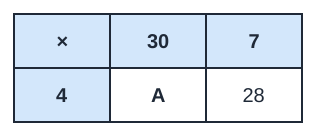
Sid starts a grid for \(37 \times 4\). The diagram shows it.

The letter A hides a number.

What is the number A?

What is the answer to \(37 \times 4\)?

A grid for the grid method. The top row has × then 30 and 7. The second row has 4, then a box marked A under the 30 and 28 under the 7.

Model answer

A is \(30 \times 4 = 120\)
\(120 + 28 = 148\)
\(37 \times 4 = 148\)

Explanation

A is \(30 \times 4\). 3 tens times 4 is 12 tens, and 12 tens is 120. Then add the parts: \(120 + 28 = 148\). A common mistake is to write A as 12, which forgets that 30 is 3 tens.

Mark scheme
  1. 1 mark

    A = 120

    Do not accept 12. A correct answer with no working scores the mark.

  2. 1 mark

    148

    Follow through: their A + 28. A correct answer with no working scores the mark.

Question 4

4 marks

Each box hides one digit.

What is the missing digit in each line?

\(\square 3 \times 4 = 92\)

\(1 \square \times 5 = 95\)

\(4 \square \times 2 = 88\)

\(\square 6 \times 5 = 180\)

Model answer

\(23 \times 4 = 92\)
\(19 \times 5 = 95\)
\(44 \times 2 = 88\)
\(36 \times 5 = 180\)
The digits are 2, 9, 4 and 3.

Explanation

Try a digit and multiply to check it. The ones can help: in the first line, \(3 \times 4 = 12\), so 1 ten is carried and the tens must make 9. A common mistake is to guess and not check the whole calculation.

Mark scheme
  1. 1 mark

    First box: 2

    Accept an answer that writes the whole calculation, such as \(23 \times 4 = 92\). A correct answer with no working scores the mark.

  2. 1 mark

    Second box: 9

    Accept \(19 \times 5 = 95\). A correct answer with no working scores the mark.

  3. 1 mark

    Third box: 4

    Accept \(44 \times 2 = 88\). A correct answer with no working scores the mark.

  4. 1 mark

    Fourth box: 3

    Accept \(36 \times 5 = 180\). A correct answer with no working scores the mark.

Ready to try the rest? Tap your answers and see straight away how you did.

Topic notes

Multiplying 2-digit numbers

The big idea

A 2-digit number has tens and ones, like 36. You can multiply it by splitting it into its tens and its ones. Multiply each part, then add the answers. The times tables you know do most of the work. There are three ways to set it out. Each way does the same thing.

Way 1: partitioning

Partitioning means splitting a number into parts. 23 is 20 and 3.

A book has 23 lines on each page. How many lines are there on 3 pages?

You need \(23 \times 3\). Split 23 into 20 and 3.

\(20 \times 3 = 60\), because 2 tens times 3 is 6 tens.

\(3 \times 3 = 9\)

Add the two parts: \(60 + 9 = 69\).

There are 69 lines.

Way 2: the grid method

The grid method puts the same parts in a table. Write the tens and the ones along the top. Write the other number at the side. Multiply to fill each box, then add.

A car park has 4 floors. Each floor has 43 spaces. How many spaces are there altogether?

You need \(43 \times 4\). Split 43 into 40 and 3.

A grid for 43 times 4. The top row shows 40 and 3. Under them are 160 for 40 times 4, and 12 for 3 times 4.
The grid for 43 × 4: 40 × 4 = 160 and 3 × 4 = 12.

\(40 \times 4 = 160\), because 4 tens times 4 is 16 tens.

\(3 \times 4 = 12\)

Add the two parts: \(160 + 12 = 172\).

There are 172 spaces.

Way 3: short multiplication

Short multiplication is a quicker way to write it down. Line up the ones under the ones. Start with the ones, then do the tens.

Here is \(23 \times 3\) again:

\[ \begin{array}{ccc} & 2 & 3 \\ \times & & 3 \\ \hline & 6 & 9 \end{array} \]

Ones: \(3 \times 3 = 9\). Write 9.

Tens: \(2 \times 3 = 6\). Write 6.

Sometimes the ones make 10 or more. Then you carry the tens. This means you write them small, under the line, in the tens column. Then you add them on after you multiply the tens.

Here is \(43 \times 4\) again:

\[ \begin{array}{cccc} & & 4 & 3 \\ \times & & & 4 \\ \hline & 1 & 7 & 2 \\ & & {\scriptsize 1} & \end{array} \]

Ones: \(3 \times 4 = 12\). Write 2, carry 1.

Tens: \(4 \times 4 = 16\), add the carried 1 to get 17. Write 17.

The answer is 172, the same as the grid method. The carried 1 is the 1 ten from 12.

A beekeeper has 8 shelves. There are 27 jars of honey on each shelf. How many jars are there?

You need \(27 \times 8\).

\[ \begin{array}{cccc} & & 2 & 7 \\ \times & & & 8 \\ \hline & 2 & 1 & 6 \\ & & {\scriptsize 5} & \end{array} \]

Ones: \(7 \times 8 = 56\). Write 6, carry 5.

Tens: \(2 \times 8 = 16\), add the carried 5 to get 21. Write 21.

There are 216 jars.

Check your answer with partitioning: \(20 \times 8 = 160\) and \(7 \times 8 = 56\). Then \(160 + 56 = 216\).

Using it in a story

Some stories need two steps. Work out each part, then add.

A farm has 14 sheep and 23 hens. A sheep has 4 legs. A hen has 2 legs. How many legs are there altogether?

Sheep: \(10 \times 4 = 40\) and \(4 \times 4 = 16\). So \(14 \times 4 = 56\) legs.

Hens: \(20 \times 2 = 40\) and \(3 \times 2 = 6\). So \(23 \times 2 = 46\) legs.

Altogether: \(56 + 46 = 102\).

There are 102 legs.

Remember

  • Start with the ones, then do the tens.
  • When you do the tens, multiply first. Then add the carried digit.
  • 40 is 4 tens, so \(40 \times 4\) is 160, not 16.
  • To multiply by 10, move each digit one place to the left: \(52 \times 10 = 520\).

Common mistakes

  • Adding instead of multiplying. \(37 \times 2\) is 74, not 39.
  • Forgetting the carried digit. \(43 \times 4\) is 172, not 162.
  • Writing two answers side by side. In \(37 \times 2\), the tens make 6 and the ones make 14. The answer is 74, not 614.
  • Forgetting what a digit is worth. \(20 \times 8\) is 160, not 16.
  • Stopping before you add. In the grid for \(43 \times 4\), add 160 and 12 to finish.

Top tip

Check your answer a different way. If short multiplication and the grid give the same answer, you can be sure it is right.

Study Helper Hints first, answers after you try

Stuck on this one? Ask for a hint and I’ll point you in the right direction, without giving the answer away. Once you’ve checked your answer, I’ll show you how the marks are awarded.