Level:
Correct: 0
Incorrect: 0
Marks: 0/0
Practice
Course:
Topics:
Year 3 Maths Smart practice A mixed round aimed at your weak spots
Unit 1
Place value
Unit 2
Addition and subtraction
Unit 3
Multiplication and division
Unit 4
Fractions
Unit 5
Measurement
Measurement
Length
Quick practice5 skills
Perimeter
Quick practice5 skills
Mass
Quick practice5 skills
Capacity and volume
Quick practice5 skills
Money
Quick practice5 skills
Telling the time
Quick practice6 skills
Units of time and durations
Quick practice6 skills
Unit 6
Geometry
Unit 7
Statistics
Statistics
Pictograms
Quick practice5 skills
Bar charts
Quick practice6 skills
Tables
Quick practice5 skills
Avg
score:
–
Topics
done:
0/36

Equivalent fractions

Practise 17 questions on Equivalent fractions for Year 3 Maths. Tap your answer and find out straight away if you are right, with the Study Helper on hand if you get stuck.

  • 17 questions
  • 1–4 marks each
  • Instant marking
  • No sign-up needed
17 questions, marked as you go

Sample questions with model answers

Here are 4 of the questions in this topic, each with a model answer, an explanation of why it earns the marks and the mark scheme.

Question 1

1 mark

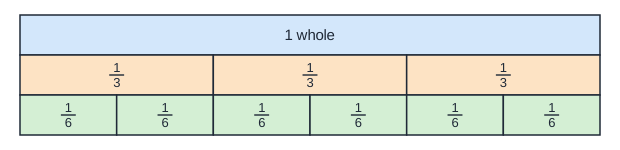
The picture shows a fraction wall.

What is the missing number?

\(\dfrac{1}{3} = \dfrac{2}{\square}\)

A fraction wall. The rows from top to bottom are 1 whole, 3 thirds and 6 sixths. Each brick is labelled with its fraction.

Model answer

Two \(\dfrac{1}{6}\) bricks fit under one \(\dfrac{1}{3}\) brick.

6

Explanation

Find the \(\dfrac{1}{3}\) brick and look at the bricks under it. Two \(\dfrac{1}{6}\) bricks fit exactly, so \(\dfrac{1}{3} = \dfrac{2}{6}\). A common mistake is to add 1 to the denominator because 1 was added to the numerator.

Mark scheme
  1. 1 mark

    6

    Accept 2/6 written out. Do not accept 4 (adding 1 to 3).

Question 2

2 marks

What are the two missing numbers?

\(\dfrac{1}{2} = \dfrac{\square}{10}\)   \(\dfrac{1}{4} = \dfrac{\square}{12}\)

Model answer

Half of 10 is 5, so \(\dfrac{1}{2} = \dfrac{5}{10}\).

\(12 \div 4 = 3\), so \(\dfrac{1}{4} = \dfrac{3}{12}\).

5 and 3

Explanation

In a fraction equal to \(\dfrac{1}{2}\), the numerator is half of the denominator. In a fraction equal to \(\dfrac{1}{4}\), the numerator is one quarter of the denominator. So find half of 10, and one quarter of 12. A common mistake is to write the same missing number in both, without working each one out.

Mark scheme
  1. 1 mark

    5 (\(\dfrac{1}{2} = \dfrac{5}{10}\))

    Accept the fraction 5/10 written out.

  2. 1 mark

    3 (\(\dfrac{1}{4} = \dfrac{3}{12}\))

    Accept the fraction 3/12 written out.

Question 3

2 marks

Two pizzas are the same size.

Pizza A is cut into 2 equal slices. Pizza B is cut into 6 equal slices.

Ola eats 1 slice of pizza A.

How many slices of pizza B are the same amount?

Model answer

Ola eats \(\dfrac{1}{2}\) of pizza A.

Half of 6 slices is 3 slices.

3

Explanation

One slice of pizza A is one half of that pizza. To eat half of pizza B you need half of its 6 slices, which is 3. So \(\dfrac{1}{2} = \dfrac{3}{6}\). A common mistake is to say 1 slice, but the slices of pizza B are smaller.

Mark scheme
  1. 1 mark

    \(\dfrac{1}{2} = \dfrac{3}{6}\) / half of 6; or the correct answer 3 with no working

  2. 1 mark

    3

    Accept 3 slices. Do not accept 1 or 2. A correct answer with no working scores full marks.

Question 4

4 marks

Two cakes are the same size.

Cake A is cut into 4 equal slices. Cake B is cut into 8 equal slices.

Sid eats 3 slices of cake A.

What fraction of cake A does Sid eat?

Gita eats the same amount of cake B. How many slices does she eat?

What fraction of cake A is left?

What fraction of cake B is left?

Model answer

Sid eats \(\dfrac{3}{4}\) of cake A.

\(\dfrac{3}{4} = \dfrac{6}{8}\), so Gita eats 6 slices.

Cake A: 1 slice of 4 is left, which is \(\dfrac{1}{4}\).

Cake B: 2 slices of 8 are left, which is \(\dfrac{2}{8}\).

Explanation

Each slice of cake A is the same as 2 slices of cake B. So 3 slices of A match 6 slices of B. The amounts left are also equal, because \(\dfrac{1}{4} = \dfrac{2}{8}\). A common mistake is to say Gita needs 3 slices, but the slices of cake B are smaller.

Mark scheme
  1. 1 mark

    \(\dfrac{3}{4}\)

    Accept 3/4, three quarters or 6/8.

  2. 1 mark

    6 slices

    Accept 6.

  3. 1 mark

    \(\dfrac{1}{4}\)

    Accept 1/4 or one quarter, or 2/8.

  4. 1 mark

    \(\dfrac{2}{8}\)

    Accept 2/8, two eighths or 1/4. Follow through: 8 take away their number of slices for Gita, out of 8.

Ready to try the rest? Tap your answers and see straight away how you did.

Topic notes

Equivalent fractions

The big idea

Half a bar is the same amount as two quarters of the same bar. Fractions that are worth the same amount are called equivalent fractions. "Equivalent" means "equal". The numbers look different, but the amount is the same.

Remember the two numbers in a fraction. The denominator (the bottom number) says how many equal parts make the whole. The numerator (the top number) says how many of those parts you have.

Fraction walls

A fraction wall has rows of bricks. Every row is the same length, and each row is one whole. Each row is split into a different number of equal bricks.

A fraction wall with rows for 1 whole, 2 halves, 4 quarters and 8 eighths. 1 half, 2 quarters and 4 eighths are shaded, and they are all the same length.
A fraction wall. One half, two quarters and four eighths are shaded. They all end in the same place.

Bricks that end in the same place show equivalent fractions. So \(\dfrac{1}{2} = \dfrac{2}{4} = \dfrac{4}{8}\).

A path has 12 equal slabs. Max walks along \(\dfrac{1}{6}\) of the path. How many slabs does he walk on? Write this as a fraction in twelfths.

To find one sixth, share the 12 slabs into 6 equal groups. There are 2 slabs in each group, because \(6 \times 2 = 12\).

Max walks on 2 slabs. That is 2 out of 12 slabs, so it is \(\dfrac{2}{12}\) of the path.

So \(\dfrac{1}{6} = \dfrac{2}{12}\).

Number lines

Equivalent fractions sit at the same place on a number line. Here, each gap is one eighth.

A number line from 0 to 1 with 8 equal gaps. One quarter is at the same place as 2 eighths. One half is at the same place as 2 quarters and 4 eighths. Three quarters is at the same place as 6 eighths.
A number line from 0 to 1 with 8 equal gaps. Equivalent fractions share a place on the line.

Finding a missing number

Look at the two denominators. Work out what the first was multiplied by to make the second. Then multiply the numerator by the same number.

\[ \dfrac{2}{3} = \dfrac{\square}{6} \]

3 was multiplied by 2 to make 6. So multiply the 2 by 2 as well. \(2 \times 2 = 4\). The missing number is 4, so \(\dfrac{2}{3} = \dfrac{4}{6}\).

Here is why it works. Cut every third into 2 equal parts, and you get sixths. So 1 third is 2 sixths, and 2 thirds are 4 sixths.

A fence has 5 equal panels. Each panel is made of 2 equal planks. Kim paints 3 panels, so she paints \(\dfrac{3}{5}\) of the fence. How many planks does she paint? What fraction of all the planks is that?

The fence has \(5 \times 2 = 10\) planks. So each plank is one tenth of the fence.

Kim paints \(3 \times 2 = 6\) planks. So she paints 6 planks, which is \(\dfrac{6}{10}\) of the fence.

It is the same painted part. So \(\dfrac{3}{5} = \dfrac{6}{10}\). The top and the bottom were both multiplied by 2.

Spotting equivalent fractions in a picture

To check a picture, count all the equal parts and the shaded parts. Then look for groups that make the fraction easier to see.

A floor has 9 equal tiles, in 3 rows with 3 tiles in each row. The 3 tiles in the top row are blue. Show that \(\dfrac{1}{3}\) of the floor is blue.

There are 9 tiles, and 3 of them are blue. So \(\dfrac{3}{9}\) of the floor is blue.

Now look at the rows. There are 3 equal rows, and 1 of them is blue. So \(\dfrac{1}{3}\) of the floor is blue.

It is the same blue part, so \(\dfrac{3}{9} = \dfrac{1}{3}\).

Common mistakes

  • Adding instead of multiplying. Adding 1 to both numbers in \(\dfrac{1}{4}\) gives \(\dfrac{2}{5}\), which is not equal to \(\dfrac{1}{4}\).
  • Thinking bigger numbers make a bigger fraction. \(\dfrac{4}{8}\) is not more than \(\dfrac{1}{2}\). They are equal.
  • Changing only the denominator. \(\dfrac{1}{6}\) is not the same as \(\dfrac{1}{12}\), because twelfths are smaller. \(\dfrac{1}{6} = \dfrac{2}{12}\).
  • Using only one brick when the numerator is more than 1. \(\dfrac{3}{4}\) means 3 quarter bricks, not 1.

Top tip

Use your finger on a fraction wall. Find the end of the brick, then look straight down. Any brick that ends in the same place is equivalent.

Study Helper Hints first, answers after you try

Stuck on this one? Ask for a hint and I’ll point you in the right direction, without giving the answer away. Once you’ve checked your answer, I’ll show you how the marks are awarded.