Level:
Correct: 0
Incorrect: 0
Marks: 0/0
Practice
Course:
Topics:
Year 3 Maths Smart practice A mixed round aimed at your weak spots
Unit 1
Place value
Unit 2
Addition and subtraction
Unit 3
Multiplication and division
Unit 4
Fractions
Unit 5
Measurement
Measurement
Length
Quick practice5 skills
Perimeter
Quick practice5 skills
Mass
Quick practice5 skills
Capacity and volume
Quick practice5 skills
Money
Quick practice5 skills
Telling the time
Quick practice6 skills
Units of time and durations
Quick practice6 skills
Unit 6
Geometry
Unit 7
Statistics
Statistics
Pictograms
Quick practice5 skills
Bar charts
Quick practice6 skills
Tables
Quick practice5 skills
Avg
score:
–
Topics
done:
0/36

Adding and subtracting fractions

Practise 17 questions on Adding and subtracting fractions for Year 3 Maths. Tap your answer and find out straight away if you are right, with the Study Helper on hand if you get stuck.

  • 17 questions
  • 1–4 marks each
  • Instant marking
  • No sign-up needed
17 questions, marked as you go

Sample questions with model answers

Here are 4 of the questions in this topic, each with a model answer, an explanation of why it earns the marks and the mark scheme.

Question 1

1 mark

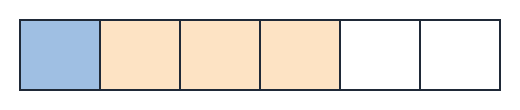
The picture shows a bar in 6 equal parts. The blue part is \(\dfrac{1}{6}\). The orange parts are \(\dfrac{3}{6}\).

Work out \(\dfrac{1}{6} + \dfrac{3}{6}\)

A bar in 6 equal parts. The first part is blue, the next three parts are orange and the last two parts are white.

Model answer

1 part and 3 parts make 4 parts of the 6.

\(\dfrac{4}{6}\)

Explanation

Count the blue and orange parts together, and there are 4. The whole bar still has 6 equal parts, so the answer is \(\dfrac{4}{6}\). A common mistake is to add the denominators and write \(\dfrac{4}{12}\).

Mark scheme
  1. 1 mark

    \(\dfrac{4}{6}\)

    Accept 4/6, four sixths or 2/3. Do not accept 4/12.

Question 2

2 marks

Mia reads \(\dfrac{2}{9}\) of a book on Monday. She reads \(\dfrac{4}{9}\) of it on Tuesday.

What fraction of the book has Mia read?

Model answer

\(\dfrac{2}{9} + \dfrac{4}{9} = \dfrac{6}{9}\)

\(\dfrac{6}{9}\)

Explanation

Mia reads on both days, so add the two fractions. Both fractions are ninths, so add the numerators and keep the denominator 9. A common mistake is to add the denominators too and write \(\dfrac{6}{18}\).

Mark scheme
  1. 1 mark

    \(\dfrac{2}{9} + \dfrac{4}{9}\) / \(2 + 4 = 6\) ninths; or the correct answer \(\dfrac{6}{9}\) with no working

  2. 1 mark

    \(\dfrac{6}{9}\)

    Accept 6/9, six ninths or 2/3. Do not accept 6/18. A correct answer with no working scores full marks.

Question 3

2 marks

A ribbon is 1 metre long. Ravi cuts off \(\dfrac{4}{10}\) of a metre.

What fraction of a metre is left?

Model answer

1 metre is \(\dfrac{10}{10}\) of a metre.

\(\dfrac{10}{10} - \dfrac{4}{10} = \dfrac{6}{10}\)

Explanation

Write the whole metre as 10 tenths. Take away 4 tenths and 6 tenths are left. A common mistake is to write \(\dfrac{4}{10}\) again, which is the piece cut off and not the piece left.

Mark scheme
  1. 1 mark

    \(1 = \dfrac{10}{10}\) / \(10 - 4 = 6\) tenths; or the correct answer \(\dfrac{6}{10}\) with no working

  2. 1 mark

    \(\dfrac{6}{10}\) of a metre

    Accept 6/10, six tenths or 3/5. Accept 0.6 if a pupil writes it, or 60 cm. A correct answer with no working scores full marks.

Question 4

4 marks

A jar of sweets is full.

Ana eats \(\dfrac{2}{9}\) of the sweets. Ben eats \(\dfrac{4}{9}\) of the sweets.

What fraction of the sweets have they eaten?

What fraction of the sweets is left?

Then Mum puts back \(\dfrac{1}{9}\) of a jar. What fraction of a jar is there now?

Model answer

\(\dfrac{2}{9} + \dfrac{4}{9} = \dfrac{6}{9}\)

\(1 - \dfrac{6}{9} = \dfrac{3}{9}\)

\(\dfrac{3}{9} + \dfrac{1}{9} = \dfrac{4}{9}\)

Explanation

A full jar is 9 ninths. Six ninths have gone, so 3 ninths are left. Putting back 1 more ninth makes 4 ninths. A common mistake is to add the \(\dfrac{1}{9}\) to the fraction eaten instead of the fraction left.

Mark scheme
  1. 1 mark

    Eaten: \(\dfrac{6}{9}\)

    Accept 6/9, six ninths or 2/3.

  2. 1 mark

    Left: \(\dfrac{3}{9}\)

    Accept 3/9, three ninths or 1/3. Follow through: 1 take away their fraction eaten.

  3. 1 mark

    \(\dfrac{3}{9} + \dfrac{1}{9}\) / \(3 + 1 = 4\) ninths; or the correct answer \(\dfrac{4}{9}\) with no working

    Follow through from their fraction left.

  4. 1 mark

    Now: \(\dfrac{4}{9}\)

    Accept 4/9 or four ninths. A correct answer with no working scores both of these two marks.

Ready to try the rest? Tap your answers and see straight away how you did.

Topic notes

Adding and subtracting fractions

The big idea

When fractions have the same denominator (the same bottom number), all the parts are the same size. So you can add and take away the parts, just like cats or cars. 2 sevenths and 3 sevenths make 5 sevenths, just as 2 cats and 3 cats make 5 cats. In this topic, the answers are never more than 1 whole.

Adding fractions

Add the numerators (the top numbers). Keep the denominator the same.

\[ \dfrac{2}{7} + \dfrac{3}{7} = \dfrac{5}{7} \]

The denominator shows the size of the parts. Adding more parts does not change their size. So the denominator stays 7.

A bar split into 7 equal parts, each labelled one seventh. Braces show 2 sevenths and 3 sevenths above the bar, and 5 sevenths below it.
A bar in 7 equal parts. 2 sevenths and 3 sevenths make 5 sevenths.

Milo pours \(\dfrac{1}{5}\) of a bucket of water into a tub. Then he pours in \(\dfrac{2}{5}\) of a bucket. How much water is in the tub?

Add the numerators: \(1 + 2 = 3\).

Keep the denominator: 5.

\(\dfrac{1}{5} + \dfrac{2}{5} = \dfrac{3}{5}\)

There is \(\dfrac{3}{5}\) of a bucket of water in the tub.

Making one whole

When the numerator and the denominator are the same, the fraction is one whole. So \(\dfrac{4}{4} = 1\) and \(\dfrac{6}{6} = 1\).

\[ \dfrac{3}{4} + \dfrac{1}{4} = \dfrac{4}{4} = 1 \]

To make 1, the two numerators add up to the same number as the denominator.

Subtracting fractions

Take away the numerators. Keep the denominator the same.

\[ \dfrac{7}{8} - \dfrac{3}{8} = \dfrac{4}{8} \]

You can also write \(\dfrac{4}{8}\) as \(\dfrac{1}{2}\), because 4 eighths is half of the whole. Both answers are right.

How much is left?

To find how much is left, write 1 as a fraction first. One whole is \(\dfrac{5}{5}\), or \(\dfrac{8}{8}\), or \(\dfrac{10}{10}\). Use the denominator in the question.

A bar split into 5 equal parts, each labelled one fifth. 2 parts are shaded. The other 3 parts are the 3 fifths left.
\(1 - \dfrac{2}{5} = \dfrac{5}{5} - \dfrac{2}{5} = \dfrac{3}{5}\)

Ali's water bottle is full. He drinks \(\dfrac{2}{10}\) of the water. What fraction of the water is left?

A full bottle is 1 whole. Write it in tenths: \(\dfrac{10}{10}\).

Take away the numerators: \(10 - 2 = 8\).

\(\dfrac{10}{10} - \dfrac{2}{10} = \dfrac{8}{10}\)

\(\dfrac{8}{10}\) of the water is left.

Check your answer: \(\dfrac{8}{10} + \dfrac{2}{10} = \dfrac{10}{10}\), the whole bottle.

A flower bed is split into 6 equal parts. Daisies grow in \(\dfrac{2}{6}\) of the bed. Tulips grow in \(\dfrac{1}{6}\) more of the bed than the daisies. Grass covers the rest. What fraction of the bed is grass?

Tulips: \(\dfrac{2}{6} + \dfrac{1}{6} = \dfrac{3}{6}\)

Daisies and tulips: \(\dfrac{2}{6} + \dfrac{3}{6} = \dfrac{5}{6}\)

Grass: the whole bed is \(\dfrac{6}{6}\). So \(\dfrac{6}{6} - \dfrac{5}{6} = \dfrac{1}{6}\).

Grass covers \(\dfrac{1}{6}\) of the bed.

Common mistakes

  • Adding the denominators. \(\dfrac{1}{6} + \dfrac{4}{6}\) is \(\dfrac{5}{6}\), not \(\dfrac{5}{12}\).
  • Taking away the denominators. \(\dfrac{9}{10} - \dfrac{4}{10}\) is \(\dfrac{5}{10}\), not \(\dfrac{5}{0}\).
  • Forgetting the denominator. \(1 - \dfrac{4}{9}\) is \(\dfrac{5}{9}\), not 5.
  • Giving the part that has gone when the question asks how much is left.
  • Taking 1 from the numerator. \(1 - \dfrac{2}{7}\) is \(\dfrac{5}{7}\), not \(\dfrac{1}{7}\).

Top tip

Say the fractions in words: "two fifths add one fifth". Fifths add to fifths, so your answer must be in fifths too.

Study Helper Hints first, answers after you try

Stuck on this one? Ask for a hint and I’ll point you in the right direction, without giving the answer away. Once you’ve checked your answer, I’ll show you how the marks are awarded.