Practise 17 questions on Tables for Year 3 Maths. Tap your answer and find out straight away if you are right, with the Study Helper on hand if you get stuck.
17 questions
1–4 marks each
Instant marking
No sign-up needed
17 questions, marked as you go
Sample questions with model answers
Here are 4 of the questions in this topic, each with a model answer, an explanation of why it earns the marks and the mark scheme.
Question 1
1 mark
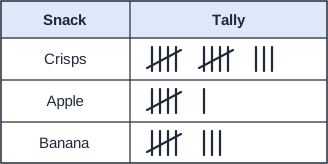
The tally chart shows the snacks children chose.
How many children chose crisps?
Model answer
Two groups of five make 10, and 3 more make 13. 13
Explanation
Count the groups in 5s, then count on the single marks: 5, 10, 11, 12, 13. A common mistake is to count only one of the groups and answer 8.
Mark scheme
1 mark
13
Do not accept 5 (the number of groups and single marks), 8 (one group and 3 marks) or 23.
Question 2
2 marks
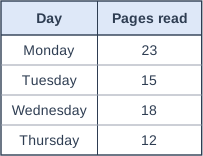
The table shows how many pages Zara read each day.
How many more pages did she read on Monday than on Thursday?
Find the two numbers in the table, then take the smaller from the larger. How many more means find the difference. A common mistake is to add the two numbers.
Mark scheme
1 mark
uses 23 and 12, such as \(23 - 12\); or the correct answer 11 with no working
1 mark
11 (more pages)
A correct answer with no working scores full marks.
Question 3
2 marks
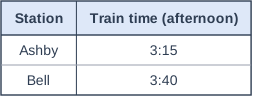
The timetable shows a train that goes to Bell.
How long does the train take to go from Ashby to Bell?
Model answer
From 3:15 to 3:40 is 25 minutes. 25 minutes
Explanation
Count on from the first time to the second. From 3:15 to 3:30 is 15 minutes, and from 3:30 to 3:40 is 10 more. A common mistake is to subtract the times as ordinary numbers without thinking about what they mean.
Mark scheme
1 mark
uses 3:15 and 3:40, such as counting on from 3:15; or the correct answer 25 minutes with no working
1 mark
25 minutes
Accept 25 mins, 25 min or 25 on its own. Do not accept 25 hours. A correct answer with no working scores full marks.
Question 4
4 marks
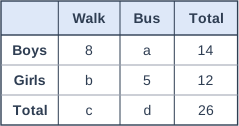
The table shows how some children get to school. Some numbers are missing.
Each Total is the sum of the numbers in its row or column. Start with a row where only one number is missing. You can check your answers: c and d should add up to 26. A common mistake is to add when a total is already given.
Mark scheme
1 mark
a = 6
From \(14 - 8\). Each letter earns one mark on its own.
1 mark
b = 7
From \(12 - 5\).
1 mark
c = 15
From \(8 + 7\). Allow follow-through from the pupil's value of b.
1 mark
d = 11
From \(6 + 5\) or \(26 - 15\). Allow follow-through from the pupil's value of a or c.
Ready to try the rest? Tap your answers and see straight away how you did.
Ctrl + Enter to check
Study HelperHints first, answers after you try
Stuck on this one? Ask for a hint and I’ll point you in the right direction, without giving the answer away. Once you’ve checked your answer, I’ll show you how the marks are awarded.