Practise 16 questions on 3-D shapes for Year 3 Maths. Tap your answer and find out straight away if you are right, with the Study Helper on hand if you get stuck.
16 questions
1–4 marks each
Instant marking
No sign-up needed
16 questions, marked as you go
Sample questions with model answers
Here are 4 of the questions in this topic, each with a model answer, an explanation of why it earns the marks and the mark scheme.
Question 1
1 mark
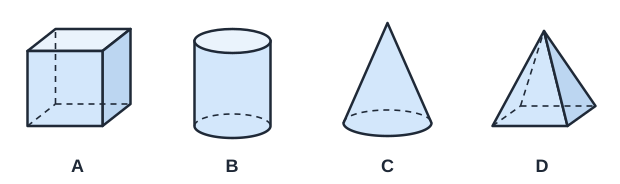
The picture shows four 3-D shapes.
Which shape is the cone?
Model answer
C
Explanation
A cone has one round flat face and a curved surface that comes up to a point. Shape D also comes to a point, but it has flat faces and straight edges, so it is a pyramid. Mixing up these two is a common mistake.
Mark scheme
1 mark
C
Accept 'shape C'. Do not accept D (a pyramid), which also comes to a point.
Question 2
2 marks
Anya says, "A sphere has lots of vertices."
Is Anya right? How do you know?
Model answer
No. A sphere is curved all over, so it has no corners. It has no vertices at all.
Explanation
A vertex is a corner where edges meet. A sphere has no edges and no corners, just one curved surface. A common mistake is to think a shape must have some corners because most shapes do.
Mark scheme
1 mark
No, with a relevant but incomplete reason, such as 'it is round'
No alone scores 0.
1 mark
a complete reason: a sphere has no vertices, because it is curved all over and has no corners or edges
Accept 'it has no corners'. A complete correct reason on its own scores both marks.
Question 3
3 marks
Leo makes 2 models of a triangular prism.
He uses a stick for each edge and a clay ball for each vertex.
A triangular prism has 9 edges and 6 vertices.
How many sticks and how many clay balls does he need altogether?
One model needs 9 sticks and 6 clay balls. Two models need double that amount. A common mistake is to add the 9 and the 6 together, but sticks and clay balls are different things.
Mark scheme
1 mark
doubles the number of edges or vertices, such as \(2 \times 9\) or \(2 \times 6\); or the correct answers 18 sticks and 12 clay balls with no working
1 mark
18 sticks
Accept 18 with the word sticks or edges, or 18 clearly given first.
1 mark
12 clay balls
Accept 12 with the words clay balls, balls or vertices. A correct answer with no working scores full marks.
Question 4
4 marks
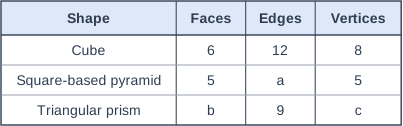
The table shows the faces, edges and vertices of three shapes. Some numbers are missing.
Work out a, b and c.
Then which shape has the same number of faces as vertices?
Model answer
a = 8 b = 5 c = 6 The square-based pyramid has 5 faces and 5 vertices.
Explanation
Picture each shape and count. A square-based pyramid has 4 edges round the bottom and 4 going up to the point, which makes 8. A triangular prism has 2 triangles and 3 rectangles, which makes 5 faces. A common mistake is to count the edges when the table asks for faces.
Mark scheme
1 mark
a = 8
A square-based pyramid has 8 edges.
1 mark
b = 5
A triangular prism has 5 faces.
1 mark
c = 6
A triangular prism has 6 vertices.
1 mark
square-based pyramid
Accept pyramid. It has 5 faces and 5 vertices. Do not accept cube (6 faces and 8 vertices).
Ready to try the rest? Tap your answers and see straight away how you did.
Ctrl + Enter to check
Study HelperHints first, answers after you try
Stuck on this one? Ask for a hint and I’ll point you in the right direction, without giving the answer away. Once you’ve checked your answer, I’ll show you how the marks are awarded.