Practise 21 questions on Comparing and ordering numbers for Year 3 Maths. Tap your answer and find out straight away if you are right, with the Study Helper on hand if you get stuck.
21 questions
1–4 marks each
Instant marking
No sign-up needed
20 questions, marked as you go
Sample questions with model answers
Here are 4 of the questions in this topic, each with a model answer, an explanation of why it earns the marks and the mark scheme.
Question 1
1 mark
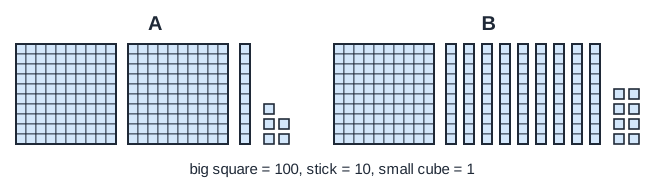
The picture shows two groups of base 10 blocks.
Which group shows the greater number?
Model answer
A has 2 hundreds, so A is 215. B has 1 hundred, so B is 198. A is greater.
Explanation
Compare the hundreds first. A has 2 hundreds and B has only 1 hundred, so A is greater. A common mistake is to choose B because it has more blocks.
Mark scheme
1 mark
A
Accept 215, or 'group A'. Do not accept B.
Question 2
1 mark
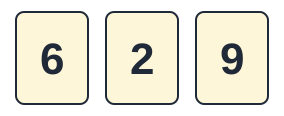
The picture shows three digit cards.
Use each card once. What is the smallest 3-digit number you can make?
Model answer
Put the digits in order from smallest to largest. 269
Explanation
To make the smallest number, put the smallest digit in the hundreds place, then the next smallest in the tens place. That gives 269. A common mistake is to write the largest number, 962.
Mark scheme
1 mark
269
Do not accept 962 (the largest) or 296.
Question 3
2 marks
Ollie says, "98 is greater than 102, because 9 is bigger than 1."
Is Ollie right? How do you know?
Model answer
No, Ollie is not right. 102 has 1 hundred. 98 has no hundreds. So \(98 < 102\).
Explanation
Compare the values of the digits, not just the digits themselves. The 1 in 102 is worth 100, but the 9 in 98 is worth only 90. So 102 is greater. A common mistake is to compare the first digits when the numbers have different numbers of digits.
Mark scheme
1 mark
No, with a relevant but incomplete reason, for example 'you cannot just look at the first digit' or '102 has more digits'
'No' alone, or 'No, 102 is bigger' with no reason, scores 0.
1 mark
A complete correct reason, for example: 102 has 1 hundred and 98 has no hundreds; or 98 is less than 100 and 102 is more than 100; or the 9 in 98 is worth 90, but the 1 in 102 is worth 100
A complete correct reason on its own scores both marks.
Question 4
4 marks
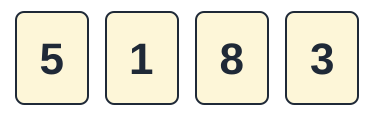
The picture shows four digit cards. Choose three cards to make a 3-digit number. Use each card only once.
What is the largest number you can make?
What is the smallest number you can make?
What is the largest number you can make that is less than 500?
What is the smallest number you can make that is greater than 500?
Model answer
Largest: 8, then 5, then 3 makes 853. Smallest: 1, then 3, then 5 makes 135. Less than 500: 3 goes first, then 8, then 5, which makes 385. Greater than 500: 5 goes first, then 1, then 3, which makes 513.
Explanation
The hundreds digit matters most. For the largest number under 500, the first digit must be less than 5, and 3 is the biggest choice. Then use the biggest digits left. For the smallest number over 500, start with 5 and use the smallest digits left. A common mistake is to use all four cards.
Mark scheme
1 mark
853
Do not accept 8531, which has 4 digits.
1 mark
135
Do not accept 1358.
1 mark
385
Do not accept 358 or 185.
1 mark
513
Do not accept 531 or 500. If the answers are not labelled, take them in the order the questions are asked. Correct answers with no working score full marks.
Ready to try the rest? Tap your answers and see straight away how you did.
Ctrl + Enter to check
Study HelperHints first, answers after you try
Stuck on this one? Ask for a hint and I’ll point you in the right direction, without giving the answer away. Once you’ve checked your answer, I’ll show you how the marks are awarded.