Level:
Correct: 0
Incorrect: 0
Marks: 0/0
Practice
Course:
Topics:
Year 3 Maths Smart practice A mixed round aimed at your weak spots
Unit 1
Place value
Unit 2
Addition and subtraction
Unit 3
Multiplication and division
Unit 4
Fractions
Unit 5
Measurement
Measurement
Length
Quick practice5 skills
Perimeter
Quick practice5 skills
Mass
Quick practice5 skills
Capacity and volume
Quick practice5 skills
Money
Quick practice5 skills
Telling the time
Quick practice6 skills
Units of time and durations
Quick practice6 skills
Unit 6
Geometry
Unit 7
Statistics
Statistics
Pictograms
Quick practice5 skills
Bar charts
Quick practice6 skills
Tables
Quick practice5 skills
Avg
score:
–
Topics
done:
0/36

Addition and subtraction word problems

Practise 21 questions on Addition and subtraction word problems for Year 3 Maths. Tap your answer and find out straight away if you are right, with the Study Helper on hand if you get stuck.

  • 21 questions
  • 1–4 marks each
  • Instant marking
  • No sign-up needed
20 questions, marked as you go

Sample questions with model answers

Here are 4 of the questions in this topic, each with a model answer, an explanation of why it earns the marks and the mark scheme.

Question 1

1 mark

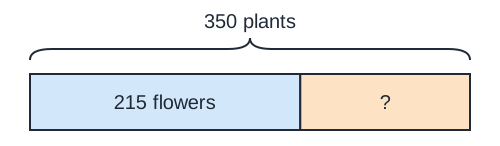
A garden has 350 plants.

The bar model shows that 215 plants are flowers. The rest are vegetables.

How many vegetable plants are there?

A bar model. One long bar is split into two parts. The first part says 215 flowers. The second part has a question mark. A brace above the whole bar says 350 plants.

Model answer

\(350 - 215 = 135\)
There are 135 vegetable plants.

Explanation

The bar shows that the whole is 350 and one part is 215. To find the other part, take the part you know from the whole. A common mistake is to add 350 and 215.

Mark scheme
  1. 1 mark

    135

    A missing unit is fine.

Question 2

1 mark

A bike costs £95.

Ella has saved £68.

How much more money does she need?

Model answer

\(95 - 68\)
\(68 + 2 = 70\)
\(70 + 25 = 95\)
\(2 + 25 = 27\)
Ella needs £27 more.

Explanation

Find the gap between what Ella has and what the bike costs. Counting on from 68 to 95 is a good way. A common mistake is to add and say £163.

Mark scheme
  1. 1 mark

    £27

    Accept 27. A missing £ sign is fine.

Question 3

2 marks

A class has £50 to spend on a party.

It spends £14 on balloons and £26 on food.

How much of the £50 is left?

Model answer

\(14 + 26 = 40\)
\(50 - 40 = 10\)
£10 is left.

Explanation

First add the two amounts spent. Then take the total away from £50, or count on from £40 to £50. A common mistake is to stop at £40, which is what the class spent and not what is left.

Mark scheme
  1. 1 mark

    \(14 + 26 = 40\) (£); or the correct answer £10 with no working

    Accept taking away one price at a time: \(50 - 14 = 36\).

  2. 1 mark

    £10

    Accept 10. Follow through from one error in the first step. A correct answer with no working scores full marks.

Question 4

4 marks

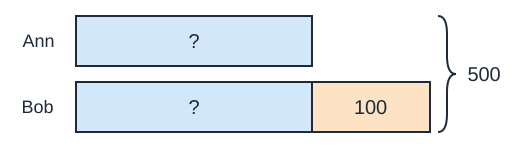
Ann and Bob have 500 stickers altogether.

Bob has 100 more stickers than Ann.

The bar model shows this.

How many stickers does each child have?

A bar model with two bars. Ann's bar has one part with a question mark. Bob's bar has two parts: one with a question mark, and one that says 100. A brace on the right spans both bars and says 500.

Model answer

\(500 - 100 = 400\)
The two equal parts make 400, so each is 200.
Ann has 200 stickers.
Bob has \(200 + 100 = 300\) stickers.

Explanation

The bar model shows two equal parts and an extra 100. Take away the extra 100 to leave the two equal parts. Half of 400 is 200. A common mistake is to halve 500 and say 250 each, but Bob must have 100 more.

Mark scheme
  1. 1 mark

    Takes away the extra 100: \(500 - 100 = 400\); or the correct answers Ann 200 and Bob 300 with no working

  2. 1 mark

    Halves 400: \(400 \div 2 = 200\)

    Accept any correct way of finding two equal parts of 400.

  3. 1 mark

    Ann has 200 stickers

  4. 1 mark

    Bob has 300 stickers

    Follow through from their number for Ann. A correct answer with no working scores full marks.

Ready to try the rest? Tap your answers and see straight away how you did.

Topic notes

Addition and subtraction word problems

The big idea

A word problem tells a short story with numbers in it. You must decide what to do with the numbers. The story tells you whether to add or to take away.

Add or subtract?

Read the story. Then ask, "Will the answer be bigger or smaller than the start?"

The story saysWhat it meansSo you
altogether, in total, more arrive, get onthings are put togetheradd
left, gave away, sold, get offsome are taken awaysubtract
how many more, how many fewer, the differencefind the gapsubtract, or count on

Take care with "more". "How many more?" asks for a gap, so you do not add.

Use these steps every time.

  1. Read the story. What does it ask?
  2. Choose: add or subtract.
  3. Work it out, in your head or in columns.
  4. Read the story again with your answer. Does it make sense?

A cinema has 264 people watching a film. 52 people leave before the end. How many people stay to the end?

"Leave" means some people go away. That makes the number smaller, so subtract.

\(264 - 52 = 212\)

212 people stay to the end.

Bar models

A bar model is a picture of the story. The long bar is the whole. The boxes are the parts.

  • To find the whole, add the parts.
  • To find a part, take the other part away from the whole.
A bar for a whole of 300. One part is 125 and the other part is marked with a question mark.
The whole is 300 and one part is 125. To find the other part, work out 300 take away 125.

Finding the gap

"How many more?" and "How many fewer?" both ask for a difference. A difference is the gap between two numbers. Count on from the smaller number, or take the smaller number away from the bigger one.

Pia's book has 315 pages. She has read 240 pages. How many more pages must she read?

Find the gap between 240 and 315. Count on in jumps.

  • 240 to 300 is 60.
  • 300 to 315 is 15.

Add the jumps: \(60 + 15 = 75\).

Pia must read 75 more pages.

Missing numbers

Some problems have a number missing. In \(360 + \square = 700\), count on from 360. Add 40 to reach 400. Then add 300 to reach 700. So the missing number is \(40 + 300 = 340\). You can also work out \(700 - 360\).

Two-step problems

A two-step problem needs two calculations. Do them one at a time, and use your first answer in the second step.

Dan picks 135 strawberries. Sue picks 40 fewer than Dan. How many strawberries do they pick altogether?

Two bars. Dan's bar is 135, split into parts of 95 and 40. Sue's bar is one part of 95.
Dan picks 135. Sue's bar is 40 shorter than Dan's bar.

Step 1: find Sue's number. "Fewer" means take away: \(135 - 40 = 95\).

Step 2: "Altogether" means add: \(135 + 95 = 230\).

They pick 230 strawberries altogether.

Sometimes you know the end of the story, but not the start. Then go back through the story. Undo each step with the opposite calculation.

Lola had some money. She spent 60p on a comic. Then she spent 25p on a drink. Now she has 40p. How much did she have at the start?

Start at the end, and go backwards.

She spent 25p on the drink, so add it back: \(40 + 25 = 65\). She had 65p before the drink.

She spent 60p on the comic, so add that back too: \(65 + 60 = 125\).

Lola had 125p at the start.

Check by going forwards: \(125 - 60 = 65\), and \(65 - 25 = 40\).

Common mistakes

  • Adding because you see the word "more". "How many more?" means find the difference.
  • Adding all the numbers you can see. Follow the story in order.
  • Stopping after step 1. Read the question again to see what it asks.
  • Taking away because the story says "spent", when you need the start. Work backwards, and add it back.

Top tip

Draw a bar model before you start. It helps you see if you need to find the whole or a part.

Study Helper Hints first, answers after you try

Stuck on this one? Ask for a hint and I’ll point you in the right direction, without giving the answer away. Once you’ve checked your answer, I’ll show you how the marks are awarded.